
Minnesota Firearms Safety Hunter Education Practice Exam
$69.00
- Buy to unlock unlimited access to all Quiz questions and Answers in this Quiz.
- After purchase you can print a PDF of the whole quiz at any point. The PDF will contain the questions and the correct answers.
About this Exam
The Minnesota Firearms Safety Hunter Education certification is a vital first step for new hunters in the state. This comprehensive program is designed to promote safe, ethical, and responsible hunting practices among all participants. It ensures that hunters are equipped with the knowledge needed to handle firearms safely, understand wildlife conservation principles, and respect Minnesota’s hunting laws. While beneficial for everyone, this certification is mandatory for anyone born after December 31, 1979, who wishes to purchase a hunting license in Minnesota. Youth can begin the course at age 11, though the certificate only becomes valid once they turn 12. Adult hunters who are new to the sport also benefit greatly from this foundational training.
Ready to test your knowledge?
Buy Now to Access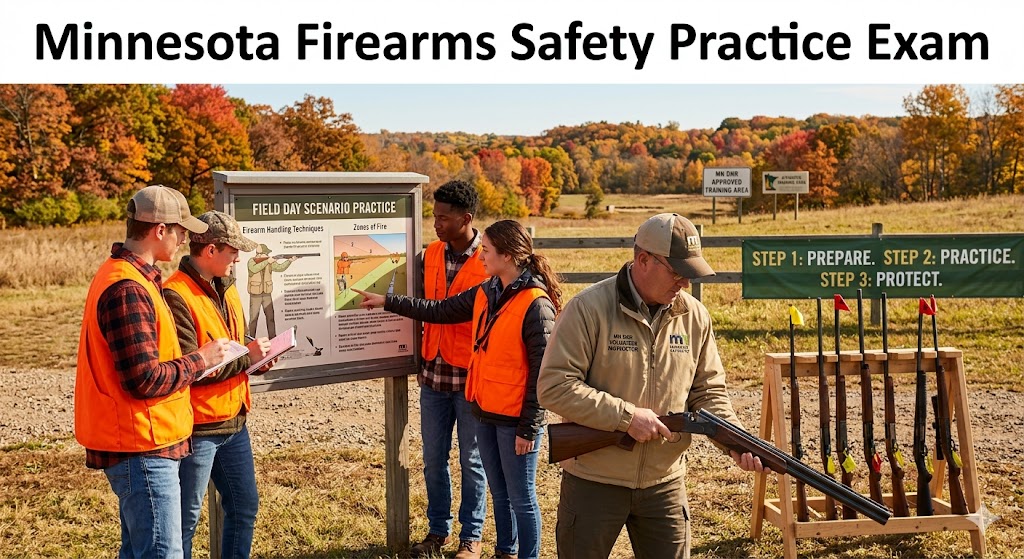
Additional Information
What the Course Entails and Exam Details
The standard course encompasses a minimum of 12 hours of
specialized training, which can be completed either in a traditional classroom
setting or through a state-approved online interactive course. The curriculum
covers several core domains essential for safety and ethical hunting. Students
will delve into the mechanics of various firearms, learning the primary rules
of safe gun handling, transport, and storage. The course places a heavy
emphasis on hunter responsibility, teaching ethics, respect for landowners, and
fair chase principles. Wildlife conservation and identification are also key
components, helping students distinguish species and understand ecological
management. Additional topics include outdoor survival skills, first aid, tree
stand safety, and a thorough review of Minnesota’s specific hunting
regulations. For most students, particularly those under 16, this knowledge is
put to the test during a mandatory practical "Field Day."
3. What to Expect in the Final Exam
The certification process involves two distinct testing
components that you must successfully complete. The first component is the
written final exam, which can be taken online at the end of an interactive
course or in person during a classroom session. This exam typically consists of
multiple-choice and true/false questions covering all the topics present in the
curriculum. To pass the written portion, students usually need to achieve a
score of 80% or higher. The second component is the Field Day practical exam,
which is required for youth hunters aged 11 to 15 and optional but recommended
for adults. During the Field Day, certified instructors will evaluate your
ability to demonstrate safe firearm handling in real-world scenarios. This
practical test includes tasks such as crossing obstacles with a firearm,
demonstrating safe zones of fire, and a live-fire exercise on a range. You must
demonstrate proficiency and a "safety-first" mindset throughout the
scenarios to pass.
How to Study and Exam Centers
Effective preparation for both the written and practical
exams is crucial for certification success. Begin by thoroughly studying the
official MN DNR Hunter Education handbook, whether you are taking the classroom
or online version. Utilize reputable online "practice exams" to
familiarize yourself with the question formats and identify any gaps in your
knowledge base. Many approved online providers offer interactive simulations
that can help reinforce safe handling rules. For the Field Day, mentally
rehearse the safe gun handling laws: Control the muzzle, Keep your finger off
the trigger until ready to shoot, Treat every firearm as if it is loaded, and
Be sure of your target and what is beyond. To take the exam, you can register
for classroom courses offered throughout the year at various locations such as
local gun clubs, police departments, or community centers. Alternatively, you
can complete the online portion through authorized portals like
ilearntohunt.com or huntercourse.com. Once the online portion is complete,
youth hunters must locate and register for a sanctioned DNR Field Day center to
finalize their certification.
Job Opportunities
from the Course
While the primary goal of the Minnesota Firearms Safety
Hunter Education course is recreational safety, obtaining this certification
can be a foundational requirement or a significant asset for various career
paths in conservation, law enforcement, and outdoor recreation.
Unlocking these career opportunities often requires further
specialized training, but this certification serves as a mandatory
prerequisite.
Specific career paths and job titles that this course
supports include:
- State
Conservation Officer: This role requires enforcing hunting regulations
and managing wildlife resources, with mandatory firearms safety expertise.
- DNR
Park Ranger: Rangers manage public lands where hunting may be
permitted, demanding a thorough understanding of safety protocols.
- Wildlife
Biologist or Technician: Professionals working in the field often
handle firearms for sampling or management and need recognized safety
certification.
- Professional
Hunting Guide: Guides must hold this certification to legally lead
clients in Minnesota and demonstrate safety leadership.
- Commercial
Outdoor Outfitter Manager: Managing a business that rents firearms or
organizes hunts requires deep knowledge of safety standards.
- Firearms
Safety Instructor: Experienced, certified individuals can pursue
further training to become volunteer instructors for this very program.
Frequently Asked Questions
Reviews
5.0
Based on 0 reviews
Leave a Review
No reviews yet. Be the first to review!