
Minnesota State Real Estate Practice Test
$69.00
- Buy to unlock unlimited access to all Quiz questions and Answers in this Quiz.
- After purchase you can print a PDF of the whole quiz at any point. The PDF will contain the questions and the correct answers.
About this Exam
Embarking on a career in real estate in Minnesota is an exciting opportunity, and passing the state licensing exam is the crucial first step. The Minnesota State Real Estate licensing path is designed for aspiring real estate agents and brokers, equipping them with the essential knowledge of both national real estate principles and specific Minnesota laws and regulations. This comprehensive guide and the associated practice tests are your ultimate resource to effectively prepare for the official licensing exam, boosting your confidence, knowledge, and likelihood of success. Achieve flexibility, significant earning potential, and the fulfillment of helping people navigate significant life transactions by mastering this vital exam.
Ready to test your knowledge?
Buy Now to Access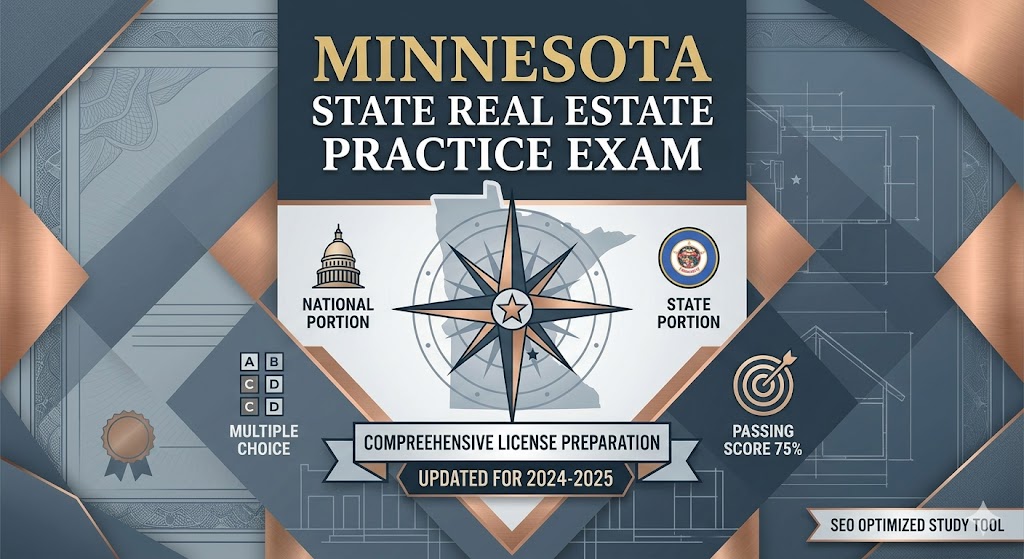
Additional Information
What the Course
Entails and Exam Details
The pre-licensing education, typically a 90-hour requirement
broken into distinct courses in Minnesota, provides the foundational knowledge
necessary for success. This preparation includes comprehensive instruction on
both national real estate topics and Minnesota-specific regulations. Practice
tests corresponding to this certification path are designed to replicate the
depth and breadth of this knowledge.
You can expect coverage on essential areas such as property
ownership forms, land use controls, real estate valuation and market analysis,
financing options, the laws of agency, required property disclosures, contract
law, and general real estate practices across the United States for the
national portion.
For the state-specific section, practice materials will dive
deep into critical Minnesota-focused topics including Minnesota real estate
license law, Department of Commerce rules and regulations, Minnesota-specific
agency law and disclosure requirements, seller property condition disclosure
forms, well and subsurface sewage treatment system disclosures, Common Interest
Communities (MCIOA), conveyance procedures including deeds and contracts for
deed, and license maintenance procedures like continuing education.
Understanding this distinction between national principles and local specifics
is vital, and effective practice tests are your best tool for mastering both.
What to Expect in the Final Exam
The actual Minnesota State Real Estate Licensing Exam is a
rigorous test of your readiness to practice competently. It is a
single-sitting, multiple-choice examination, usually with around four options
per question and no penalty for guessing. The test is divided into a national
portion and a Minnesota state-specific portion, and you must pass both
sections to be eligible for licensure.
- Format:
Computer-based multiple-choice questions.
- Number
of Questions: Typically a total of 130 questions. The national section
often comprises around 80 questions, while the state section is
approximately 50 questions. Both sections usually include a small number
of non-scored experimental questions.
- Passing
Score: You must achieve a minimum passing score of 75% on each
of the two portions (national and state-specific) to receive a passing
grade overall. For example, you would need to answer at least 60 questions
correctly on the national portion and 38 questions correctly on the state
section.
- Time
Limit: You will typically be given around four hours (e.g., 2.5 hours
for the national portion and 1.5 hours for the state portion) to complete
the entire examination. Proper time management is crucial.
- Specific
Rules: You should check the current candidate handbook provided by the
authorized state testing vendor for the most up-to-date rules. Generally,
basic calculators are permitted, while smartphones and external study
materials are strictly prohibited in the testing room. Expect a check-in
process involving identification verification. The final official exam is
administered by a state-authorized testing vendor, and it is important to
confirm the current vendor (which has recently been PSI Exams or Pearson
VUE depending on specific circumstances and updates, so always verify
through the official Minnesota Department of Commerce website) and
schedule your attempt in advance. These official exam details ensure you
understand the goal you are preparing for using comprehensive practice
materials.
How to Study and
Exam Centers
Effective study for the Minnesota State Real Estate
Licensing Exam involves a combination of thorough pre-licensing coursework and
strategic test preparation. Harnessing the power of practice tests is one of
the most impactful methods you can use.
- Utilize
Practice Tests Frequently: Incorporate varied practice tests
throughout your study schedule. Not only do they reinforce knowledge, but
they also familiarize you with the multiple-choice format and style of
questions. Focus on understanding the why behind both correct and
incorrect answers.
- Simulate
Exam Conditions: Periodically take timed practice tests in a quiet
environment, mimicking the conditions of the actual test center. This
helps you build stamina, manage anxiety, and improve your pacing.
- Analyze
Your Performance: After each practice test, review your results.
Identify specific topics where you consistently struggle and dedicate
extra study time to reinforcing those areas using your pre-licensing
materials and textbooks.
- Create
Effective Study Aids: Utilize flashcards for key real estate terms,
definitions, national and state laws, and relevant calculations. These can
be helpful for quick recall and on-the-go review.
- Review
Pre-licensing Coursework: Do not solely rely on practice tests.
Continuously review the comprehensive materials provided in your 90 hours
of pre-licensing education, particularly the areas specific to Minnesota
real estate laws and regulations, as these often test state-specific
nuances.
- Join
Study Groups: Collborating with other aspiring licensees can provide
different perspectives, clarify complex concepts, and keep you motivated.
Regarding where and how to take the exams:
- Practice
Online First: Access a wide range of practice tests and prep courses
through reputable real estate schools and online portals. Many vendors
offer various subscriptions or question banks that you can complete from
the comfort of your own home at any time. Look for resources that
guarantee up-to-date Minnesota-specific content.
- Take
the Real Exam at a Center: The official final licensing exam cannot be
taken online and must be completed in-person at an authorized testing
center managed by the current state-approved vendor. To schedule your real
exam, you must first confirm the official vendor (which is typically PSI
Exams or Pearson VUE – again, check with the Minnesota
Department of Commerce for the exact current vendor). Once
confirmed, create an account on the vendor's website, pay the required
exam fee (often around $63 per attempt), select an available testing
center location, date, and time. Physical testing centers are located
throughout Minnesota, in cities such as Blaine, Brainerd, Duluth,
Eagan, Mankato, Rochester, St. Paul, Willmar, and Woodbury. Ensure you
have completed all pre-licensing education requirements and are fully
prepared with required identification before your scheduled exam day.
Preparing in advance and utilizing dedicated practice tests significantly
enhances your readiness for the official center-based exam.
Job Opportunities from the Course
A valid Minnesota real estate license, achieved by
completing your pre-licensing education and passing the official exam, unlocks
diverse and rewarding career paths within the dynamic real estate industry.
This certification is the foundation for numerous specific job titles and
opportunities across residential, commercial, and property management sectors.
- Real
Estate Agent: The most common starting point. As a licensed agent
associated with a supervising broker, you will represent buyers and
sellers in residential property transactions, guiding them through the
entire process, negotiating offers, and helping them achieve their
homeownership dreams. You have significant flexibility in structuring your
business and managing your client base.
- Licensed
Realtor®: By joining the National Association of Realtors® (NAR),
you can carry the distinguished Realtor® title. This membership indicates
adherence to a strict code of ethics and provides access to extensive
professional resources, networking opportunities, and marketing tools.
While not technically a different license type, it is a significant
professional distinction often sought after.
- Real
Estate Broker: After gaining valuable experience (typically three
years in Minnesota), demonstrating a track record of transactions, and
completing additional education requirements, you can obtain a broker’s
license. This allows you to potentially manage your own brokerage,
supervise other agents, or work more independently with broader
responsibilities and earning potential, or hold specialized management
roles.
- Property
Manager: Focus on managing residential, commercial, or industrial
properties on behalf of owners. Responsibilities include leasing units,
collecting rent, overseeing maintenance, handling tenant relations,
managing budgets, and ensuring compliance with landlord-tenant laws. This
can be a stable and structured career path, often utilizing skills honed
in licensing.
- Leasing
Consultant: Specialize in the residential rental market. You will
assist property owners by showing apartments or townhomes, processing
rental applications, managing lease agreements, and coordinating
move-ins/outs, often for large management companies or complexes.
- Real
Estate Appraiser: While requiring separate specialized training and
licensure beyond the basic real estate salesperson license, having a
real estate background provides a valuable advantage. Appraisers determine
the market value of properties for various purposes, including mortgages,
tax assessments, estate planning, and divorce settlements. This is a
analytical role with specific licensing requirements you can explore as
your career progresses.
- Real
Estate Educator: If you discover a passion for sharing knowledge, you
can become a real estate instructor or curriculum developer, teaching
pre-licensing courses, continuing education classes, or creating
educational materials for aspiring and existing real estate professionals,
utilizing your expertise gained through the licensing process.
- Mortgage
Loan Officer: Though typically requiring a different financial
services license (e.g., NMLS), many individuals transition into
mortgage lending with a strong real estate knowledge base, as they work
closely with agents and buyers to facilitate property financing, and
understanding both sides of the transaction can be beneficial.
- Specialized
Real Estate Agent: Beyond general practice, you can carve out a niche
as a specialist in areas such as commercial real estate, industrial
properties, agricultural land, luxury homes, or focusing specifically on
buyer or seller representation, often demanding further education and
expertise build on top of your initial license.
Frequently Asked Questions
Reviews
5.0
Based on 0 reviews
Leave a Review
No reviews yet. Be the first to review!