
Mississippi NASCLA & Residential Practice Exam
$69.00
- Buy to unlock unlimited access to all Quiz questions and Answers in this Quiz.
- After purchase you can print a PDF of the whole quiz at any point. The PDF will contain the questions and the correct answers.
About this Exam
The Mississippi NASCLA and Residential Builders Exam is a critical stepping stone for contractors looking to legally build, remodel, or repair residential structures in the state.
This certification is specifically designed for aspiring residential builders, general contractors, and construction professionals who want to operate their businesses compliantly, safely, and profitably in Mississippi.
Passing this exam proves your competency in local building codes, structural integrity, and business management, giving your clients absolute peace of mind.
Whether you are a seasoned tradesperson stepping up to run your own company or a newcomer aiming to launch a contracting business, this credential establishes you as a recognized and trusted professional in the industry.
Ready to test your knowledge?
Buy Now to Access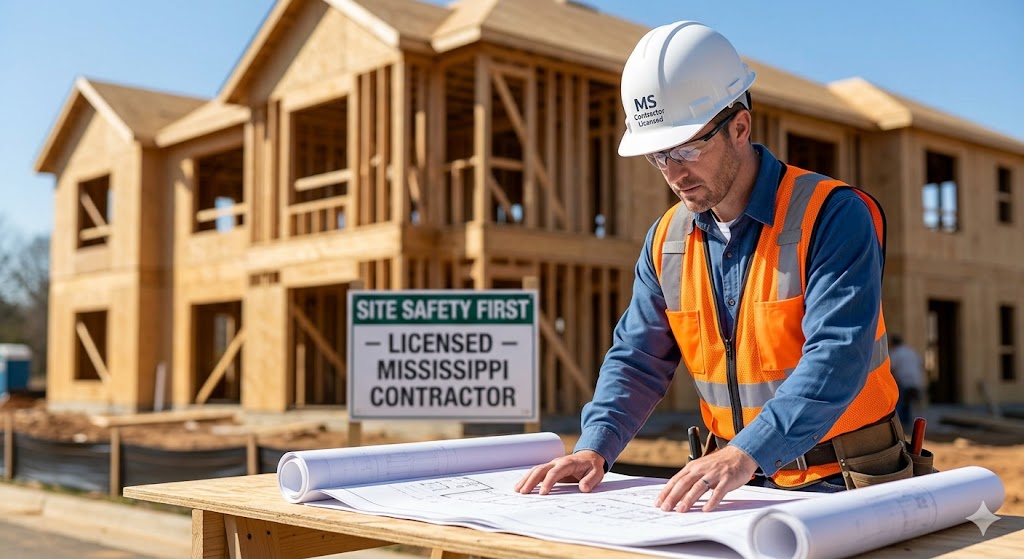
Additional Information
What the Course Entails and Exam Details
Preparing for the Mississippi residential builder exam
requires a deep understanding of both trade-specific skills and general
business practices.
The syllabus covers a wide array of core construction
topics, including site work, footings and foundations, concrete and masonry,
carpentry, roofing, and interior finish work.
You will also learn how to accurately read blueprints and
understand complex architectural plans.
Beyond hands-on construction knowledge, the course dives
heavily into business law and project management.
Candidates must master topics such as estimating, contract
law, mechanics liens, tax laws, workers' compensation, and strict adherence to
Occupational Safety and Health Administration (OSHA) standards.
What to Expect in the Final Exam
The Mississippi NASCLA and Residential exam is an open-book
test, meaning you can bring approved, properly bound reference manuals into the
testing center.
However, do not let the open-book format fool you; the exam
is strictly timed and requires rapid navigation of your reference materials.
You can expect multiple-choice questions that test your
ability to look up building codes and apply safety regulations to real-world
scenarios.
Typically, candidates have a set time limit of a few hours
to complete over 100 questions, meaning you have only a couple of minutes per
question.
To pass, you generally need to achieve a score of 70% or
higher.
Strict testing center rules apply, prohibiting loose papers,
electronic devices, or writing inside your books during the exam.
How to Study and
Exam Centers
The most actionable study strategy for an open-book exam is
mastering the index and table of contents of your approved reference books.
Spend your preparation time tabbing your manuals with
permanent index tabs and highlighting key terms, codes, and formulas.
Take as many timed practice exams as possible to build your
speed and simulate the pressure of the actual test day.
Familiarize yourself with the exact wording of the questions
so you know exactly which manual to reach for.
When it comes time to take the test, exams are typically
administered by PSI or Pearson VUE, which are authorized third-party testing
agencies.
You will need to register online through the testing
provider's portal, pay the examination fee, and schedule your test at a
physical testing center located in various cities across Mississippi or in
neighboring states.
Job Opportunities
from the Course
Earning this certification unlocks numerous high-paying and
authoritative career paths in the construction industry.
Licensed Residential Contractor: You can legally start your
own contracting business to build custom homes, single-family dwellings, and
multi-family residential units.
Construction Project Manager: Oversee large-scale
residential developments from the initial planning phases through to final
completion.
Residential Remodeler: Specialize in high-end home
renovations, additions, and structural alterations.
Site Superintendent: Manage daily on-site operations,
coordinate subcontractors, and ensure all building codes and safety regulations
are strictly followed.
Estimator: Work for large construction firms to analyze
blueprints and calculate the costs of labor, materials, and time required for
upcoming residential projects.
Building Inspector: Transition into the public sector or
private consulting to evaluate residential buildings for code compliance and
safety.
Frequently Asked Questions
Reviews
5.0
Based on 0 reviews
Leave a Review
No reviews yet. Be the first to review!