
Missouri Fire Fighter Practice
$69.00
- Buy to unlock unlimited access to all Quiz questions and Answers in this Quiz.
- After purchase you can print a PDF of the whole quiz at any point. The PDF will contain the questions and the correct answers.
About this Exam
Becoming a certified firefighter in Missouri demands dedication, physical stamina, and a thorough understanding of essential fire safety principles and techniques. This certification process is vital for ensuring that all active firefighters across the state possess the necessary knowledge and skills to protect lives and property effectively within their communities. Whether you are an aspiring career firefighter seeking to join a municipal department or a dedicated volunteer serving a rural district, obtaining this certification is a crucial, often required, step in your journey. This comprehensive study guide is specifically crafted to help you navigate and prepare for the various rigorous components of the Missouri firefighter certification exams, incorporating strategic practice testing as a cornerstone of your preparation.
Ready to test your knowledge?
Buy Now to Access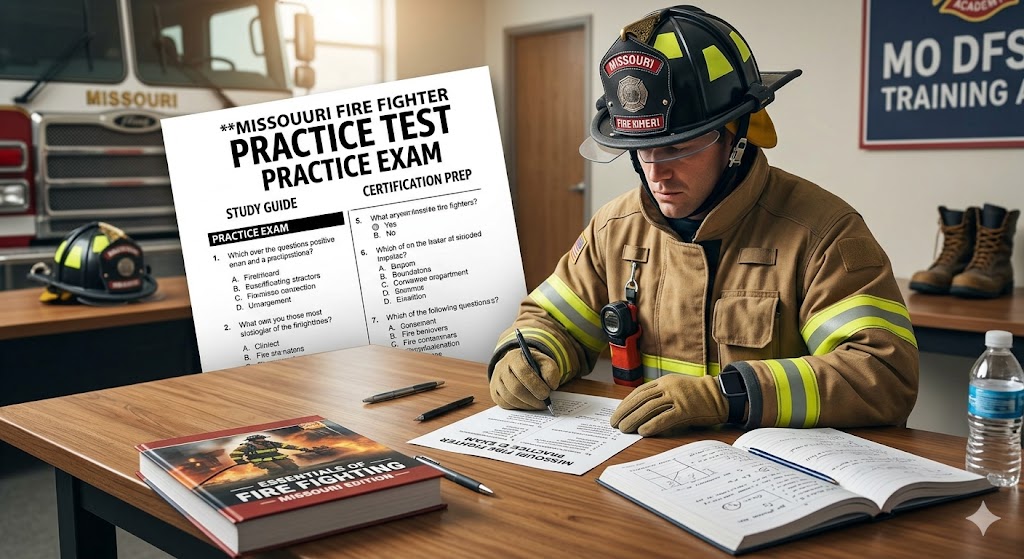
Additional Information
What the Course
Entails and Exam Details
To become a certified firefighter in Missouri, you generally
must first successfully complete an accredited firefighter training academy or
program authorized and regulated by the Missouri Division of Fire Safety (DFS).
These intensive programs blend rigorous classroom instruction with extensive
practical hands-on training evolutions. Core topics covered typically include:
- Fire
behavior and combustion dynamics
- Personal
Protective Equipment (PPE) utilization and proper maintenance
- Forcible
entry techniques and tool usage
- Ground
ladders operation and safety
- Structural
search and rescue methods
- Tactical
ventilation strategies
- Fire
hose deployment and suppression techniques
- Hazardous
materials awareness and operations levels
- Basic
emergency medical care (First Aid/CPR)
- Fire
prevention and public safety education
- Firefighter
safety, survival, and wellness protocol
What to Expect in the Final
Exam
The culminating certification typically consists of both a
written cognitive examination and a detailed practical skills evaluation, both
of which you must successfully pass.
- Written
Exam: This component generally involves a significant number of
multiple-choice questions (e.g., typically between 100-150) covering all
the critical academic subjects from your extensive training curriculum.
You will be thoroughly tested on your knowledge of fire dynamics, various
equipment, suppression strategies, safety procedures, and all relevant
regulations. There is usually a strict time limit (e.g., 2-3 hours), and
you typically need to achieve a score of 70%, 75%, or higher to successfully
pass. It is critical for candidates to verify the precise, current
requirements from the Missouri DFS website for the latest details
regarding exact question count, timing, and passing score.
- Practical
Skills Test: Here, you will be rigorously evaluated on your ability to
perform essential firefighting tasks safely, accurately, and efficiently.
You can expect various assessment stations where you must demonstrate
skills such as dressing in full PPE within a specified time frame,
effectively deploying hoses and handling nozzles, setting up various
ground ladders correctly, performing challenging search and rescue drills
in simulated environments, and demonstrating proper ventilation techniques
using relevant tools. Each practical skill is typically evaluated on a
pass/fail basis using detailed checklists.
How to Study and
Exam Centers
- Obtain
and Study Current Materials: Acquire the latest edition of the recommended
textbooks, such as IFSTA's Essentials of Fire Fighting or Jones &
Bartlett manuals, which are often the foundation of the state's
curriculum. Read these materials thoroughly, ensuring you understand not
just the how but also the underlying why of each critical
procedure.
- Active
Engagement in Training: Maximize your learning opportunities during your
formal academy training. Take detailed notes, ask clarifying questions,
and actively participate with full effort in all practical training
evolutions. Your instructors are experienced professionals and incredibly
valuable resources.
- Practice
Everything: Dedicate significant, consistent time to practicing both your
written knowledge and your practical skills. Form study groups with
classmates to quiz each other and discuss complex concepts. Practice
essential practical skills under qualified supervision and in appropriate,
designated locations (such as at your training academy or authorized fire
station with proper permission). Repeated, correct practice is key to
developing crucial muscle memory and building confidence.
- Utilize
Practice Tests: This is an absolutely crucial component for success!
Actively search for reputable online Missouri firefighter practice exams
and other study tools (like flashcard apps) specifically designed to
mirror current NFPA/IFSTA standards and incorporate any state-specific
content. Taking frequent practice tests will help you:
- Simulate
real exam conditions and manage time pressure effectively.
- Identify
critical knowledge gaps and focus your study efforts efficiently.
- Familiarize
yourself with typical question formats and content weightings.
- Track
your progress objectively and steadily build test-day confidence.
- Practice
effective time management within each exam section.
- Exam
Centers and Registration: Registration for the official Missouri
firefighter certification exams is typically coordinated directly through
the Missouri Division of Fire Safety (DFS) or through your accredited
training academy. Consult the Missouri DFS official website regularly for
current exam schedules, application procedures, deadlines, and approved
testing locations throughout the state. While specific testing centers can
vary, written exams may be administered at designated facilities, community
colleges, or training academies across Missouri, and practical evaluations
are almost always conducted at accredited fire academies or training
grounds equipped with the necessary apparatus and realistic environments.
Job Opportunities
from the Course
Successfully becoming a certified firefighter in Missouri
opens the door to numerous fulfilling and challenging career paths and
specialized roles within public safety. Here are some key job opportunities
this certification can unlock:
- Municipal
Firefighter (Career): Serving in full-time, paid positions within various
city or county fire departments, responding to a wide range of fires,
medical emergencies, and accidents.
- Volunteer
Firefighter: Providing essential firefighting services to communities,
often on an as-needed basis, alongside or instead of a dedicated career
force. This certification is often required or highly recommended for
volunteer roles too.
- Firefighter/EMT
or Paramedic: Many fire departments either require or highly prefer
firefighters who are also certified Emergency Medical Technicians (EMTs)
or Paramedics. This path requires additional separate certification
beyond firefighter training. This dual role makes you a critical first
responder for both fire and various medical incidents.
- Industrial
Firefighter: Working within large industrial complexes, factories, or
refineries, specializing in preventing and suppressing fires related to
specific industrial hazards and processes.
- Wildland
Firefighter: Working for state, federal, or private agencies to manage and
suppress wildfires, often requiring additional, specialized wildland
firefighting certifications.
- Fire
Inspector: Inspecting buildings and properties for fire code compliance
and educating the public about essential fire safety practices. This is
often a significant career progression step requiring considerable
experience as a firefighter first.
- Fire
Investigator: Determining the cause and origin of various fires. Again,
this is typically a specialized, advanced role pursued after gaining
extensive experience in the field.
- Fire
Officer: Progressing to leadership and supervisory roles within a
department (like Lieutenant, Captain, or Chief) to effectively manage
personnel, equipment, and complex incident responses. This requires
significant experience and often additional specialized officer
certifications.
- Fire
Safety Educator: Developing and delivering vital public education programs
on fire prevention, safety awareness, and emergency preparedness to
schools, businesses, and community groups.
Frequently Asked Questions
Reviews
5.0
Based on 0 reviews
Leave a Review
No reviews yet. Be the first to review!