
Missouri Fire Fighter Practice Test
$69.00
- Buy to unlock unlimited access to all Quiz questions and Answers in this Quiz.
- After purchase you can print a PDF of the whole quiz at any point. The PDF will contain the questions and the correct answers.
About this Exam
The Missouri Fire Fighter I and II certifications are the crucial first steps on the path to becoming a recognized, professional firefighter within the state. This comprehensive program and its corresponding exams are designed for aspiring heroes, dedicated individuals who are willing to put their physical stamina and cognitive abilities to the ultimate test in service of their communities. This certification signifies that a candidate has mastered the fundamental knowledge and essential practical skills required to safely and effectively respond to a wide range of emergency situations. Whether you are aiming for a career in a municipal department, a fire district, or in specialized rescue, this journey begins here.
Ready to test your knowledge?
Buy Now to Access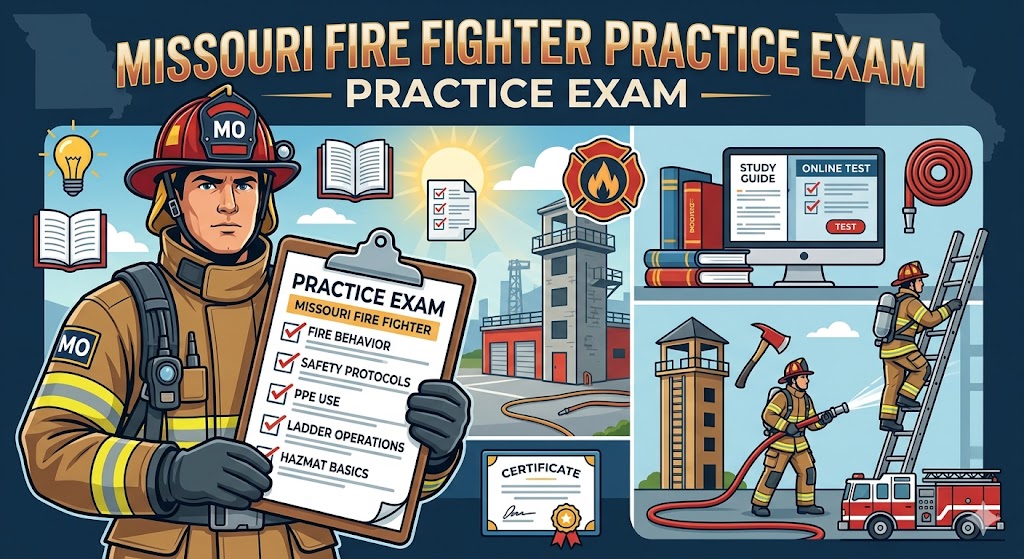
Additional Information
What the Course Entails and Exam Details
This rigorous course of study delves deep into the core
facets of modern fire service, covering everything from the underlying science
to the critical, hands-on techniques of firefighting. Students and candidates
must thoroughly prepare to demonstrate understanding and proficiency across key
topics including, but not limited to: fire behavior and dynamics, fire safety
protocols and risk assessment, fire service organization, hazardous materials
awareness and operations, the proper selection and usage of personal protective
equipment (PPE), fire streams, hoses, and nozzles, ladder operations, rescue
and extrication techniques, building construction, and ventilation strategies.
The curriculum is typically based on the National Fire Protection Association
(NFPA) standard for professional qualifications, and requires both theoretical
knowledge and practical skills mastery.
What to Expect in the Final Exam
The culmination of your preparation is a comprehensive
evaluation that tests both what you know and what you can do. The final
assessment generally consists of two distinct parts: a written knowledge exam
and a practical skills evaluation. The written portion is traditionally a
timed, multiple-choice test. You can expect around 100 questions covering the
entire range of topics studied, demanding a solid grasp of concepts and rules.
Candidates are typically required to achieve a passing score of at least 70% on
the written component to proceed or earn the certification.
Following the cognitive test, you must prove your physical
and technical competence in the practical skills exam. This hands-on evaluation
often tests a candidate across a number of core required and random skills. Be
prepared to perform tasks like donning PPE and a self-contained breathing
apparatus (SCBA) under time constraints, handling various firefighting tools,
raising and climbing ladders, applying different fire streams, and simulating
search and rescue maneuvers in challenging environments. Unlike the written
exam, practical skills are typically graded on a pass/fail basis, with the
absolute requirement of successfully completing every critical step of each
skill to pass the evaluation.
How to Study and Exam Centers
Effective preparation for the Missouri Fire Fighter
certification involves a combination of academic study, practical drills, and
physical training. Start by deeply familiarizing yourself with the officially
recommended textbooks, including the current editions of common industry
standard texts and any specific state-mandated manuals. Review the course
syllabus and use the relevant NFPA standards to ensure your study covers all
necessary job performance requirements. Make extensive use of high-quality study
resources, flashcards, online practice tests and quizzes (like the Missouri
Fire Fighter Practice Test tools), and study groups to reinforce your
theoretical knowledge. Do not neglect your physical conditioning; the CPAT
(Candidate Physical Ability Test) is often a concurrent or prerequisite
requirement for many hiring processes, and the skills exam itself requires
significant physical exertion and dexterity.
The actual written and practical skills exams are
administered by authorized entities throughout Missouri. This often includes
certified fire training academies, technical community colleges (like Ozarks
Technical Community College), and other DFS (Division of Fire Safety)
sanctioned locations. These centers are equipped to handle the logistical
demands of both the timed written testing and the dynamic, resource-intensive
skills evaluations. You must generally register and often have completed the
required training course hours with an approved provider to be eligible for the
exam. Check the Missouri Division of Fire Safety website or contact your
training provider for the most current information on exam schedules, required
prerequisites, and official testing locations. Practice tests should be taken
online in a simulated test environment to mirror the experience of the actual
written exam.
Job Opportunities
from the Course
Becoming a certified Missouri Fire Fighter I & II opens
the door to numerous vital and rewarding career opportunities in public service
and related fields within the state. Some of the common job titles and paths
that can be unlocked include:
- Career
Firefighter (Municipal & District): Standard role in municipal or
fire protection district departments, involving all aspects of fire
suppression, rescue, and emergency medical response.
- Volunteer
Firefighter: Joining many smaller or rural departments that rely
heavily on a combination of volunteer and career staff.
- Airport
Rescue Fire Fighter (ARFF): Specialized roles at major airports,
requiring additional certification in aviation-related fire rescue.
- Industrial
Firefighter: Fire safety and response roles within large manufacturing
plants, refineries, or industrial complexes.
- Fire
Service/Rescue Specialist: Positions in specialized units such as
hazardous materials teams, technical rescue (e.g., rope, trench, confined
space), or water rescue.
- Emergency
Medical Technician (EMT) or Paramedic (often requires concurrent or
subsequent certification): Most modern fire departments require EMT or
Paramedic training, and the combined role of Firefighter/EMT or
Firefighter/Paramedic is extremely common and desirable.
- Fire
Inspector / Fire Investigator (typically requires experience and further
certification): Focuses on fire prevention, building code compliance,
and determining fire origin and cause
Frequently Asked Questions
Reviews
5.0
Based on 0 reviews
Leave a Review
No reviews yet. Be the first to review!