
Modern World History Practice Test
$69.00
- Buy to unlock unlimited access to all Quiz questions and Answers in this Quiz.
- After purchase you can print a PDF of the whole quiz at any point. The PDF will contain the questions and the correct answers.
About this Exam
The Modern World History Practice Test is an invaluable resource designed specifically for students, educators, and anyone passionate about understanding the pivotal events that have shaped our global society from approximately the mid-15th century to the present day.
This practice exam serves as a crucial tool for self-assessment and targeted study.
It is tailored for individuals preparing for diverse assessments, including:
High school world history courses and final exams.
Advanced Placement (AP) World History or similar college-level courses.
College introductory history courses.
Teaching certification exams in social studies/history.
Anyone seeking to deepen their understanding of global historical dynamics.
Ready to test your knowledge?
Buy Now to Access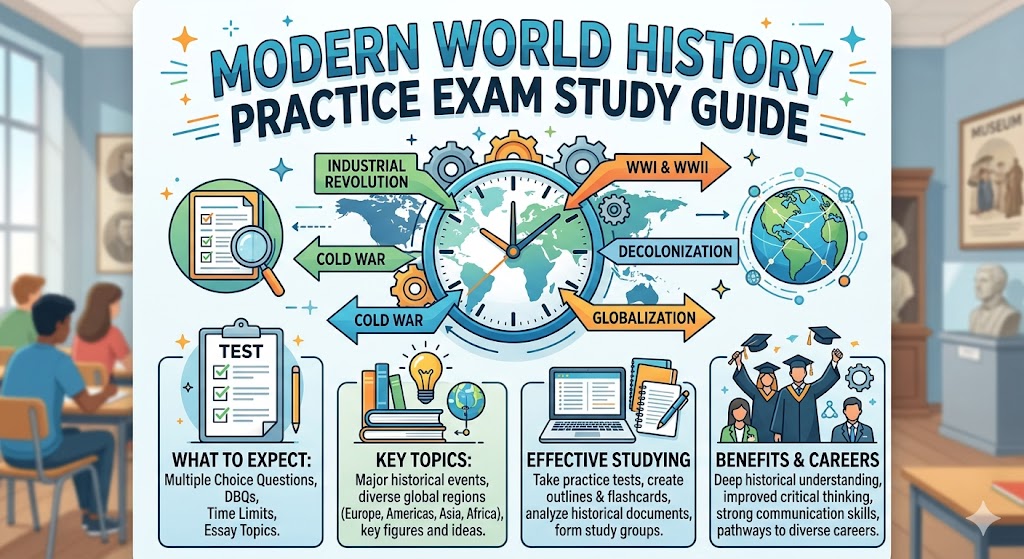
Additional Information
What the Course Entails and Exam Details
This practice exam covers a vast and dynamic period, delving
into key themes, events, and complex interactions that define the modern era on
a global scale. The underlying coursework typically encompasses critical
developments across various regions and centuries. Key topics you can expect to
encounter include:
- The
Early Modern Period (c. 1450 - c. 1750): Explore global interactions,
maritime exploration, the Renaissance, the Reformation, the rise of
powerful empires (Ottoman, Mughal, Ming, Qing, European), the Columbian
Exchange, and the Transatlantic Slave Trade.
- The
Age of Revolutions (c. 1750 - c. 1900): Analyze the Enlightenment,
political revolutions (American, French, Haitian, Latin American), the
Industrial Revolution, nationalism, and the expansion of European
imperialism.
- The
World in Crisis and Achievement (c. 1900 - c. 1945): Examine the
causes and consequences of World War I and World War II, the rise of
totalitarianism, the Great Depression, and significant cultural and
scientific shifts.
- The
Post-War World (c. 1945 - Present): Deeply understand the Cold War,
decolonization, global movements for rights and equality, the
technological revolution, globalization, and contemporary global
challenges.
The depth and specific focus may vary depending on the
particular course or curriculum the practice test is modeling, but a
comprehensive understanding of these broad themes across Europe, Africa, the
Americas, and Asia is fundamental.
What to Expect in
the Final Exam
While specific exam formats can differ, you can anticipate
several common characteristics:
- Multiple-Choice
Questions: A significant portion of the exam will likely consist of
multiple-choice questions designed to test your knowledge of historical
facts, chronological understanding, comparison, and analysis of cause and
effect. These questions may use primary and secondary source excerpts,
maps, or images as stimuli.
- Source-Based
Questions/Document-Based Questions (DBQs): Some versions may include
questions that require you to analyze provided historical documents
(written sources, images, data) and synthesize them with your prior
knowledge to answer a central historical question or build an argument.
- Short
Answer or Essay Questions: Some comprehensive exams may require
concise written responses or full-length essays, demanding a deeper
analysis, the development of a coherent thesis, and the use of relevant
historical evidence to support claims.
- Time
Limits: Standardized exams are almost always timed, so managing your
time efficiently across all sections is crucial for success.
- Passing
Scores: Requirements for a "passing" score vary greatly. For
courses, a percentage-based grade is common (e.g., 60-70% for a D or C).
For AP exams, a score of 3, 4, or 5 is generally considered a pass, with
higher scores often earning college credit. Certified teacher exams have
specific scaled score requirements.
Understanding the specific structure, scoring, and time
constraints of your target official exam is critical.
How to Study and
Exam Centers
Effective preparation is key. Leverage diverse strategies:
- Thorough
Review: Revisit textbooks, class notes, and reliable historical
resources for all major topics covered. Focus on understanding themes, key
terms, dates, and connections rather than just memorization.
- Practice
Frequently: Take the Modern World History Practice Test multiple
times. Review your answers, understand why correct answers are
correct and why incorrect ones are not. Use diverse practice
resources to ensure broad exposure.
- Identify
Weaknesses: Use practice tests to pinpoint specific eras, regions, or
themes where your knowledge is less secure. Prioritize studying these
areas.
- Form
Study Groups: Collaborating with peers can provide different
perspectives, clarify concepts, and make studying more engaging.
- Utilize
Official Resources: If preparing for a specific exam like the AP World
History, utilize materials from the College Board or relevant official
websites.
Regarding taking the official exam:
- School/Coursework:
For high school or college courses, exams are typically administered by
your school/institution in a physical classroom setting.
- Standardized
Tests: For exams like AP or teaching certifications, administration is
centralized. You may need to register and take the exam at specific
authorized centers or high schools.
- Online
Platforms: Some certifications or practice materials might be
accessible through online portals. Crucially, for official, high-stakes
exams, you must register through the official administering body.
- Testing
Centers: Search for authorized testing centers (like Pearson VUE for
some certifications) or specific physical locations designated by the exam
provider. Always verify and book your slot in advance.
Job Opportunities from the Course
A strong foundation in Modern World History, particularly
when combined with relevant degrees or certifications, can open doors to
numerous rewarding career paths. Employers in many sectors value critical
thinking, research, analytical, and communication skills honed through the
study of history. Potential job opportunities include:
- Historian
/ Researcher
- History
Teacher (High School or Middle School)
- College
History Instructor / Professor
- Museum
Curator / Archivist
- Librarian
(specifically specializing in history or social sciences)
- Journalist
/ Historical Writer
- International
Relations Specialist / Diplomat
- Policy
Analyst (in government or think tanks)
- Lawyer
(history provides strong foundational skills)
- Public
Administrator / Civil Servant
- Consultant
(with expertise in global dynamics)
- Historical
Consultant for media/entertainment
Frequently Asked Questions
Reviews
5.0
Based on 0 reviews
Leave a Review
No reviews yet. Be the first to review!