
Modes of Ventilation Practice Test
$69.00
- Buy to unlock unlimited access to all Quiz questions and Answers in this Quiz.
- After purchase you can print a PDF of the whole quiz at any point. The PDF will contain the questions and the correct answers.
About this Exam
The Modes of Ventilation Practice Exam is an essential tool designed to measure a clinician's understanding and practical knowledge of mechanical ventilation concepts. It is specifically created for healthcare professionals working in critical care and emergency settings, including Respiratory Therapists (RTs), Critical Care Nurses (RNs), and specialized medical practitioners. This test serves as a rigorous simulation, preparing candidates for official certification exams, like the NBRC TMC and CSE, or as a self-assessment to ensure competency in managing complex patient-ventilator interactions. Achieving mastery here demonstrates your ability to make critical decisions that directly impact patient outcomes, from initial setup to liberation from mechanical support.
Ready to test your knowledge?
Buy Now to Access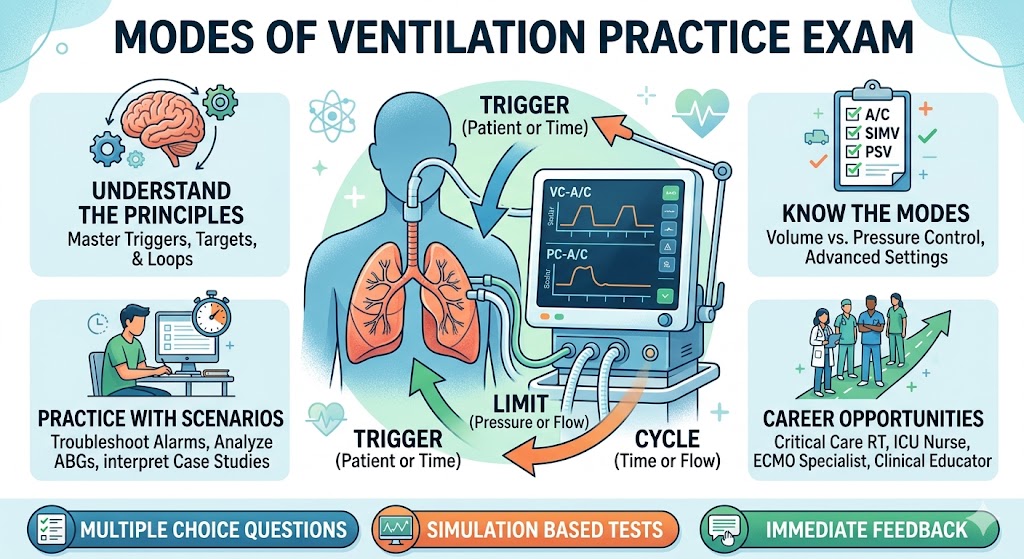
Additional Information
What the Course Entails and Exam Details
This examination covers the full spectrum of mechanical
ventilation. Candidates are expected to demonstrate deep knowledge of
theoretical principles, standard modes, advanced settings, and patient
management strategies. The syllabus typically includes:
- Core
Principles: Respiratory physiology, indications for mechanical
ventilation, invasive vs. non-invasive approaches, and safety.
- Ventilator
Triggers, Limits, and Cycles: How the ventilator starts, delivers, and
ends a breath (flow, pressure, time, patient effort).
- Primary
Ventilator Modes: Comprehensive knowledge of VC-A/C (Volume-Control
Assist-Control), PC-A/C (Pressure-Control Assist-Control), VC-SIMV
(Volume-Control Synchronized Intermittent Mandatory Ventilation), and
PC-SIMV.
- Spontaneous
and Support Modes: CPAP (Continuous Positive Airway Pressure),
BIPAP/NIV (Non-invasive Ventilation), and PSV (Pressure Support
Ventilation).
- Advanced
and Hybrid Modes: APRV (Airway Pressure Release Ventilation) and PRVC
(Pressure-Regulated Volume-Control).
- Ventilator
Settings and Parameters: Mastering settings for Tidal Volume (Vt),
FiO2 (Fraction of Inspired Oxygen), PEEP (Positive End-Expiratory
Pressure), Respiratory Rate (f), Inspiratory Time (Ti), and Flow Rate.
- Patient
Monitoring and Troubleshooting: Interpreting Arterial Blood Gases
(ABGs), analyzing waveforms (scalars and loops), recognizing
patient-ventilator dyssynchrony, and managing alarms.
What to Expect in
the Final Exam
The Modes of Ventilation Practice Exam is traditionally
administered in a computer-based, multiple-choice question format. Each
question is designed to test critical thinking, requiring you to apply
theoretical knowledge to realistic clinical scenarios rather than simply
recalling definitions.
- Format:
Multiple-choice questions (MCQ), often including case studies.
- Question
Types: Clinical scenario application, troubleshoot ventilator
data/alarms, select the best mode and settings, and interpretation of ABGs
and waveforms.
- Time
Limit: Approximately 90 minutes to two hours, mirroring the time
pressure of real board exams.
- Passing
Score: Typically set at 75% to 80% to ensure high-level competency.
- Rules:
No external materials or calculators are permitted.
How to Study and
Exam Centers
Preparation is the key to success. We recommend a structured
study plan that combines multiple learning methods.
Study Strategies:
Review Core Textbooks:
Consult authoritative sources like "Pilbeam's Mechanical
Ventilation."
Use Practice Exams Regularly:
Taking multiple practice tests under timed conditions is the best way to build
confidence and identify weaknesses.
Master Waveform
Interpretation: Dedicate significant time to studying pressure, flow, and
volume scalars to identify autopeep, leaks, and patient-ventilator conflict.
Create Flowcharts for Modes:
Develop your own visual aids comparing the triggers, targets, and limitations
of each ventilation mode.
Utilize Online Learning
Modules: Many accredited organizations and medical simulation sites offer
interaction modules.
Exam Centers and Access:
This practice test is an educational resource rather than a
government-licensed certification, which means it is easily accessible through
multiple channels:
- Authorized
Schools and Hospitals: Many college Respiratory Therapy programs and
hospital training departments use this exam as a internal benchmark.
- Online
Education Portals: Several specialized clinical education websites
offer secure online access.
- National
Boards Simulation: While not the official board exam, it is often
available as part of study packages from official boards or specialized
prep companies.
Job Opportunities
from the Course
Mastering the modes of ventilation unlocks numerous
high-demand and fulfilling career paths within the healthcare industry. It is a
critical skill set that differentiates top-tier candidates.
- Registered
Respiratory Therapist (RRT)
- Critical
Care Transport Therapist
- Neonatal/Pediatric
Respiratory Specialist
- ICU
Respiratory Therapist
- Cardiopulmonary
Rehabilitation Specialist
- Critical
Care Nurse (RN, specializing in ICU)
- Extracorporeal
Membrane Oxygenation (ECMO) Specialist
- Clinical
Application Specialist (Ventilator Manufacturer)
- Pulmonary
Function Technologist
- Emergency
Department Respiratory Therapist
Frequently Asked Questions
Reviews
5.0
Based on 0 reviews
Leave a Review
No reviews yet. Be the first to review!