
Mold Assessment Technician Practice Exam
$69.00
- Buy to unlock unlimited access to all Quiz questions and Answers in this Quiz.
- After purchase you can print a PDF of the whole quiz at any point. The PDF will contain the questions and the correct answers.
About this Exam
The Mold Assessment Technician (MAT) certification is a crucial professional credential designed for individuals seeking a career in indoor environmental health. It validates a professional's competency to identify and assess mold growth and associated moisture problems in residential and commercial buildings. This certification is ideal for home inspectors, environmental consultants, restoration contractors, public health professionals, and construction managers. Earning this designation demonstrates that a technician has the standardized knowledge and skills necessary to perform comprehensive mold assessments, collect scientific samples, and report findings to clients, often acting as the essential first step in a successful mold remediation process. It is a vital pathway for those entering this growing field, and passing the practice exam is the most effective way to ensure readiness for the final certification.
Ready to test your knowledge?
Buy Now to Access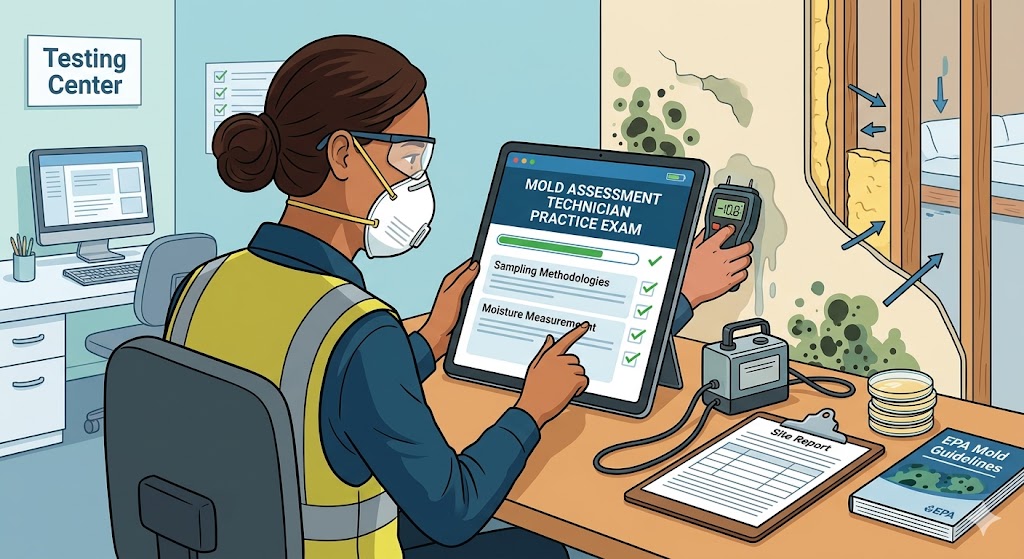
Additional Information
What the Course Entails and Exam Details
A comprehensive Mold Assessment Technician course covers a
wide range of technical and regulatory subjects to prepare candidates for field
work. The curriculum typically includes an in-depth study of fungal biology,
identifying the sources and conditions that promote mold growth. It details the
potential health effects of mold exposure for occupants and the required
personal protective equipment (PPE) and safety protocols for technicians.
The course provides significant hands-on or detailed
instruction on inspection methodologies, such as:
- Visual
inspection techniques to locate hidden mold.
- The
use of physical measurement equipment, including moisture meters and
hygrometers, to trace moisture intrusion.
- A
mastery of various sampling methodologies, including air sampling (for
spore counts and culturable samples), surface sampling (tape, swab), and
bulk sampling.
- An
introduction to interpreting laboratory analysis reports and standardizing
report writing for clients.
- A
key component is the review of applicable state regulations and industry
standards (such as IICRC S520 and EPA guidance), ensuring that the
technician understands their role, legal liabilities, and the roles of
other professionals in the mold industry.
The final certification exam for a Mold Assessment
Technician is a rigorous, proctored test that assesses comprehension of this
material. The exact number of questions and time limit can vary by the
certifying organization or state, but a typical exam often consists of 50 to
100 multiple-choice questions, which must be completed within a two to
three-hour window.
What to Expect in the Final Exam
The Mold Assessment Technician final certification exam is a
formal, proctored assessment, often delivered either in a physical testing
center or through an online proctoring service. The exam is overwhelmingly
composed of multiple-choice questions, designed to test theoretical knowledge
and its practical application. Candidates will be presented with scenario-based
questions that ask them to:
- Determine
the best sampling strategy for a given moisture problem.
- Correctly
interpret sample data from a lab report.
- Identify
the appropriate PPE for a specific remediation oversight scenario.
- Identify
sources of moisture intrusion from structural diagrams or photos.
Depending on the state or organization, the exam might also
feature short-answer, matching, or even simulation-based components to evaluate
field assessment skills. A passing score is usually set between 70% and 80%,
though some rigorous state licenses may require higher. Time limits are
strictly enforced, but are designed to be sufficient for well-prepared
candidates. There are typically no open-book resources allowed. The primary
objective is to verify that the technician can make accurate, safe, and legally
defensible decisions in the field.
How to Study and Exam Centers
To succeed on the Mold Assessment Technician exam, a
structured study plan is essential. Start by thoroughly reviewing the textbook
or study guide provided by your training course. It's not enough to memorize
facts; you must understand the "why" behind visual inspections, the
physics of moisture movement, and the scientific methodology of sampling.
- Practice
with Tools: If your course includes hands-on training, maximize your
time with moisture meters, air pumps, and thermal imaging cameras.
Understanding their practical application makes written questions about
them much clearer.
- Use
Practice Exams: This is the single most effective way to prepare.
Regularly taking a Mold Assessment Technician practice exam will
familiarize you with the question format, highlight areas where you need
more study, and improve your test-taking speed.
- Focus
on Regulations: Do not overlook the legal and regulatory sections.
Memorize key roles, required reports, and standard timeframes for your
state or certifying body.
Regarding exam centers, you generally have two main options:
Authorized Schools and
Training Providers: Most organizations that offer the required MAT course
also host the proctored final exam, often immediately following the conclusion
of the class.
State-Approved Testing
Centers: If your MAT is for state licensure, you will likely need to
register for the exam through the state's regulatory body. These exams are
often administered through third-party services like Pearson VUE, which operate
a network of secure, computerized testing centers nationwide.
Job Opportunities
from the Course
Earning your Mold Assessment Technician certification opens
the door to a specialized and expanding sector of the indoor air quality and
construction industries. This qualification is an excellent asset for
individuals looking to advance their current careers or launch new ones. Below
is a list of job titles and career paths that a Mold Assessment Technician
certification can unlock:
- Mold
Assessment Technician / Mold Inspector: The primary entry-level role,
focusing on visual inspections, sampling, and creating assessment reports.
- Mold
Assessment Consultant: A more advanced role in some states, with
increased authority in planning surveys and interpreting complex data.
- Indoor
Air Quality (IAQ) Technician / Consultant: A broader environmental
role that uses mold assessment as a core competency.
- Restoration
Project Manager: Oversees water damage and mold remediation projects,
utilizing their technician knowledge to verify effective remediation.
- Environmental
Field Technician: Performs a variety of sampling and assessment tasks,
including mold, in commercial and residential settings.
- Home
Inspector (with a Mold Specialization): Allows home inspectors to
offer high-demand, specialized services as an add-on.
- Facility
Manager: Uses the knowledge to better maintain building health and
manage indoor air quality issues pro-actively.
- Public
Health Inspector / Environmental Health Specialist: Work for
governmental agencies to assess health risks in public or regulated
spaces.
Frequently Asked Questions
Reviews
5.0
Based on 0 reviews
Leave a Review
No reviews yet. Be the first to review!