
Mold Remediation Certification Practice Exam
$69.00
- Buy to unlock unlimited access to all Quiz questions and Answers in this Quiz.
- After purchase you can print a PDF of the whole quiz at any point. The PDF will contain the questions and the correct answers.
About this Exam
Mold remediation certification validates the knowledge and skills necessary to safely and effectively address mold issues in residential, commercial, and industrial properties.
This certification is designed for restoration professionals, contractors, property managers, and indoor air quality specialists who wish to formalize their expertise and demonstrate their commitment to industry standards.
Successfully navigating this certification process, which often includes a comprehensive exam and potentially practical assessments, distinguishes individuals in a critical environmental health field.
A practice exam is an invaluable tool for candidates, providing insight into the content, format, and depth of the actual certification test, and is a key step in a robust study plan.
The main objective of a practice exam is to build confidence and identify areas for further review before taking the official exam.
Ready to test your knowledge?
Buy Now to Access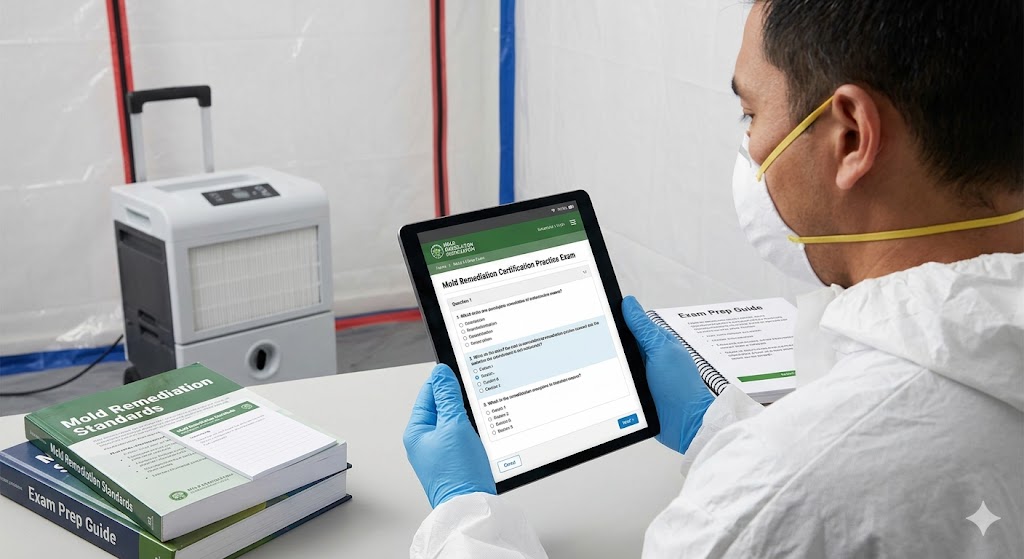
Additional Information
What the Course
Entails and Exam Details
Specific course content and exam details can vary
significantly depending on the certifying body, such as the IICRC, ACAC, or
relevant state licensing boards.
However, a typical comprehensive mold remediation course and
exam will cover several core areas.
You should expect in-depth training and assessment on mold
biology, identifying conditions conducive to mold growth, and the associated
health effects of exposure for both occupants and workers.
Key emphasis is always placed on industry standards,
relevant regulations from OSHA and the EPA, and legal guidelines governing mold
remediation practices.
Core topics usually include proper inspection techniques,
contained removal procedures, and the correct use of personal protective
equipment (PPE).
Crucial technical skills like designing containment,
controlling air pressure, and implementing post-remediation verification
processes are also central to these programs.
The details of the practice exam itself will mirror the
structure of the actual theoretical test to the best extent possible.
What to Expect in
the Final Exam
While formats can differ, most final certification exams,
and especially the practice exams that prepare you for them, consist
primarily of multiple-choice questions.
A typical practice exam might feature 100 to 120
multiple-choice questions, which is a standard format for many environmental
certifications.
This format ensures efficient grading and comprehensive
coverage of diverse topics within the allotted time.
You can usually expect a time limit ranging from 2 to 3
hours to complete the examination.
Candidates should prepare for a closed-book testing
environment, requiring a deep internal understanding of the material.
Passing scores generally fall around 70% or higher,
reflecting the need for a high level of competency.
For the full certification, some bodies may also include a
practical or hands-on assessment in addition to the written exam, but practice
exams for written components focus on theory and knowledge.
Make sure to confirm the exact rules and parameters with
your specific certifying body well in advance.
How to Study and
Exam Centers
Effective preparation is essential for success, and a robust
study strategy should incorporate multiple methods.
Start by thoroughly reviewing all provided course materials,
relevant textbooks, and industry standards documents, such as the ANSI/IICRC
S520.
Taking multiple practice exams is a highly recommended
strategy, allowing you to get comfortable with the exam format, manage your
time, and identify knowledge gaps.
Consider creating flashcards for key terms, regulatory
requirements, equipment types, and health effects to reinforce memory.
Join study groups or participate in online forums to discuss
challenging concepts and share learning strategies with other candidates.
It is absolutely crucial to understand relevant health,
safety, and environmental regulations, as these form a significant portion of
many mold remediation exams.
Most certification bodies now offer exams through secure
online proctoring services, allowing you to test from a suitable location.
Alternatively, you may be able to take the exam at
authorized training centers, authorized schools, or specifically designated
physical testing centers like those operated by Pearson VUE, depending on the
requirements of the certifying organization.
Verify the specific options available for your exam and book
your testing session early to secure your preferred date and format.
Job Opportunities from the Course
Upon achieving mold remediation certification, you will be
qualified for various specialized roles within the environmental health,
restoration, and real estate sectors.
Specific opportunities include, but are not limited to, the
following positions:
- Mold
Remediation Technician - Performing hands-on mold containment,
removal, and cleanup procedures on a wide range of projects.
- Mold
Inspector - Conducting thorough assessments, sampling, and reporting
on mold issues in diverse property types to guide remediation efforts.
- Indoor
Air Quality Consultant - Advising clients on broader indoor
environmental health concerns, including mold prevention, assessment, and
mitigation.
- Remediation
Supervisor or Project Manager - Overseeing field teams, designing
remediation plans, ensuring safety protocols, and managing projects from
start to finish.
- Environmental
Restoration Manager - Leading comprehensive restoration operations
including mold, water, fire, and other damage restoration services within
a company.
- Property
Manager with Mold Expertise - Applying specific mold knowledge to
maintain healthy building environments and manage issues effectively for
residential or commercial properties.
Frequently Asked Questions
Reviews
5.0
Based on 0 reviews
Leave a Review
No reviews yet. Be the first to review!