
Monitoring for Health Problems Practice Exam
$69.00
- Buy to unlock unlimited access to all Quiz questions and Answers in this Quiz.
- After purchase you can print a PDF of the whole quiz at any point. The PDF will contain the questions and the correct answers.
About this Exam
The Monitoring for Health Problems certification is a fundamental stepping stone for aspiring healthcare professionals.
It is designed to evaluate a candidate’s ability to observe, measure, and report critical changes in a patient's physical condition.
This exam is primarily targeted at nursing assistants, patient care technicians, medical assistants, and home health aides.
By passing this test, candidates prove they have the keen observational skills required to ensure patient safety and effectively support doctors and nurses.
It serves as a vital benchmark for anyone looking to enter the frontline of clinical or residential care.
Ready to test your knowledge?
Buy Now to Access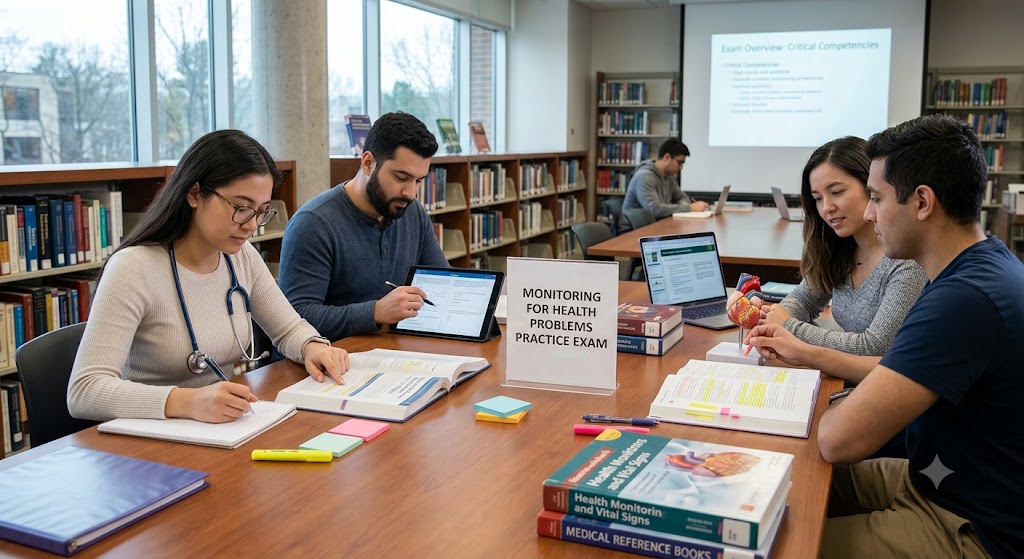
Additional Information
What the Course Entails and Exam Details
The coursework leading up to this exam covers a wide array
of essential clinical skills.
Students learn how to accurately take and record vital
signs, including blood pressure, temperature, pulse, and respiration rates.
The syllabus also dives heavily into recognizing the early
warning signs of acute medical emergencies, such as strokes, heart attacks, and
respiratory distress.
Furthermore, the curriculum details the proper use of
essential medical monitoring equipment like pulse oximeters and automated blood
pressure cuffs.
Proper documentation and communication protocols are also
central to the course, ensuring that you know exactly how to report
deteriorating health conditions to the supervising medical staff.
What to Expect in the Final Exam
When sitting for the final assessment, you can expect a
rigorous blend of theoretical and practical evaluations.
The written portion typically consists of 50 to 75
multiple-choice questions designed to test your critical thinking and
situational judgment.
Candidates are generally given between 90 and 120 minutes to
complete the written exam.
To pass, most certification boards require a minimum score
of 75% to 80%.
In addition to the multiple-choice section, many exam boards
include a practical skills evaluation where you must physically demonstrate
tasks—such as taking a manual blood pressure reading—in front of a proctor.
Strict rules apply during testing, including the prohibition
of mobile devices, smartwatches, and outside reference materials.
How to Study and
Exam Centers
To succeed, you should adopt a well-rounded study strategy
that includes both book learning and hands-on practice.
Taking a Monitoring for Health Problems practice exam is one
of the most effective ways to familiarize yourself with the phrasing of medical
questions.
Use flashcards to memorize normal vital sign ranges and key
medical terminology.
For the practical portion, practice your physical
assessments on friends or family members until the steps become second nature.
When you are ready to take the test, exams are typically
administered through major testing portals like Pearson VUE or Prometric.
Additionally, many state-approved nursing schools,
vocational colleges, and local Red Cross chapters serve as authorized physical
testing centers.
Job Opportunities
from the Course
Earning a credential in monitoring health problems opens the
door to numerous high-demand healthcare careers.
- Certified
Nursing Assistant (CNA): Providing direct care and monitoring vital signs
for patients in hospitals and long-term care facilities.
- Patient
Care Technician (PCT): Working alongside doctors and nurses to monitor
patient health, draw blood, and perform EKGs.
- Medical
Assistant (MA): Operating in outpatient clinics to check in patients,
record initial health metrics, and assist with minor procedures.
- Home
Health Aide (HHA): Assisting elderly or disabled individuals in their own
homes while keeping a close eye on their daily health status.
- Telemetry
Technician: Specializing in monitoring electronic displays of patients'
heart rhythms and vital signs in critical care units.
- Emergency
Room Technician: Supporting trauma teams by rapidly assessing and
continuously monitoring incoming patients.
Frequently Asked Questions
Reviews
5.0
Based on 0 reviews
Leave a Review
No reviews yet. Be the first to review!