
Montana FFA Agronomy Practice Test
$69.00
- Buy to unlock unlimited access to all Quiz questions and Answers in this Quiz.
- After purchase you can print a PDF of the whole quiz at any point. The PDF will contain the questions and the correct answers.
About this Exam
The Montana FFA Agronomy Career Development Event (CDE) is a challenging and rewarding competition designed for high school agricultural education students across the state.
This event tests students' knowledge and skills in crop production, soil science, plant physiology, weed and pest identification, and related agricultural technologies. It is ideal for students interested in farming, conservation, agribusiness, and environmental science.
Preparing for this competition with a comprehensive practice exam helps students sharpen their critical thinking and prepare for successful careers in the diverse agricultural industry.
Ready to test your knowledge?
Buy Now to Access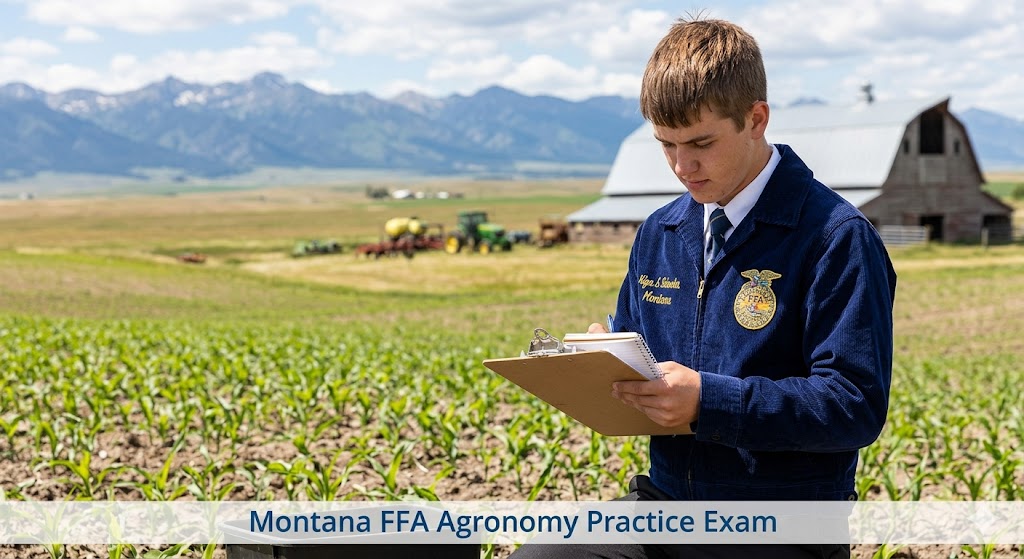
Additional Information
What the Course Entails and Exam Details
This examination covers a broad range of topics critical to
modern agronomy.
Students must demonstrate proficiency in identifying common
field crops, weeds, seeds, insects, and plant diseases.
A strong understanding of soil formation, classification,
soil fertility, erosion control, and soil conservation practices is required.
The syllabus covers the entire process of growing key
Montana crops, from planting dates and seed selection to harvest methods and
crop storage.
Students must understand the life cycles of agricultural
pests and apply appropriate management techniques, including chemical,
biological, and mechanical controls.
Participants are tested on their ability to perform
practical calculations related to seeding rates, fertilizer application,
sprayer calibration, and agricultural economics.
Familiarity with the latest tools, including GPS/GIS
systems, drones, and data analysis in precision agriculture, is essential.
What to Expect in the Final Exam
While the exact structure of the official Montana FFA
Agronomy CDE can vary slightly from year to year, students can generally expect
the final competition to include several distinct components.
A significant portion usually consists of a written
knowledge test, often multiple-choice, covering theories and facts across all
agronomy domains.
The practical application phase is critical and typically
features identification stations where students must quickly and accurately
label various plant, seed, insect, and disease samples.
Students should also prepare for practical, hands-on
activities, such as analyzing soil samples or solving agronomy-related math
problems based on real-world scenarios.
A strict time limit is applied to each section, demanding
that students possess both depth of knowledge and speed in recall and
computation. The scoring is rigorous, with points awarded for accuracy in
identification, correct calculation procedures, and overall knowledge on the
written component. State-level results determine who represents Montana at the
national FFA competition.
How to Study and Exam Centers
Effective preparation for the Montana FFA Agronomy
competition requires a mix of theoretical study and practical practice.
Students should begin by thoroughly reviewing materials
provided by their local FFA advisors and classroom agricultural educators. The
official Montana FFA guidelines for the Agronomy CDE are an essential resource,
outlining specific identification lists and scoring breakdowns.
Practice with previous CDE tests is crucial; students should
time themselves during these mock exams to build confidence and accuracy.
Creating flashcards for identification of seeds, weeds, plants, insects, and
equipment is highly recommended, as visual recognition is key to scoring high
in the ID section. Group study with team members can also help clarify complex
topics and improve practical problem-solving skills.
Regarding exam locations, the practice tests and qualifying
rounds are typically administered within high school agricultural education
departments under the supervision of their FFA advisors or through online
platforms designated by the Montana FFA Association.
The actual state-level Agronomy CDE, however, is a physical
event held annually as part of the Montana FFA State Convention or a specific
Career Development Event hub, often located at Montana State University in
Bozeman or rotating through other authorized educational centers across the
state. Advisors will inform eligible teams about specific registration details
and locations for the state competition.
Job Opportunities
from the Course
Mastering the skills covered in the Agronomy CDE opens doors
to many diverse and well-paying careers in the agricultural sector. The
certification and experience gained provide an excellent foundation for these
roles:
- Crop
Consultant / Agronomist
- Seed
Production Specialist
- Soil
Scientist / Conservationist
- Agricultural
Educator (High School or Extension)
- Pest
Control Advisor (PCA)
- Precision
Agriculture Technician
- Fertilizer
Sales and Management Representative
- Farm
Manager or Rancher
- Agricultural
Economist
- Plant
Breeder or Geneticist (with advanced degree)
- Grain
Merchandiser or Elevator Manager
- Agricultural
Research Technician
- Irrigation
Specialist
- Agricultural
Loan Officer
Frequently Asked Questions
Reviews
5.0
Based on 0 reviews
Leave a Review
No reviews yet. Be the first to review!