
Mosquito Control Applicator Certification Practice Exam
$69.00
- Buy to unlock unlimited access to all Quiz questions and Answers in this Quiz.
- After purchase you can print a PDF of the whole quiz at any point. The PDF will contain the questions and the correct answers.
About this Exam
The Mosquito Control Applicator Certification is a vital professional credential designed for individuals working in public health, vector control, or general pest management.
It validates the knowledge and skills necessary to safely and effectively manage mosquito populations, thereby reducing the transmission of diseases like West Nile virus, Zika, and Eastern Equine Encephalitis.
This certification is essential for anyone who intends to apply pesticides for mosquito control as part of their job, ensuring they comply with all federal, state, and local regulations.
It is ideal for field technicians, environmental health specialists, and employees of commercial pest control companies or municipal mosquito control districts.
Ready to test your knowledge?
Buy Now to Access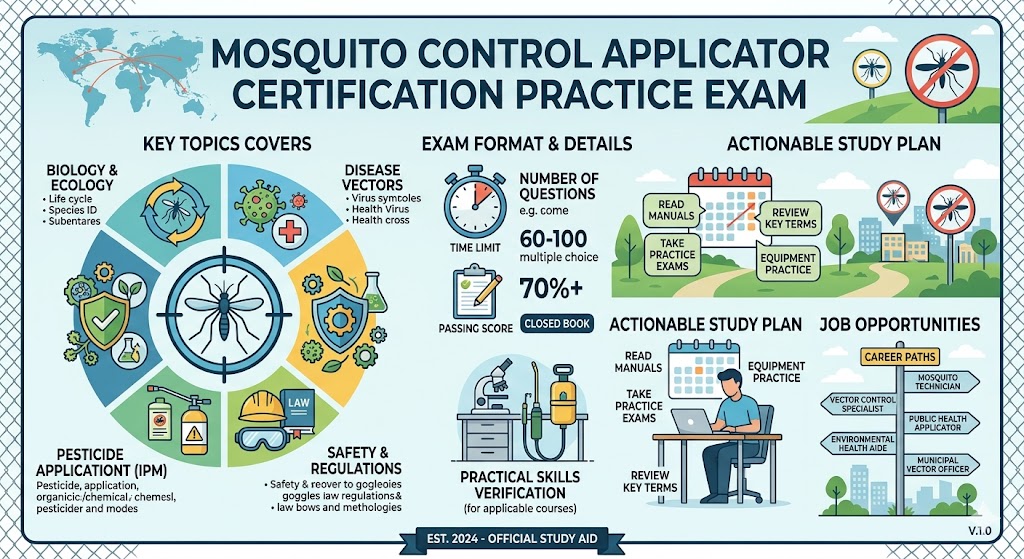
Additional Information
What the Course Entails and Exam Details
This comprehensive course, and the associated certification,
covers a broad spectrum of critical topics to prepare you for the field.
You will delve deeply into the fundamentals of mosquito
biology, including their complex life cycles, specific habitat requirements,
and the various species that act as disease vectors.
A significant portion of the material focuses on the
principles of Integrated Pest Management (IPM), emphasizing a holistic approach
that combines surveillance, source reduction, biological controls, and the
judicious use of pesticides.
Key areas of study include the proper selection, handling,
and application of larval and adult mosquito control products, as well as the
operation and maintenance of application equipment.
You will also gain thorough knowledge of pesticide safety,
label interpretation, personal protective equipment (PPE), and the
environmental regulations governing the use of public health pesticides.
What to Expect in
the Final Exam
While specific requirements can vary by state or certifying
body, the Mosquito Control Applicator Certification exam generally follows a
consistent, rigorous format.
The exam is typically a closed-book, written assessment
consisting of approximately 50 to 100 multiple-choice questions.
Candidates are given a fixed time limit, often ranging from
90 minutes to two hours, to complete the test.
A passing score, usually 70% or higher, is required to
obtain your certification.
The exam often includes distinct sections, requiring you to
pass both a 'Core' safety and law component and a 'Category-Specific' mosquito
control component to achieve full licensure.
You can expect questions that test your ability to read
pesticide labels, calculate application rates, identify mosquito larvae, and
respond to emergency spills or exposure scenarios.
How to Study and
Exam Centers
Effective preparation for this exam involves a structured
study plan that utilizes diverse learning resources.
Begin by thoroughly reviewing the official study manuals
provided by your state’s lead pesticide regulatory agency or relevant
cooperative extension service.
Supplement your reading with interactive tools, such as the
Mosquito Control Applicator Certification Practice Exam, to familiarize
yourself with the question format, test your recall, and pinpoint areas needing
further study.
Attend in-person or online training workshops, which often
offer expert instruction, hands-on equipment demonstrations, and valuable
opportunities for discussion.
State departments of agriculture, public health agencies,
and local vector control associations are excellent sources for official exam
dates, study materials, and information on approved course providers.
Exam administration typically takes place at designated
testing centers, which may include state agency offices, computer-based testing
facilities like Pearson VUE, or authorized cooperative extension offices.
Check your specific state’s pesticide program website for a
complete list of testing locations and to register for an exam session.
Job Opportunities from the Course
Earning this certification significantly enhances your
career prospects in the essential field of public health pest management.
It validates your expertise and ensures that potential
employers view you as a qualified, responsible professional.
Completing this course and passing the exam can lead to
diverse roles, including:
- Mosquito
Control Technician
- Vector
Control Specialist
- Public
Health Pesticide Applicator
- Environmental
Health Specialist
- Field
Surveillance Technician
- Municipal
Mosquito Control Officer
- Commercial
Pest Control Applicator (Public Health Category)
- Vector
Control Program Supervisor
- Seasonal
Mosquito Control Aide
Frequently Asked Questions
Reviews
5.0
Based on 0 reviews
Leave a Review
No reviews yet. Be the first to review!