
Motor Protection Practice Exam
$69.00
- Buy to unlock unlimited access to all Quiz questions and Answers in this Quiz.
- After purchase you can print a PDF of the whole quiz at any point. The PDF will contain the questions and the correct answers.
About this Exam
The Motor Protection Practice Exam is a comprehensive certification pathway for electrical professionals, maintenance technicians, and engineers who specialize in the installation, configuration, and troubleshooting of electric motor systems. Electric motors are the workhorses of general and specialized industries, from manufacturing to wastewater treatment, and their proper protection is critical to preventing costly downtime, catastrophic failure, and safety hazards. This certification demonstrates your expertise in identifying potential motor hazards, selecting the correct protective devices, and configuring them according to rigorous industry standards like the NEC (National Electrical Code) and IEEE. It is designed for those seeking to validate their practical knowledge and advance their career in heavy-duty electrical systems.
Ready to test your knowledge?
Buy Now to Access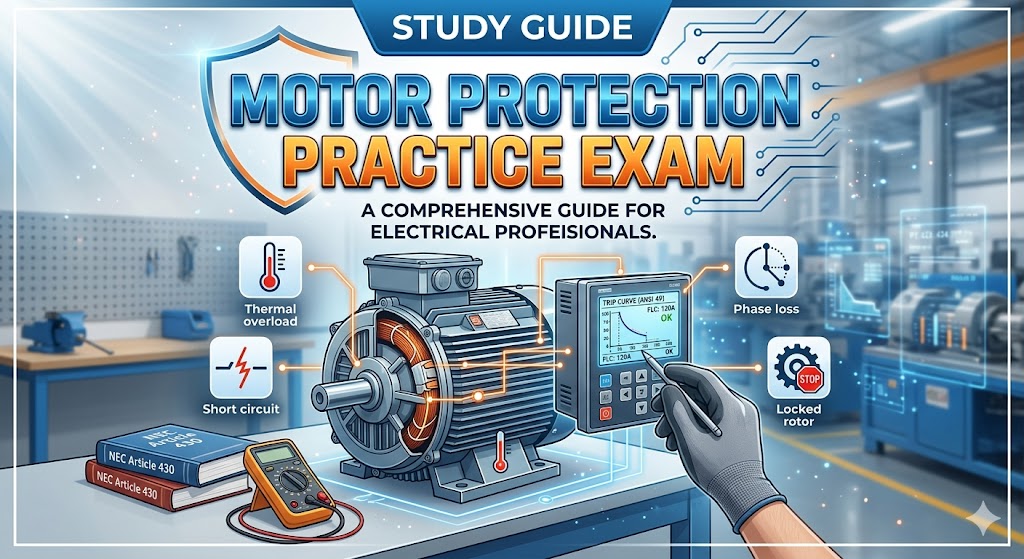
Additional Information
What the Course Entails and Exam Details
The final certification exam tests your practical
understanding of a detailed syllabus. This practice exam mimics that structure
to give you the most accurate simulation possible. You will be tested on your
ability to analyze motor nameplate data, perform critical safety calculations,
and configure advanced numerical and thermal overload relays.
Core Topics Covered
- Motor
Fundamentals and Hazards: Understanding motor construction, full-load
current (FLC), locked-rotor current (LRC), service factors, thermal damage
curves, and common failure modes (e.g., overload, stalling,
single-phasing, ground faults).
- Protection
Standards and Rules: Expert application of the National Electrical
Code (NEC) Article 430, including rules for overload protection sizing,
short-circuit protection, and branch circuit design.
- Thermal
Overload Protection: Configuring traditional bimetallic and modern
electronic thermal overload relays based on current, temperature, and
tripping classes (Class 10, 20, 30).
- Current-Based
Protection: Analyzing and setting instant and time-delay overcurrent
relays (ANSI 50/51), current imbalance protection (ANSI 46), and phase
failure detection.
- Voltage
and Differential Protection: Implementing undervoltage (ANSI 27) and
overvoltage (ANSI 59) protection, and the principles of sensitive motor
differential protection (ANSI 87M) for large machines.
- Testing
and Troubleshooting: Practical procedures for field-testing protection
schemes using secondary injection test sets and interpreting relay event
logs.
What to Expect in the Final Exam
The formal final exam is a rigorous, computer-based
assessment designed to evaluate both theoretical knowledge and practical
troubleshooting skills. Candidates should prepare for a stressful yet rewarding
test that mirrors real-world scenarios.
Exam Format
- Format:
The exam typically consists of 60 to 80 multiple-choice questions and
several scenario-based, interactive troubleshooting simulations.
- Time
Limit: You will have between 2 and 3 hours to complete the exam.
- Passing
Score: The passing score is usually set at 70% or 75%, depending on
the specific certifying body.
- Allowed
Materials: Most testing centers operate as "closed book,"
but you will be provided with necessary data tables and relevant sections
of code (such as NEC Article 430) on-screen or as a reference manual.
- Proctoring:
The exam is strictly proctored, whether taken at a physical center or
through a secure online proctoring portal.
How to Study and Exam Centers
Preparation is the key to conquering this exam. The most
successful candidates combine theoretical study with hands-on practice. Don't
rely on memory alone; prioritize understanding the why behind each
protection method.
Actionable Study Strategies
- Simulate
the Exam: The best way to use this practice exam is to create a
realistic testing environment. Time yourself, eliminate distractions, and
take the full test in one sitting to build stamina and identify weak
areas.
- Master
the NEC: Create "cheat sheets" for key parts of NEC Article
430, particularly tables and calculation methods for sizing overload
protection. Practice calculating settings for motors with different
Service Factors and Temperature Rises.
- Use
Visual Tools: Draw protection diagrams. Map out where a branch circuit
breaker (short-circuit protection) goes versus where an overload relay
(thermal protection) is placed.
- Analyze
Event Logs: Find practice problems that require you to look at a fault
event log from a numerical relay and determine what type of fault occurred
and which protection element should have tripped.
Testing Locations and Exam Access
Once you are prepared, you can schedule your final exam
through one of the following official channels:
- Authorized
Training Providers: Many community colleges, trade schools, and union
training centers offer the course and administer the final exam in their
own testing labs.
- Physical
Testing Centers: The exam may be available through established global
testing networks like Pearson VUE or Prometric, allowing you to take it in
a secured local office.
- Online
Proctored Exams: Some certifying bodies offer the flexibility to take
the exam from your home or office using a webcam and professional
live-proctoring software. Check your specific provider for eligibility and
system requirements.
Job Opportunities from the Course
A certification in Motor Protection acts as a powerful
differentiator in the electrical and maintenance fields. Industry is
experiencing a significant shortage of professionals with specific expertise in
heavy-duty rotating machinery and complex control systems. This certification
proves to employers that you have the specialized skills necessary to manage
their most critical assets.
High-Demand Career Paths
- Industrial
Electrician
- Electrical
Maintenance Technician
- Plant
Maintenance Engineer
- Control
Systems Technician
- Substation
Electrician
- Renewable
Energy Field Technician (Wind/Solar Pumps)
- Automation
and Drives Specialist
- Electrical
Inspector
- Reliability
Engineer
Frequently Asked Questions
Reviews
5.0
Based on 0 reviews
Leave a Review
No reviews yet. Be the first to review!