
Motor Speech Exam 1 Practice
$69.00
- Buy to unlock unlimited access to all Quiz questions and Answers in this Quiz.
- After purchase you can print a PDF of the whole quiz at any point. The PDF will contain the questions and the correct answers.
About this Exam
The Motor Speech 1 Practice Exam is a crucial resource designed to support and challenge speech-language pathology (SLP) students and aspiring clinicians as they delve into the complexities of motor speech disorders.
This comprehensive study tool provides an exceptional opportunity to simulate the rigor and content of fundamental exams focused on recognizing, assessing, and understanding various speech production difficulties.
It serves as a valuable preparation bridge for those navigating their foundational coursework and clinical education, ensuring a deeper comprehension and improved confidence.
Whether you are an undergraduate student just beginning your journey or a graduate student aiming for mastery in neural bases of speech, this practice exam offers targeted reinforcement and valuable feedback on your knowledge level.
Ready to test your knowledge?
Buy Now to Access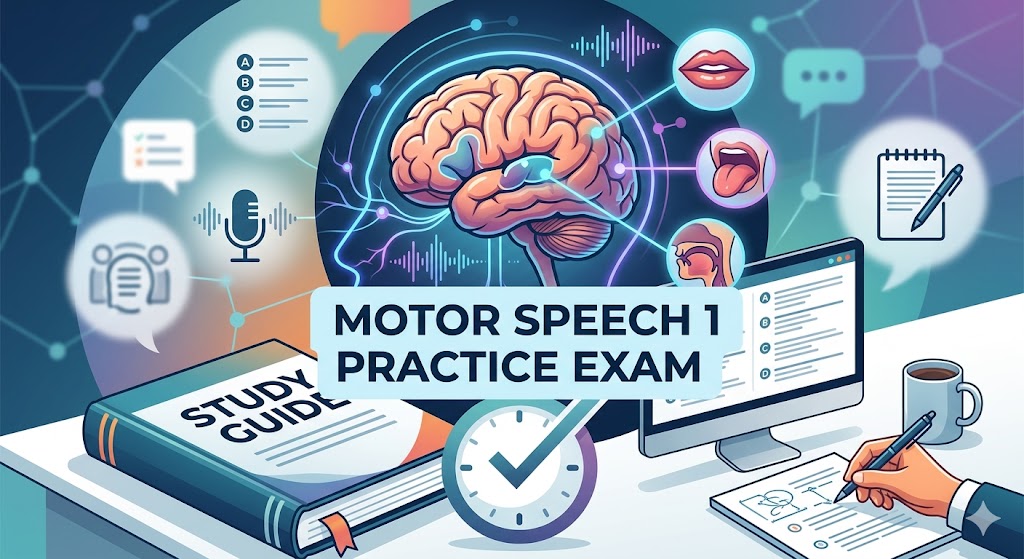
Additional Information
What the Course Entails and Exam Details
While specific course structures and official exams will
vary, the foundational knowledge and skills covered by the [Motor Speech Exam 1
Practice] typically encompass:
- Neuroanatomy
& Neurophysiology: A thorough examination of the neuroanatomy and
neurophysiology underpinning speech production, including central and
peripheral nervous system involvement and cranial nerve functions.
- Differential
Diagnosis: Detailed analysis and differentiation between key motor
speech disorders, primarily encompassing the various types of dysarthria
(e.g., flaccid, spastic, ataxic, hypokinetic, hyperkinetic, mixed) and
apraxia of speech.
- Speech
Characteristics: Assessments of your understanding related to typical
versus impaired speech mechanisms, acoustic characteristics, and
perceptual features critical for diagnosis and description.
- Assessment
Principles: Foundational concepts in patient assessment techniques,
clinical observation, understanding etiologies, and basic principles of
treatment planning for motor speech impairments.
Expect the practice material to be comprehensive, ensuring
you engage with the core theoretical and emerging clinical application aspects
relevant to this field.
What to Expect in the Final Exam
As you prepare using the Motor Speech 1 Practice Exam, you
can typically anticipate exam formats that reflect common academic testing
methods in speech-language pathology programs.
This often translates to a substantial component of
multiple-choice questions meticulously crafted to test your factual recall,
conceptual understanding, and clinical reasoning abilities concerning disorder
characteristics and theoretical knowledge.
Furthermore, the practice material may include other
assessment types such as true/false scenarios, matching exercises, or even
short answer questions that require detailed, descriptive analyses of potential
speech samples or case study summaries.
While specific passing scores and time limits are determined
by each educational institution or certifying body for official examinations
(often requiring performance in the 70-80% range or higher), using this
practice exam allows you to refine your timing and strategy.
Be mindful that official, high-stakes assessments usually
operate under strict time constraints, typically ranging from one to three
hours depending on the exam's comprehensive nature and depth.
Focus on accurately recalling information and applying
critical thinking within these time limits to maximize your performance on both
practice runs and the actual exam.
How to Study and
Exam Centers
Adopt Effective Study Strategies:
- Active
Learning: Immerse yourself actively with the material by creating
comprehensive flashcards that cover neuroanatomical structures, specific
dysarthria types, and distinct acoustic/perceptual features.
- Deep
Review: Reinforce your understanding by regularly comparing and
contrasting the different motor speech disorders in detail, highlighting
their unique neural damage sites, speech characteristics, and potential
treatment approaches.
- Simulate
Exam Conditions: Consistently utilize resources like the [Motor Speech
Exam 1 Practice] as a primary component of your preparation, simulating
timed exam conditions to build your stamina and familiarity.
- Target
Weaknesses: Identify and focus on your weaker areas by meticulously
reviewing every missed question, understanding why the correct
answer is accurate and why the alternative options are incorrect,
effectively targeting your knowledge gaps.
- Collaborative
Learning: Form supportive study groups with peers to discuss
challenging concepts, share diverse perspectives, and reinforce learning
through mutual explanation and quiz sessions.
- Expert
Guidance: Do not hesitate to consult your course instructors, academic
advisors, and specialized textbooks/scholarly articles whenever you
encounter particularly complex topics or require additional clarification.
Locating Exam Centers:
The [Motor Speech Exam 1 Practice] itself is usually
accessible through your university's specific online learning platforms or
other designated educational portals, offering flexible self-administration for
your convenience.
For subsequent official university final exams or major
professional licensure tests, like the ASHA Praxis exam, designated, supervised
testing centers are typically required.
These can include university computer labs specifically set
up for standardized testing or widely available professional test centers, such
as Pearson VUE, which administer numerous certifications.
It is essential to proactively check your academic program's
guidelines or visit the relevant licensing body’s official website for precise
information on exam registration, available testing locations, scheduling
procedures, and specific required identification/materials well in advance.
Job Opportunities from the Course
Mastering the critical knowledge in motor speech disorders,
as represented by the content within the Motor Speech 1 Practice Exam, is
fundamental to a successful and impactful career as a qualified Speech-Language
Pathologist.
This specialized expertise significantly enhances your
clinical proficiency and opens doors to diverse and rewarding opportunities in
various settings, including:
- Medical
Settings: Clinical Speech-Language Pathologist in prominent medical
centers or hospitals, providing acute and long-term care for individuals
with neurological impairments like strokes, traumatic brain injuries, or
neurodegenerative conditions.
- Rehabilitation
Facilities: Dedicated SLP within outpatient rehabilitation facilities,
guiding adults through specialized speech therapy programs focused on
improving communication skills and quality of life.
- Schools:
Compassionate SLP in school environments, supporting students from diverse
age groups facing developmental motor speech challenges or delays that
impact their learning and social interactions.
- Early
Intervention: Impactful Early Intervention Specialist, identifying and
addressing subtle speech and communication difficulties in infants,
toddlers, and their families during critical developmental stages.
- Geriatric
Care: Specialized SLP in skilled nursing facilities or home health
settings, providing essential care and support for older adults
experiencing age-related changes or specific neurological conditions
affecting their speech and language.
- Research
& Academia: Advancing Researcher or dedicated university
Instructor, focusing your expertise on investigating innovative assessment
techniques, effective treatment methodologies, and teaching the next
generation of SLPs.
- Specialized
Clinics: Collaborative team member in specialized clinics catering to
unique populations, such as those focusing on specific age groups, voice
disorders, swallowing difficulties, or conditions with concurrent speech
challenges.
Frequently Asked Questions
Reviews
5.0
Based on 0 reviews
Leave a Review
No reviews yet. Be the first to review!