
MPRE Rules Practice Test
$69.00
- Buy to unlock unlimited access to all Quiz questions and Answers in this Quiz.
- After purchase you can print a PDF of the whole quiz at any point. The PDF will contain the questions and the correct answers.
About this Exam
The Multistate Professional Responsibility Examination,
widely known as the MPRE, is a vital hurdle on the path to becoming a licensed
attorney in the United States. This certification exam is specifically designed
to measure a candidate’s knowledge and understanding of established standards
related to the professional conduct of lawyers. It is not a test of an
individual's personal ethics, but rather a rigorous assessment of their command
of the laws and rules governing the legal profession. Passing the MPRE is a
prerequisite for admission to the bars of nearly every U.S. state and
jurisdiction. It is therefore designed for law students, generally in their
second or third year, and foreign-trained lawyers seeking licensure in the U.S.
This study guide and our associated practice test are engineered to help you
master these rules before test day.
Ready to test your knowledge?
Buy Now to Access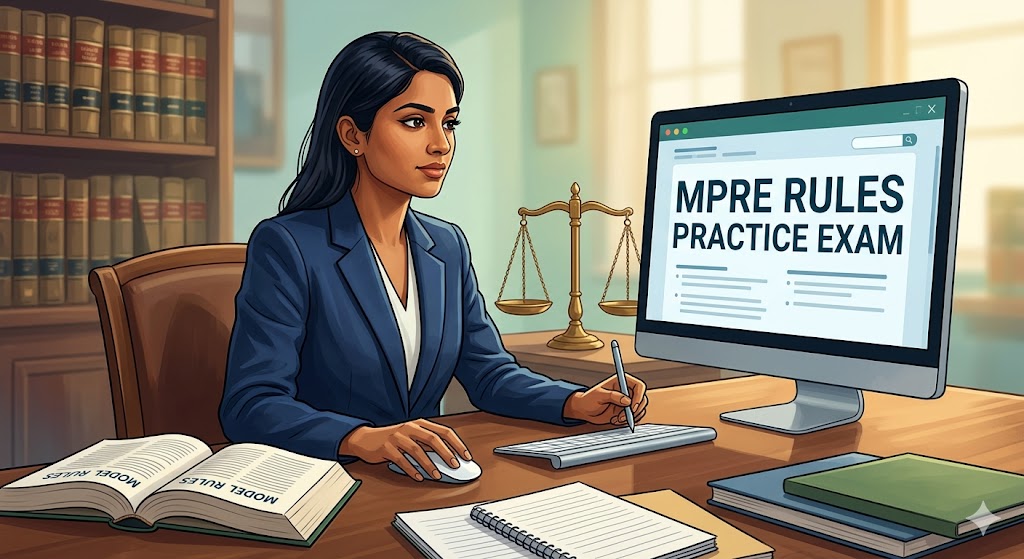
Additional Information
What the Course Entails and Exam Details
Preparing for the MPRE requires a deep dive into the
regulatory framework of the American legal system. While there is no mandatory
"course" you must take, your study must focus exclusively on several
key bodies of law. The examination is primarily based on the ABA Model Rules of
Professional Conduct and the ABA Model Code of Judicial Conduct. However, it
also incorporates generally accepted principles established in the Restatement
(Third) of the Law Governing Lawyers, as well as relevant procedural and evidentiary
rules. The exam syllabus is comprehensive. You will need to cover the following
areas extensively.
- Regulation
of the Legal Profession: Including admission to the bar, misconduct,
and the overarching powers of courts and disciplinary agencies.
- The
Client-Lawyer Relationship: Covering the scope of representation,
confidentiality, and fees.
- Privilege
and Confidentiality: Distinguishing between the ethical duty of
confidentiality and the attorney-client privilege.
- Independent
Professional Judgment (Conflicts of Interest): This is a heavily
tested area regarding current clients, former clients, and a lawyer's own
self-interest.
- Competence,
Legal Malpractice, and Other Civil Liability: Understanding the
standard of care required of an attorney.
- Litigation
and Other Advocacy: Mastering the rules of fairness to opposing
parties, candor toward the tribunal, and maintaining the impartiality of
the court.
- Different
Roles of the Lawyer: Such as advisor, evaluator, or negotiator.
- Safeguarding
Client and Third-Party Property: Including trust accounts and the
obligation to deliver funds or property promptly.
- Communications
About Legal Services: Regulating advertising, solicitation, and
specialization claims.
- Judicial
Ethics: Knowledge of the Model Code of Judicial Conduct is essential
for a complete study plan.
What to Expect in
the Final Exam
The final MPRE exam follows a strict format that requires
efficient time management and sharp analytical skills. The exam is administered
exclusively as a Computer-Based Test (CBT). It consists of exactly 60
multiple-choice questions. It is important to note that only 50 of these
questions are actually scored. The other 10 questions are unscored pretest
questions that the NCBE (National Conference of Bar Examiners) is testing for
future exams. You will not know which questions are which, so it is vital to answer
every single question as if it counts toward your score.
You are allotted a total of two hours to complete the
examination. This averages out to exactly two minutes per question, meaning you
cannot afford to get bogged down on any single item. There is no penalty for
guessing, so you should always provide an answer. Scoring is on a scaled system
ranging from 50 to 150. There is no single, national passing score. Each
jurisdiction sets its own minimum passing score for admission to practice law.
For instance, many jurisdictions require a scaled score between 75 and 86.
Because specific rules vary by location, it is critical that you verify the
required passing score with your specific jurisdiction's board of law
examiners.
How to Study and
Exam Centers
Effective preparation for the MPRE hinges on familiarizing
yourself with both the rules and the way they are applied in practice
questions. Since the questions are often nuanced, rote memorization of the
Model Rules is rarely enough to guarantee success. You must apply the rules to
complex, hypothetical scenarios where the facts are deliberately designed to be
close calls. The best approach is a mixture of intense rule review and timed
practice tests, such as our MPRE Rules Practice Test, which replicates the
difficulty and style of the actual NCBE questions. Reviewing the answer
explanations for practice questions, even the ones you got right, is a highly
effective way to internalize the rationale behind the correct choice and avoid
traps.
The MPRE is administered by LSAC (Law School Admission
Council) on behalf of the NCBE. You must create an account on the NCBE website
to register. After registration, you must then log into your LSAC account to
pay the exam fee and schedule your test center. Testing takes place multiple
times throughout the year, usually in March, August, and November. The actual
exam is taken at dedicated test centers managed by Pearson VUE. You will
take the exam on a computer at one of their authorized physical testing
locations. Be sure to check the current NCBE regulations regarding required
identification and prohibited items, as test center security is extremely
strict.
Job Opportunities
from the Course
Passing the MPRE does not grant a standalone license;
however, it is an essential and non-negotiable step toward unlocking a legal
career. Without a passing MPRE score, you cannot be admitted to practice law in
nearly any U.S. jurisdiction. Completing this requirement directly clears the
path toward the following professional roles and career paths.
- Licensed
Attorney (Public and Private Practice)
- Corporate
In-House Counsel
- Public
Defender
- Prosecutor
/ District Attorney
- Judicial
Clerk (often a prerequisite)
- Government
Attorney / Federal Agency Lawyer
- Law
Professor / Academic Legal Scholar
- Compliance
Officer or In-House Legal Consultant
- Judge
(which typically requires a prior legal license)
Frequently Asked Questions
Reviews
5.0
Based on 0 reviews
Leave a Review
No reviews yet. Be the first to review!