
MPTC Use of Force Practice Test
$69.00
- Buy to unlock unlimited access to all Quiz questions and Answers in this Quiz.
- After purchase you can print a PDF of the whole quiz at any point. The PDF will contain the questions and the correct answers.
About this Exam
Mastering the use of force model is perhaps the most
critical component of modern law enforcement training.
The Municipal Police Training Committee (MPTC) Use of Force
certification guarantees that police officers possess the legal knowledge,
ethical grounding, and practical decision-making skills required to handle
high-stress encounters safely and constitutionally.
This exam is designed specifically for recruit police
officers currently enrolled in an academy, as well as veteran officers
requiring mandatory in-service recertification.
Preparing with an MPTC Use of Force Practice Test is the most effective way to ensure you can apply complex legal standards, such as Graham v. Connor, under pressure, validating your readiness to protect and serve within authorized guidelines
Ready to test your knowledge?
Buy Now to Access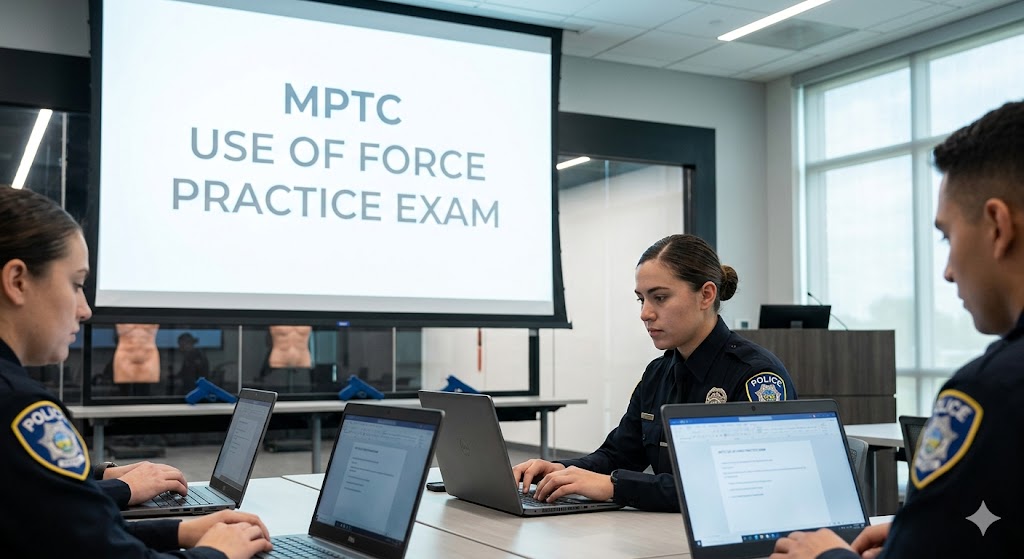
Additional Information
What the Course Entails and Exam Details
This training is not simply about physical defensive
tactics; it is deeply rooted in constitutional law, case law, and human
physiology during stress.
The curriculum and corresponding exam cover the mandatory
knowledge necessary to make sound, justifiable, and split-second decisions
regarding the application of force.
Core topics covered in the training and on the exam include:
- Legal
Framework: Detailed understanding of the Fourth Amendment, relevant
Supreme Court decisions (especially objectivity standards), and
state-specific statutes governing the use of force.
- The
Use of Force Model: Comprehensive knowledge of the recognized levels
of resistance (compliant, resistant, assaultive, deadly) and the
corresponding authorized response levels (presence, verbal commands,
less-lethal force, deadly force).
- De-escalation
Strategies: Mastering verbal communication, time, distance, and
shielding techniques to resolve conflicts without relying on physical
force whenever possible.
- Medical
Considerations: Understanding positional asphyxia, excited delirium,
the dynamic nature of injury, and the duty to provide medical aid
immediately after control is established.
- Decision
Making: Analyzing realistic scenarios to determine the appropriate and
necessary level of force based on the totality of circumstances.
What to Expect in the Final Exam
While the physical application of skills is tested
practically during academy training, the official MPTC written exam focuses
strictly on your cognitive understanding of the material.
Candidates must be prepared for a rigorous assessment that
challenges not just recall, but legal application.
Here is a breakdown of the standard exam format:
- Format:
The written exam is traditionally a comprehensive, multiple-choice
assessment, designed to eliminate ambiguity and test direct knowledge of
legal definitions and authorized responses.
- Question
Volume: You should anticipate between 50 and 100 questions, depending
on whether it is a recruit-level entry exam or an in-service
recertification update.
- Passing
Score: Because this subject matter is crucial for public safety and
officer liability, a high standard is required; a passing score of 80% or
higher is typically mandatory.
- Time
Limit: You will be under strict time constraints, usually allotted 1
to 2 minutes per question, reflecting the need for instinctive knowledge
in the field.
- Rules:
This is a closed-book examination; standard proctoring rules apply, and no
outside reference materials are allowed.
How to Study and
Exam Centers
Preparation is vital because the legal terminology must be
matched precisely with scenario-based logic.
Effective study strategies go beyond rote memorization of
definitions and focus on the practical application of the MPTC model.
Utilize these actionable study methods:
- Leverage
Practice Tests: Taking a dedicated MPTC Use of Force Practice Test is
invaluable. It forces you to apply legal standards to different resistance
levels and familiarizes you with the specific, often tricky, phrasing used
in the official exam.
- Case
Law Review: Master the facts and the holdings of key U.S. Supreme
Court cases, ensuring you understand exactly why a certain action was
deemed constitutional or unconstitutional.
- Flashcards
for Terminology: Use flashcards for definitions of
"reasonable," "necessary," "imminent
threat," and the specific descriptions of resistance types.
- Visualize
Scenarios: When reviewing the force model, close your eyes and
visualize a scenario for each resistance type, then mentally walk through
the correct lawful response.
Exam Centers:
The final, official MPTC Use of Force exam is administered
directly by accredited police academies or designated regional MPTC in-service
training coordinators.
This exam is not typically available at generic, commercial
testing centers like Pearson VUE.
If you are a recruit, your testing will be scheduled as part
of your academy curriculum; if you are in-service, your agency will schedule
you at a authorized regional academy or departmental training facility. You
must follow the scheduling instructions provided by your commanding officer or
training director.
Opportunities from the Course
A certified and current knowledge of Use of Force policy is
a mandatory legal prerequisite for exercising police powers.
Success on this exam validates that you are equipped with
the legal foundation needed to progress from a trainee to a fully sworn
officer.
This certification is required for and unlocks the following
career paths within the law enforcement and public safety sector:
- Sworn
Municipal Police Officer
- State
Police Trooper
- Sheriff's
Deputy
- Transit
Police Officer
- Campus
Police Officer (at authorized institutions)
- Environmental
Police Officer
- Specialized
Unit Operator (e.g., SWAT/Tactical Teams, which require advanced use of
force mastery)
- Law
Enforcement Field Training Officer (FTO)
Frequently Asked Questions
Reviews
5.0
Based on 0 reviews
Leave a Review
No reviews yet. Be the first to review!