
MTA Tower Operator Practice Exam
$69.00
- Buy to unlock unlimited access to all Quiz questions and Answers in this Quiz.
- After purchase you can print a PDF of the whole quiz at any point. The PDF will contain the questions and the correct answers.
About this Exam
The MTA Tower Operator certification is a significant
qualification within New York City's Metropolitan Transportation Authority.
This role is absolutely vital for ensuring the safe and
efficient movement of subway trains throughout the vast MTA system.
Tower operators manage complex signal systems, control track
switches, and coordinate train traffic, making split-second decisions that
impact thousands of daily commuters.
This exam is designed for individuals seeking to enter this
demanding yet rewarding career path, including current MTA employees looking
for advancement and external candidates aiming for a stable, impactful
position.
Success on this exam demonstrates your mastery of crucial
safety protocols, operational knowledge, and technical skills required for this
essential role.
Ready to test your knowledge?
Buy Now to Access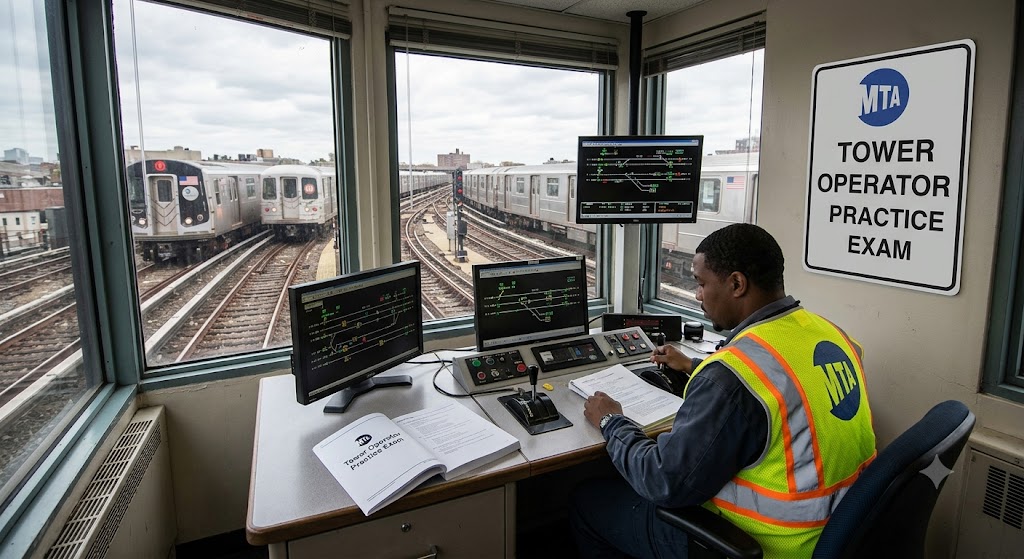
Additional Information
What the Course Entails and Exam Details
Preparing for the MTA Tower Operator exam requires deep
understanding across several key domains.
The associated training and examination details encompass
comprehensive study of:
MTA Rules and Regulations: You must have an expert grasp of
the specific operating rules, safety procedures, and communication protocols
unique to the MTA subway system.
Signal Systems and Interlocking: Understanding how different
signal types work, interpreting signal indications, and managing interlocking
plants (the mechanism that prevents conflicting train movements) is paramount.
Track Layout and Switching Operations: Visualizing track
configurations, understanding switch functions, and coordinating safe routes
for trains is a core skill tested extensively.
Problem-Solving and Critical Thinking: Many questions will
present complex scenarios and require you to apply rules and operational
knowledge to determine the safest and most efficient course of action under
pressure.
Train Movement Coordination: You'll learn how to safely
direct train traffic, manage yard operations, and respond effectively to
service disruptions or emergencies.
Communication Skills: Effective communication, both verbal
and written, is essential for coordination with train crews, dispatchers, and
other personnel.
This section provides a solid foundation, ensuring you are
well-versed in all aspects necessary to excel in the examination.
What to Expect in the Final Exam
The actual final examination for MTA Tower Operator
certification is a rigorous assessment designed to thoroughly evaluate your
knowledge and practical understanding.
While specific details can vary slightly by exam cycle, here
is what candidates can typically expect:
Format: The exam is predominantly multiple choice, requiring
you to select the single best answer from several options.
Some questions may involve interpreting diagrams, signal
indications, or evaluating complex operational scenarios.
Passing Score Requirements: The passing score is
substantial, reflecting the high stakes and critical safety responsibilities of
the role.
Expect a required score in the range of 70% to 80% or
potentially higher; aim for excellence rather than just passing.
Time Limits: There will be a strictly enforced time limit to
complete the examination.
Managing your time effectively will be crucial, ensuring you
can thoughtfully consider each question without rushing.
Specific Rules: The exam will be formally proctored and
typically administered in a secure, quiet environment.
It is generally a closed-book examination, meaning you will
rely solely on your knowledge and preparation; no reference materials are
permitted during the test.
Knowing these details in advance allows you to approach your
preparation with focused intent.
How to Study and
Exam Centers
Effectively preparing for the MTA Tower Operator exam is the
key to unlocking this rewarding career.
Implement these proven study strategies:
Deep Dive into Study Materials: Thoroughly study the
officially provided MTA rules, regulations, and operational manuals. Pay
meticulous attention to details, definitions, and specific procedural steps.
Utilize Diagrams and Visual Aids: Spend significant time
studying track maps, signal diagrams, and illustrations of interlocking
systems. Visual understanding is crucial for visualizing train movements and
making correct decisions.
Leverage Practice Exams: Take advantage of available
practice exams, including the [MTA Tower Operator Practice Exam] associated
with this guide. Simulate actual exam conditions – time yourself, answer
diligently, and thoroughly review both correct and incorrect answers to
understand the underlying principles. This is an invaluable tool for
identifying knowledge gaps and building confidence.
Form a Study Group: Collaborate with other candidates.
Discussing complex scenarios, clarifying rule interpretations, and testing each
other's knowledge can be highly beneficial.
Seek Mentorship (if possible): If you are already an MTA
employee, connect with experienced Tower Operators to gain real-world insights
and practical knowledge.
Stay Updated: Be aware of any recent updates to MTA rules or
operational procedures.
Exam Centers: Regarding the final exam location, the MTA
typically administers its examinations at dedicated MTA recruitment and testing
centers within New York City.
The specific location will be communicated to you directly
upon successful application and scheduling. These are professional, secure
testing environments designed to ensure fairness and integrity.
By combining focused study with effective practice methods,
you can confidently approach the exam and achieve your goal.
Job Opportunities
from the Course
Successfully passing the MTA Tower Operator exam and
achieving certification opens direct doors to impactful careers within the MTA
subway system.
The primary job opportunities and career paths unlocked
include:
MTA Tower Operator
This role involves controlling the interlocking machine,
managing track switches, and directing train movements within designated areas
or yards. It is a critical position ensuring safe and efficient operations.
Potential for advancement within the operations department:
With experience and further training, successful Tower Operators may have
opportunities for advancement to supervisory or managerial roles within train
movement coordination, yard operations, or signal system management.
This certification is not just a test; it's a critical step
towards a stable and fulfilling career serving the millions of people who rely
on New York City's subway system every day.
Frequently Asked Questions
Reviews
5.0
Based on 0 reviews
Leave a Review
No reviews yet. Be the first to review!