
MTG Judge Comprehensive Rules (CR) Practice Exam
$69.00
- Buy to unlock unlimited access to all Quiz questions and Answers in this Quiz.
- After purchase you can print a PDF of the whole quiz at any point. The PDF will contain the questions and the correct answers.
About this Exam
The MTG Judge Comprehensive Rules (CR) constitute the
definitive, incredibly detailed, living document that governs every possible
interaction within Magic: The Gathering. To become a certified judge at any
level, a candidate must demonstrate extensive knowledge of this foundational
text. While many learn the game through intuition, a judge must understand the
exact "why" and "how" behind every complex board state.
This practice exam is specifically designed for aspiring judges, existing
judges looking to level up, rules advisors, and serious competitive players who
require a mastery of rules nuances. It serves as a simulation, allowing you to
gauge your readiness for official Judge Academy, Regional Coordinator, or other
organization testing by presenting challenging scenarios that require deep CR
knowledge.
Ready to test your knowledge?
Buy Now to Access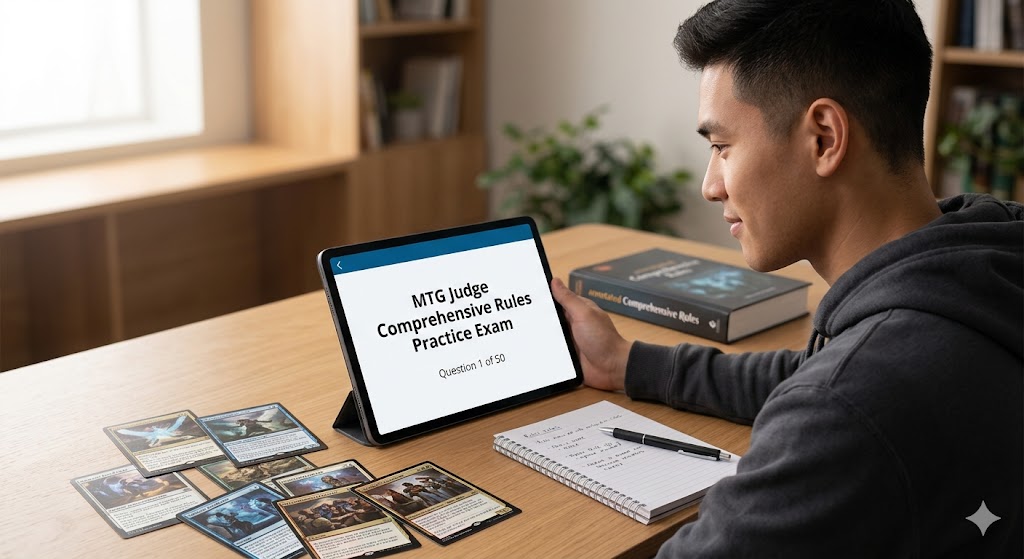
Additional Information
What the Course Entails and Exam Details
Preparing for the Comprehensive Rules (CR) exam requires
studying the rules document itself rather than a simplified course syllabus.
Candidates must master foundational and advanced game mechanics. The core
topics usually emphasized include: The standard Turn Structure (priority,
steps, and phases), State-Based Actions (SBAs), and the detailed process of
Casting Spells and Activating Abilities (handling dynamic costs, targeting, and
modes). A significant portion of the material delves into the infamous Continuous
Effects and the "Layers" system (how effects like power/toughness
changes, type changing, and color additions interact in the correct order).
Other essential areas covered include Keyword Mechanics (evergreen, static, and
triggered), Dynamic Rules Interactions (copy effects, replacement effects vs.
triggers, dependency loops, and modal double-faced cards), and complex
multiplayer rules interactions. Mastering the CR is not about memorization of
specific card texts; it's about understanding how the underlying game engine
operates in any given scenario.
What to Expect in
the Final Exam
The actual Judge Certification exams are high-stakes tests
designed to prove competency in dynamic environments. While format specifics
can change, the final exam (especially for L1 and L2 certification) is heavily
focused on theoretical rules knowledge. The primary format is scenario-based
Multiple-Choice Questions (MCQs). You will rarely be asked direct, simple
questions; instead, you will be given complex board states involving multiple
active and passive effects, and you must correctly determine the outcome of a
specific interaction. Passing score requirements are quite high, typically
ranging from 80% to 90?pending on the exact level or organization conducting
the test. Time limits usually range from 60 to 90 minutes. While this is a practice
test that might be unproctored and have relaxed constraints, we strongly
advise simulating actual exam conditions by setting a timer and avoiding the
use of external reference materials to truly evaluate your progress. Official
exams often require that you have no reference materials, unless they are
specific materials permitted by the test administrator (like the Comprehensive
Rules document itself in certain formats, though this is rare in MCQ exams).
How to Study and Exam Centers
Effective preparation for the MTG Judge CR exam demands an
active and structured study approach. Relying solely on playing the game will
not suffice. Start by reading the actual Comprehensive Rules document
(available on the Wizards of the Coast website), specifically focusing on the
glossary and the sections related to common rules sticking points (the 600s for
Spells, 100s for Turn Structure, and 700s for Keyword Mechanics). We highly
recommend studying the official "Annotated CR" when possible, as it
provides invaluable commentary and clarification on confusing passages.
Practical study methods are crucial: Create flashcards of common State-Based
Actions and the definition of different "Steps." Engage with the
online "Judge Apps" resources and rules forums where other judges
break down difficult scenarios. Take advantage of existing online practice
tools, such as the Judge Academy's candidate portal or dedicated MTG rules
practice websites that offer random question generators. Official Judge
Certification exams are typically administered online through specific portals,
such as the Judge Academy learning management system, which may sometimes use
specialized proctoring software. Some exams (especially L2/L3 or during large
MagicFests/Grand Prix events) may include a physical interview or practical
floor assessment, but the core theoretical exam is usually digital.
Job Opportunities
from the Course
Mastery of the MTG Comprehensive Rules is not a standalone
"job training course," but it is the prerequisite theoretical
knowledge for all specialized roles within the tournament and judging
infrastructure. It unlocks several career paths and advanced certifications
within the Magic community:
- Competitive
Event Judge (at tournaments from local levels up to Pro Tours and
MagicFests)
- Tournament
Organizer (or specialized roles, like Scorekeeper, at major events)
- Competitive
Player (enhancing dynamic strategic understanding)
- MTG
Arena Content Creator or Community Manager (where accurate rules knowledge
is vital)
- Professional
Rules Advisor
- Official
Tournament Manager or Event Staff for authorized LGS (Local Game Stores)
- Advanced
Judge Certifications (like Level 2 or Level 3 Judge)
Frequently Asked Questions
Reviews
5.0
Based on 0 reviews
Leave a Review
No reviews yet. Be the first to review!