
MuleSoft Developer Practice Exam
$69.00
- Buy to unlock unlimited access to all Quiz questions and Answers in this Quiz.
- After purchase you can print a PDF of the whole quiz at any point. The PDF will contain the questions and the correct answers.
About this Exam
The MuleSoft Developer exam validates your ability to successfully build, test, debug, and deploy complex Mule applications.
This certification is specifically designed for integration developers, software engineers, and IT professionals who want to demonstrate their expertise in the Anypoint Platform.
Achieving this highly respected credential proves to employers that you have the fundamental skills required to design and manage application networks using API-led connectivity.
Whether you are transitioning from another middleware technology or starting fresh in enterprise integration, this study guide will put you on the fast track to certification success.
Ready to test your knowledge?
Buy Now to Access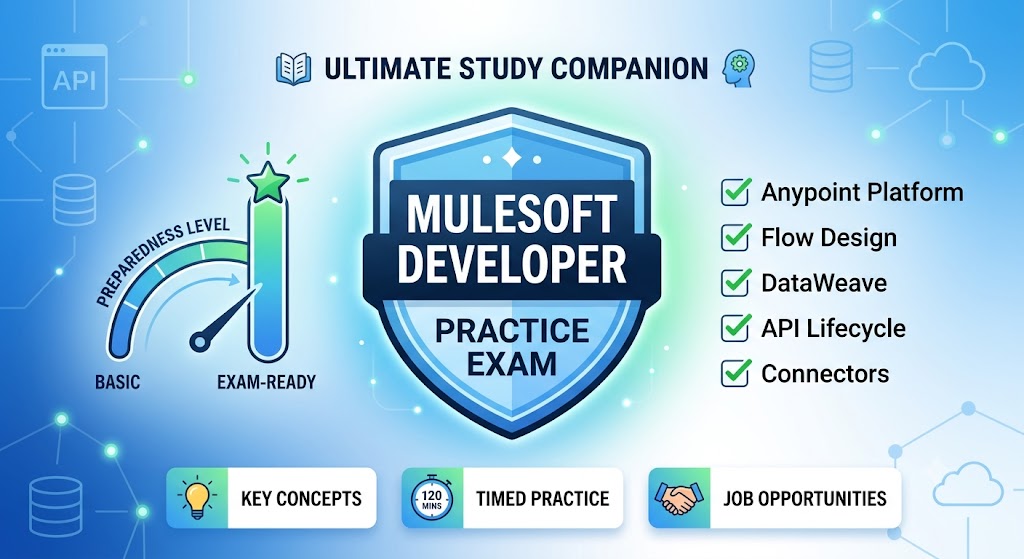
Additional Information
What the Course Entails and Exam Details
Preparing for this certification requires a deep
understanding of the MuleSoft ecosystem and the underlying Anypoint Platform
architecture.
The core syllabus covers building robust API-led
connectivity networks and deploying Mule applications seamlessly to CloudHub.
You will learn exactly how to design, build, and consume
REST APIs while effectively managing and transforming application data.
A significant portion of the course involves transforming
complex data structures using DataWeave, routing events, and managing intricate
error-handling scenarios.
Additionally, the training material emphasizes testing your
Mule applications using MUnit to ensure you can write scalable, robust, and
error-free code.
What to Expect in the Final Exam
The final assessment is a rigorous test of both your
conceptual knowledge and your practical problem-solving abilities.
You will face exactly 60 multiple-choice and multiple-select
questions that must be completed within a strict 120-minute time limit.
To successfully pass the exam and earn your official
certification, you must achieve a minimum passing score of 70 percent.
The exam features heavily scenario-based questions that
require you to carefully analyze Mule application configurations and identify
the correct outcomes or missing code elements.
Calculators and outside reference materials are strictly
prohibited, making thorough memorization of core concepts and foundational
DataWeave syntax absolutely essential.
How to Study and
Exam Centers
The most effective way to prepare is by combining
theoretical study with extensive, hands-on practice in Anypoint Studio.
Make sure to complete the official developer training
courses and utilize every MuleSoft Developer practice exam available to gauge
your readiness.
Setting up a free Anypoint Platform account and building
your own sample APIs from scratch will help solidify your understanding of
abstract concepts.
When you feel confident and ready to test, you can easily
schedule your exam through the official Webassessor portal.
Candidates have the excellent flexibility to take the exam
via a secure, online proctored environment from the comfort of their home, or
in person at any authorized physical testing center worldwide.
Job Opportunities
from the Course
Earning this certification unlocks numerous high-paying and
highly sought-after career paths in the rapidly expanding field of enterprise
integration.
Below is a breakdown of the prominent job opportunities you
can pursue after passing the exam:
- MuleSoft
Developer: Design, build, and implement complex integration solutions
and APIs using the Anypoint Platform.
- Integration
Engineer: Connect disparate enterprise systems and ensure seamless
data flow across an entire organization.
- API
Developer: Build, test, and lifecycle-manage secure APIs that drive
modern digital transformation initiatives.
- Salesforce
Integration Specialist: Specialize in bridging the technological gap
between core Salesforce products and external third-party applications.
- Solutions
Architect (Junior Level): Assist senior architects in designing
broader enterprise application networks and defining API-led connectivity
strategies.
Frequently Asked Questions
Reviews
5.0
Based on 0 reviews
Leave a Review
No reviews yet. Be the first to review!