
Multi Engine Commercial Checkride Practice Test
$69.00
- Buy to unlock unlimited access to all Quiz questions and Answers in this Quiz.
- After purchase you can print a PDF of the whole quiz at any point. The PDF will contain the questions and the correct answers.
About this Exam
Are you ready to elevate your pilot career to twin-engine operations?
The Multi Engine Commercial Checkride is the pivotal final step to unlocking a world of advanced aviation opportunities.
This comprehensive practical test is designed for already-certified commercial single-engine pilots or private pilots looking to add a multi-engine rating.
It validates your ability to safely and competently command multi-engine aircraft in various normal and emergency scenarios, especially during single-engine flight.
Ready to test your knowledge?
Buy Now to Access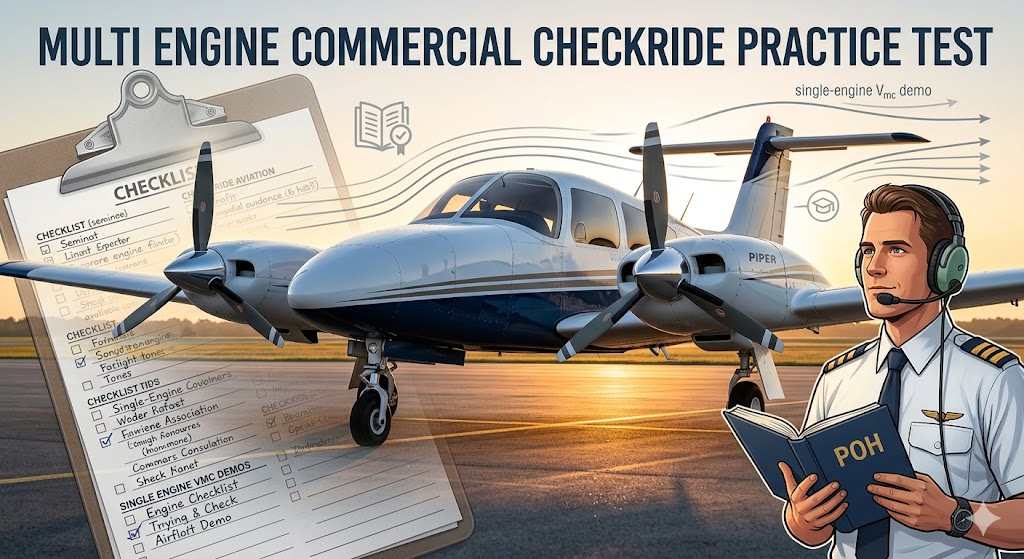
Additional Information
What the Course Entails and Exam Details
Preparation for this checkride covers a deep understanding
of complex multi-engine systems, critical aerodynamics, and high-performance
aircraft operations.
Your training and study syllabus will extensively detail
topics including advanced engine and propeller operations, fuel and electrical
systems, landing gear mechanisms, and sophisticated flight planning for
performance and weight and balance.
Crucially, you will master multi-engine aerodynamics,
focusing heavily on Minimum Controllable Airspeed (Vmc) and associated
performance lost during an engine failure.
Flight skills training covers precision takeoffs, climbs,
cruise, approaches, and landings, with an unyielding emphasis on simulated
engine failures during all critical phases of flight – a core element of the
final assessment.
What to Expect in the Final Exam
Unlike typical multiple-choice exams, the Multi Engine
Commercial Checkride is a comprehensive, multi-part practical evaluation with a
Designated Pilot Examiner (DPE).
You should expect a rigorous Oral Examination first, where
the DPE will probe your theoretical knowledge across all multi-engine topics
and the Airmen Certification Standards (ACS).
Satisfaction in the oral allows you to proceed to the
Practical Flight Test, where you will demonstrate your proficiency in a
suitable multi-engine airplane.
Evaluation is based entirely on the tolerances specified
within the current ACS; there is no numerical passing score, but you must
satisfy the examiner's standards for every required task, showing safe
procedures and sound decision-making throughout the several-hour process, which
typically includes about 1.5-3 hours for the oral and 1-2 hours for the flight
portion.
How to Study and Exam Centers
Successful checkride performance demands diligent study of
key FAA publications like the Airplane Flying Handbook and Multi-Engine Pilot
ACS, alongside thorough review of your specific aircraft's Pilot’s Operating
Handbook (POH).
Structure your study around extensive practice, utilizing
sample oral questions and scenarios – essentially a personalized practice test
– to identify knowledge gaps.
Complement this with frequent simulated scenarios, mock
orals with instructors or peers, and consistent practice flights focusing
intensely on critical procedures and single-engine operations to build muscle
memory and confidence.
You cannot take this 'exam' in a standard testing center;
instead, you must schedule and complete the real checkride with an authorized
Designated Pilot Examiner (DPE) at a suitable airport, typically arranged
through your flight school.
For initial training and endless practice, you will work
closely with qualified instructors
at established flight schools equipped with proper
multi-engine aircraft and simulators.
Job Opportunities from the Course
Obtaining a Multi Engine Commercial Certification opens the
door to a wide array of rewarding and diverse aviation career paths.
Unlocking these opportunities often leads pilots to becoming
Regional Airline Pilots, commanding sophisticated twin-turboprop or jet
aircraft.
Many certificated pilots find fulfilling careers as:
Charter Pilots, flying passengers and cargo in various
business jets or multi-engine turboprops.
Cargo Pilots for major logistics companies or independent
operators.
Flight Instructors (MEI) focusing specifically on teaching
multi-engine students.
Aerial Survey Pilots utilizing twin-engine platforms for
mapping and inspection.
Air Ambulance Pilots, providing critical medical transport
in high-performance twins.
Corporate or Business Aviation Pilots, operating privately
owned or fractionally shared multi-engine aircraft.
Frequently Asked Questions
Reviews
5.0
Based on 0 reviews
Leave a Review
No reviews yet. Be the first to review!