
Multicultural Law Enforcement Practice Exam
$69.00
- Buy to unlock unlimited access to all Quiz questions and Answers in this Quiz.
- After purchase you can print a PDF of the whole quiz at any point. The PDF will contain the questions and the correct answers.
About this Exam
The Multicultural Law Enforcement certification and its accompanying curriculum are designed to prepare modern public safety professionals for the complexities of policing in an increasingly diverse society.
This program focuses heavily on equipping personnel with the cultural competence necessary to navigate interactions with citizens from various ethnic, racial, religious, and socioeconomic backgrounds.
It is specifically tailored for police academy recruits, active-duty law enforcement officers looking to advance their careers, criminal justice students, and federal agents.
Ultimately, the goal of this training is to build stronger community trust, reduce instances of bias, and ensure that justice is administered fairly and safely across all cultural lines.
Ready to test your knowledge?
Buy Now to Access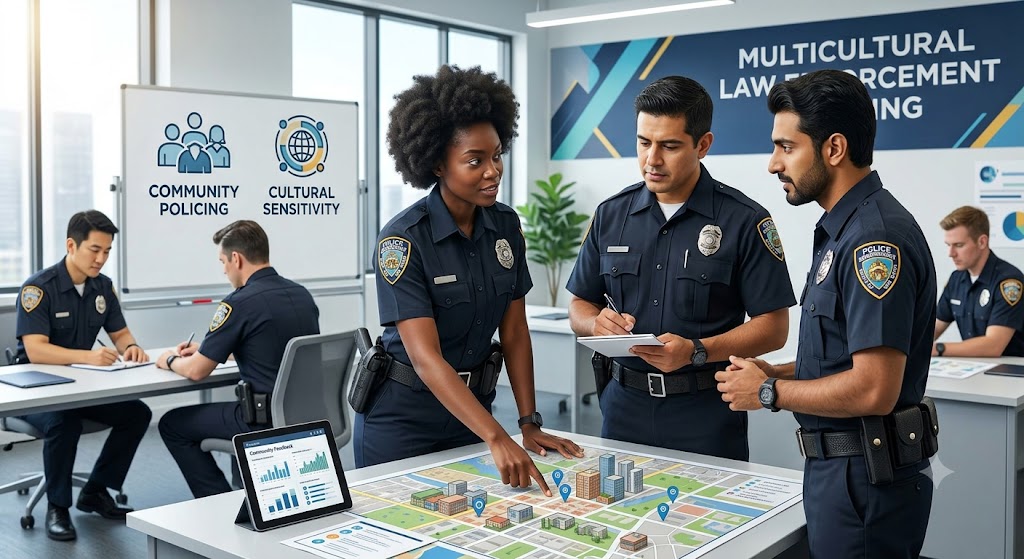
Additional Information
What the Course
Entails and Exam Details
The syllabus for a Multicultural Law Enforcement course is
broad, focusing on both sociological concepts and practical, on-the-ground
policing strategies.
Core topics typically include cross-cultural communication
techniques, understanding and overcoming implicit bias, and the identification
and investigation of hate crimes.
Students will also explore the historical relationships
between law enforcement and specific minority groups to better understand
current community dynamics.
Furthermore, the course delves into the legal and ethical
aspects of racial profiling, de-escalation tactics tailored for cultural
barriers, and strategies for effective community policing in multicultural
neighborhoods.
The accompanying exam tests a candidate's ability to apply
these theoretical concepts to real-world law enforcement scenarios.
What to Expect in
the Final Exam
When taking the final exam, candidates should expect a
comprehensive test that relies heavily on both multiple-choice questions and
scenario-based assessments.
The scenario-based questions are particularly important, as
they require test-takers to read a simulated police encounter and choose the
most culturally sensitive and legally sound course of action.
Passing score requirements vary by institution and state
academy, but candidates are generally required to achieve a minimum score of
70% to 80% to demonstrate proficiency.
Time limits are strictly enforced, with most exams allowing
between 90 and 120 minutes for completion.
Standard testing rules apply, meaning the exam is typically
closed-book, strictly proctored, and prohibits the use of any mobile phones or
unauthorized electronic devices.
How to Study and Exam Centers
To succeed on this exam, active and scenario-based study
strategies are highly recommended.
Candidates should take multiple practice exams to
familiarize themselves with the phrasing of the questions and the pacing of the
test.
Reviewing case studies of real-world police encounters,
participating in study groups to discuss different cultural perspectives, and
thoroughly reading course materials—such as the widely used "Multicultural
Law Enforcement" textbooks—are essential steps for preparation.
As for exam centers, testing locations depend on the
administrative body offering the course.
If taken as part of a college degree, exams are usually held
at university testing centers or online via secure, proctored portals like
Canvas or Blackboard.
For active officers and recruits, exams are frequently
administered on-site at state or regional police academies, or through
authorized third-party testing facilities like Pearson VUE.
Job Opportunities
from the Course
Earning a certification or completing coursework in
Multicultural Law Enforcement unlocks a variety of impactful career paths in
public safety and community relations.
Police Officer / Deputy Sheriff: This is the most direct
path, where officers use cultural competence daily while patrolling diverse
neighborhoods.
Community Liaison Officer: A specialized role focused
entirely on bridging the gap between police departments and specific cultural
or ethnic groups within the community.
Federal Law Enforcement Agent: Agencies like the FBI, DEA,
and Homeland Security highly value candidates with multicultural training for
domestic and international assignments.
Diversity and Inclusion Officer: Many large metropolitan
police departments hire specialists to oversee internal diversity training and
ensure equitable hiring practices.
Criminal Investigator / Detective: Investigators benefit
from this training when interviewing witnesses, victims, and suspects from
varying cultural backgrounds, ensuring better cooperation and case outcomes.
Frequently Asked Questions
Reviews
5.0
Based on 0 reviews
Leave a Review
No reviews yet. Be the first to review!