
Munitions Firefighting Practice Exam
$69.00
- Buy to unlock unlimited access to all Quiz questions and Answers in this Quiz.
- After purchase you can print a PDF of the whole quiz at any point. The PDF will contain the questions and the correct answers.
About this Exam
The Munitions Firefighting certification is a highly specialized credential designed to train first responders on the extreme hazards of fires involving explosives, ammunition, and military ordnance.
This rigorous course is primarily designed for military firefighters, Department of Defense (DoD) contractors, and civilian fire professionals who operate on joint-use bases or near explosive storage facilities.
It equips dedicated individuals with the specialized knowledge needed to make split-second, life-saving decisions when dealing with volatile and unpredictable materials.
Ready to test your knowledge?
Buy Now to Access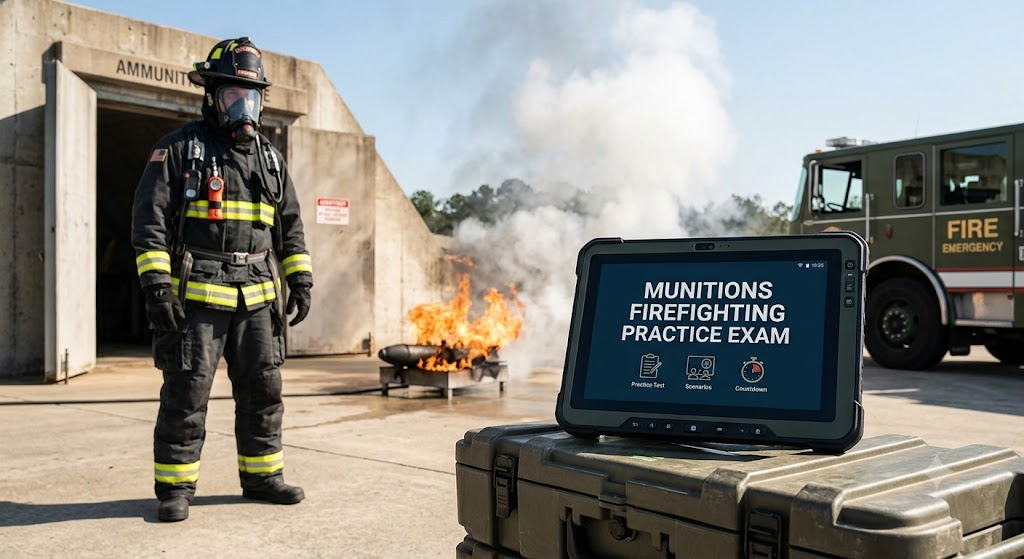
Additional Information
What the Course
Entails and Exam Details
The syllabus for munitions firefighting covers an intense
range of critical emergency response skills and theoretical knowledge.
Students will dive deeply into understanding explosive
hazard classes, division codes, and compatibility groups.
The core topics include calculating proper evacuation
distances, establishing safety perimeters, and identifying the correct
extinguishing agents to use—or knowing when to let a fire burn to prevent a
catastrophic detonation.
Additionally, the curriculum covers understanding facility
markings, handling unexploded ordnance (UXO) scenarios, and coordinating
emergency response plans with specialized bomb squads and base commanders.
What to Expect in
the Final Exam
The final exam is designed to thoroughly test both your
theoretical knowledge and your ability to apply it under pressure.
Typically, candidates can expect a comprehensive
multiple-choice test consisting of 50 to 100 questions, depending on the
specific certifying body (such as IFSAC or Pro Board).
You will likely be given a time limit of around two hours to
complete the written portion.
A standard passing score is usually set at 70% or higher,
reflecting the zero-margin-for-error nature of the job.
In addition to the written test, candidates must often pass
a practical evaluation where they must demonstrate situational awareness,
properly identify hazard symbols, and simulate setting up incident command
perimeters under strict safety rules.
How to Study and
Exam Centers
Success in the munitions firefighting exam requires a
strategic and disciplined approach to studying.
Start by thoroughly reviewing DoD fire protection manuals
and relevant National Fire Protection Association (NFPA) standards,
specifically focusing on NFPA 400 and guidelines for explosive materials.
Utilize flashcards to memorize hazard symbols, evacuation
tables, and compatibility groups, as these require instant recall.
Taking multiple practice exams is highly encouraged to
familiarize yourself with the phrasing of the questions and to build your
time-management skills.
When it comes time to take the test, exams are typically
administered at authorized military base testing centers, DoD fire academies,
or specialized civilian training facilities that hold Pro Board or IFSAC
accreditation.
Some theoretical portions may be available via secure online
portals like Pearson VUE, though practical assessments must always be done in
person at a certified training ground.
Job Opportunities
from the Course
Successfully passing this exam and obtaining your
certification opens the door to incredibly rewarding and specialized career
paths.
Military Firefighter
Department of Defense (DoD) Fire Protection Specialist
Airport Firefighter (specifically at Joint-Use or Military
Airfields)
Industrial Firefighter (for munitions and aerospace
manufacturers)
Unexploded Ordnance (UXO) Safety Officer
Federal Emergency Management Agency (FEMA) Hazard Specialist
Private Defense Contractor Firefighter
Frequently Asked Questions
Reviews
5.0
Based on 0 reviews
Leave a Review
No reviews yet. Be the first to review!