
Muscles, Movements, and Occlusion in Dentistry Practice Test
$69.00
- Buy to unlock unlimited access to all Quiz questions and Answers in this Quiz.
- After purchase you can print a PDF of the whole quiz at any point. The PDF will contain the questions and the correct answers.
About this Exam
The Muscles, Movements, and Occlusion certification is a critical milestone for dental and oral health professionals.
This assessment is meticulously designed for dental students, hygienists, orthodontic assistants, and practicing clinicians looking to solidify their understanding of the stomatognathic system.
It evaluates your mastery of the complex interactions between the masticatory muscles, the temporomandibular joint (TMJ), and the alignment of the teeth.
Passing this exam proves your foundational knowledge in preventing, diagnosing, and treating bite abnormalities and functional jaw disorders.
Ultimately, this credential highlights your commitment to providing top-tier, biomechanically sound dental care.
Ready to test your knowledge?
Buy Now to Access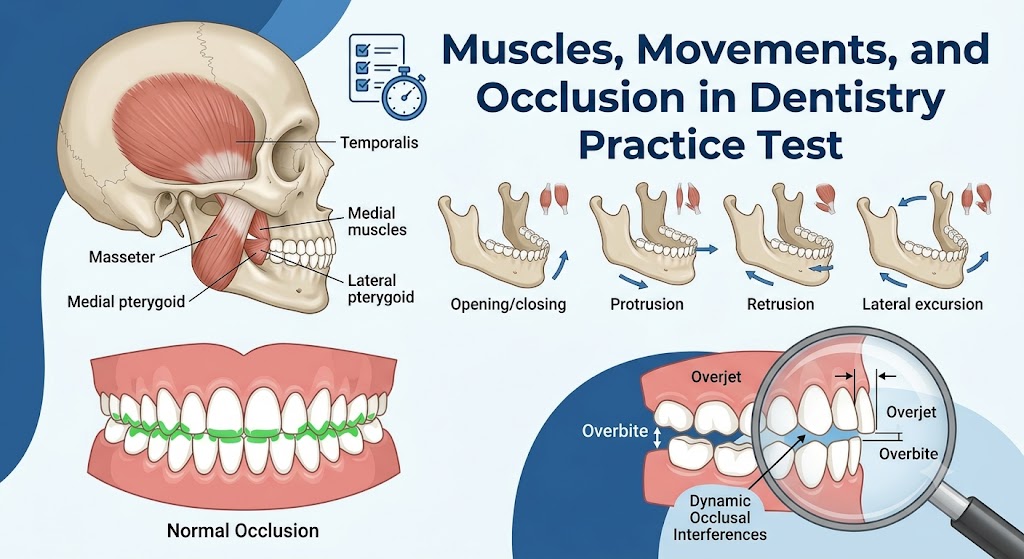
Additional Information
What the Course Entails and Exam Details
This comprehensive course delves deep into the anatomy and
physiology of the human skull, jaw, and neck.
Students will thoroughly explore the muscles of mastication,
including the masseter, temporalis, and both the medial and lateral pterygoids.
The syllabus covers the precise kinematics of jaw movements,
detailing protrusion, retrusion, elevation, depression, and lateral excursions.
A major focus is placed on dental occlusion, teaching
students to identify Class I, II, and III malocclusions, as well as the
principles of anterior guidance and canine protection.
Additionally, the curriculum touches upon the neuromuscular
control of chewing and swallowing.
The exam details focus on theoretical knowledge combined
with clinical applications, ensuring you can translate anatomical concepts into
real-world patient scenarios.
What to Expect in the Final Exam
The final assessment is rigorously structured to test both
your rote memorization and your clinical reasoning skills.
You can expect a format consisting primarily of
multiple-choice questions, alongside diagram-labeling tasks where you must
identify specific muscles, joints, and occlusal contact points.
Typically, the exam contains between 75 and 100 questions, with
a strict time limit of 90 to 120 minutes.
To achieve certification, candidates are generally required
to secure a passing score of 70% or higher.
The testing environment is highly regulated, meaning no
external study materials, mobile devices, or unapproved reference guides are
permitted during the session.
How to Study and
Exam Centers
Mastering this highly anatomical subject requires a blend of
visual learning and active recall.
Begin by utilizing 3D anatomical models or specialized
dental software to visualize the spatial relationships of the TMJ and
masticatory muscles.
Flashcards are incredibly effective for memorizing muscle
origins, insertions, innervations, and actions.
Take full advantage of full-length practice exams to
acclimate yourself to the pacing and phrasing of the actual test questions.
When it comes time to sit for the exam, testing is highly
accessible.
Candidates can usually schedule their exam through
recognized physical testing centers like Pearson VUE or Prometric.
Alternatively, many authorized dental schools and
credentialing bodies now offer secure, online-proctored portals, allowing you
to take the exam from the comfort of your home under live supervision.
Job Opportunities
from the Course
Earning a passing grade on this exam opens doors to a
variety of specialized and rewarding roles within the dental industry.
As a Clinical Dental Assistant, this knowledge allows you to
better assist dentists during complex restorative or prosthodontic procedures.
Dental Hygienists utilize these skills daily to screen
patients for TMJ disorders, bruxism, and abnormal wear facets during routine
cleanings.
Orthodontic Assistants rely heavily on an understanding of
occlusion to help fit appliances and monitor the shifting of teeth into proper
alignment.
Prosthodontic Technicians use the principles of jaw movement
and bite alignment to fabricate highly accurate crowns, bridges, and dentures
in a dental laboratory.
Finally, experienced professionals can leverage this
expertise to become Dental Educators or Clinical Instructors, guiding the next
generation of oral healthcare providers.
Frequently Asked Questions
Reviews
5.0
Based on 0 reviews
Leave a Review
No reviews yet. Be the first to review!