
Music Appreciation Practice Test
$69.00
- Buy to unlock unlimited access to all Quiz questions and Answers in this Quiz.
- After purchase you can print a PDF of the whole quiz at any point. The PDF will contain the questions and the correct answers.
About this Exam
A comprehensive Music Appreciation Practice Test is designed for anyone eager to explore, understand, and evaluate the vast world of music. This practice exam, and the underlying subject itself, isn't just for aspiring musicians. It’s for enthusiasts, students, and curious minds from all walks of life. The core purpose is to test your understanding of fundamental musical elements, historical context, key composers, and various genres, from the earliest classical works to modern sounds. By engaging with this test, you'll develop deeper critical listening skills and cultural awareness, all while confirming your readiness for introductory-level college courses, self-directed learning milestones, or potentially gaining credit through specific credit-by-exam programs. This guide and practice material will empower you to confidently navigate and appreciate the artistry and impact of music throughout history.
Ready to test your knowledge?
Buy Now to Access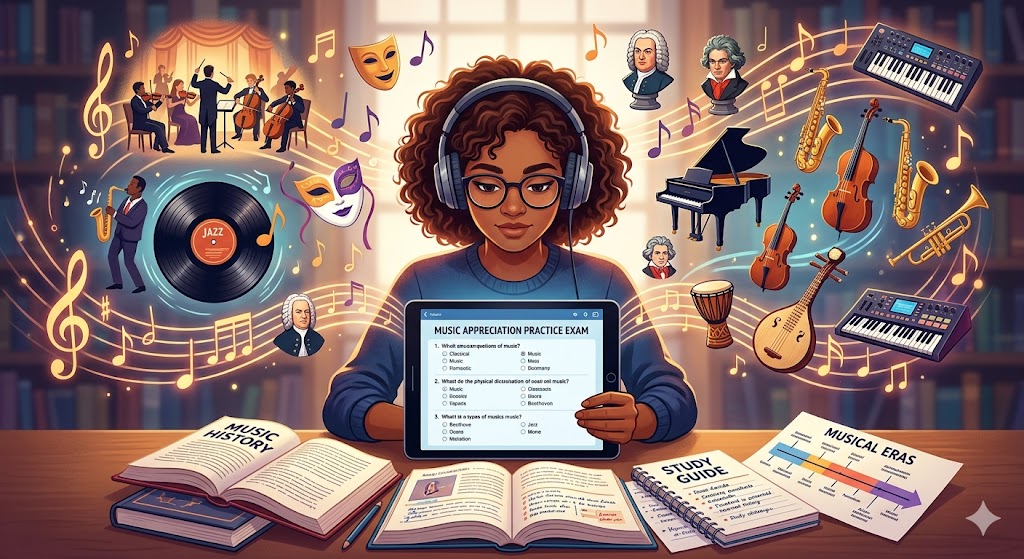
Additional Information
What the Course Entails and Exam Details
A foundational understanding of music appreciation, as
covered in this practice exam and the studies it simulates, typically includes
a detailed exploration of several key areas. Firstly, you can expect extensive
coverage of the core Elements of Music: melody, rhythm, harmony,
texture, timbre, and form. This involves recognizing and defining concepts like
major and minor scales, different meters, various dynamics, and how musical
sections are structured.
Secondly, the course and exam will journey through Music
History Chronologically: covering the characteristics, major developments,
and key figures of distinct periods. These typically include the Medieval and
Renaissance eras (gregorian chant, polyphony), the Baroque period (Bach,
Handel, Vivaldi), the Classical era (Mozart, Beethoven, Haydn), the Romantic
age (Schopin, Liszt, Verdi), and the 20th/21st Centuries (modernism, jazz,
blues, popular music, global traditions). Within each era, you’ll focus on
significant Composers and Their Major Works: associating pieces like
Beethoven’s Symphony No. 5, Mozart’s Operas, or Stravinsky’s The Rite of
Spring with their creators and historical significance.
Furthermore, you will be expected to demonstrate
understanding of Instrument Families: identifying the four main
orchestral groups (strings, woodwinds, brass, percussion) and their
characteristic sounds, as well as common keyboards and electronic instruments.
Recognizing different Vocal Ranges and Ensembles (soprano, alto, tenor,
bass, choir, orchestra, chamber groups, jazz big bands) is also fundamental.
Finally, a significant portion likely emphasizes Critical Listening and
Analysis: where you must apply your knowledge to identify styles, periods,
and elements within actual musical selections provided as listening examples.
This practice test mirrors these comprehensive educational standards to truly
challenge and refine your music appreciation skills.
What to Expect in
the Final Exam
While the exact structure can vary significantly depending
on the institution or specific exam (such as the CLEP Humanities exam which
includes a music appreciation component), a comprehensive music appreciation
exam generally follows certain formats and includes critical sections.
Typical Exam Formats: You can almost always expect a
large portion of multiple-choice questions. These questions will test
factual knowledge of terminology, composer details, historical dates and
characteristics, and conceptual understanding. A listening section is
nearly guaranteed and arguably the most crucial part. For this, you will listen
to audio clips and be asked to identify the composer, work, era, dynamic
change, or specific musical elements (e.g., texture, form, instrument family).
These require attentive, active listening skills. Some exams, especially in a
formal classroom setting, might also include true/false questions, matching
sections (composers to works, terms to definitions), or even short
answer or essay questions. Essays may require analyzing a piece's
historical context or comparing two composers or works.
Key Exam Details to Consider: The Passing Score
for a comprehensive exam is entirely dependent on the specific body
administering it. College courses often require a score of 60-70% for a passing
grade (e.g., C or D), while credit-by-exam programs like CLEP usually require
achieving a score equivalent to earning a 'C' in the respective college course.
Always check the official requirements for the specific test you intend to
take. Similarly, Time Limits can differ. For instance, the CLEP
Humanities exam, which includes a music section, has a 90-minute limit for
approximately 140 questions. College final exams are typically 1.5 to 3 hours
long. Your practice should focus on both accuracy and efficiency under
realistic time pressure. Specific Rules and Restrictions must be
strictly followed. Real exams are proctored, meaning they are supervised. This
can occur in person at a designated testing center or online with virtual
proctoring software. During the test, you will generally not be allowed access
to textbooks, notes, phones, or any other aids, and you must maintain a quiet
environment. Check the detailed rules for your specific exam location and
format well in advance.
Practicing with our comprehensive test, and under timed
conditions, will prepare you for these standard expectations, reducing anxiety
and increasing your chances of success in any formal music appreciation
assessment.
How to Study and
Exam Centers
Successfully preparing for a comprehensive music
appreciation exam requires a multi-faceted approach, balancing active
listening, memorization, and practical test-taking.
Study Strategies:
- Active
and Deep Listening: Make this a core study method. Listen to key works
with intention, ideally wearing good headphones. Can you identify the
meter? The predominant texture? Does the melody move smoothly or in leaps?
Notice the dynamics and instrumentation. Refer to listening guides and
scores if possible.
- Structured
Note-Taking and Timelines: Create a detailed timeline of music
history. Include key dates for each era, major composers, their pivotal
works, and significant historical events or artistic movements that
influenced the music. Take specific notes on musical characteristics of
each period.
- Comprehensive
Terminology and Concept Mastery: Create and use flashcards for all
musical terms, definitions, composer names, key works, dates, and
instrument details. Quiz yourself regularly on both the term-to-definition
and definition-to-term relationships.
- Diverse
Resource Utilization: Don't rely on just one source. Utilize textbook
chapters, online resources (reputable music history sites, composer
databases), video documentaries, curated playlists (Spotify, YouTube), and
reputable lecture notes. Compare and cross-reference information.
- Regular
Practice Tests: Use comprehensive practice tests like this one! Time
yourself, answer every question honestly, and critically review all
answers afterwards. Focus heavily on understanding why an answer is
correct or incorrect. Identify weak areas and dedicate more study time to
them.
- Engage
with Live Performance: Attend concerts or watch high-quality
recordings of orchestral, opera, jazz, and chamber music performances.
Seeing and hearing instruments in their real context enhances
understanding immensely.
- Form
or Join a Study Group: Discussing concepts, analyzing pieces, and
quizzing each other with peers can provide new insights, keep you
motivated, and reinforce your knowledge through teaching.
Exam Center Information for Formal Tests: If you are
taking a music appreciation exam for academic credit or official certification
(such as CLEP or DSST), you will likely take it in a formal setting.
- College/University
Exams: If the exam is part of a specific college course you are
enrolled in, it will be administered at that institution, typically in a
classroom or designated testing hall. Check your course syllabus or
contact your professor for details.
- Credit-by-Exam
(CLEP): For programs like the College-Level Examination Program
(CLEP), which often includes a music appreciation component, official
exams are taken at authorized testing centers. These can be located on
college campuses, military bases, or designated public test centers
managed by organizations like Pearson VUE. The College Board, which
administers CLEP, provides a test center locator on its website.
- Online
and Non-Credit Exams: Many reputable online educational platforms
(like Coursera, edX, or various music schools) offer music appreciation
courses that culminate in a final exam or assessment. These tests are
typically completed online within the platform itself. Some may involve
online proctoring, while others might be untimed or open-book, depending
on the program's specific setup and purpose.
No matter the formal format, early thorough study and
consistent practice with quality resources, including this detailed practice
exam, are the surest paths to success.
Job Opportunities
from the Course
While a single introductory course or practice test isn’t
typically a direct vocational qualification, a solid foundation in music
appreciation opens doors to numerous diverse career paths, often when combined
with further education and experience. The critical thinking, historical
understanding, and deep listening skills you develop are highly valuable in
many fields.
Music Educator: With a
full degree and proper certification, you can become an elementary or high
school music teacher, where introducing students to the joy and history of
music is a central role.
Arts Administrator: Arts
organizations, orchestras, opera houses, and music festivals require
administrators with a strong cultural understanding. This role involves
fundraising, programming, marketing, and managing day-to-day operations.
Musicologist/Music Historian:
For those truly passionate about research, pursuing advanced degrees can lead
to careers in academia or research institutions, delving deeply into music’s
historical and cultural significance.
Music Critic or Journalist:
Cultivate your analytical and writing skills to review concerts, albums, and
artists for newspapers, magazines, or music blogs, shaping public discourse on
art.
Music Librarian or Archivist:
With training in library science, you can work in academic or public libraries,
managing and preserving vast collections of musical scores, recordings, and
historical documents.
Radio or Podcast
Broadcaster/Producer: Knowledge of diverse musical styles and history is
essential for hosting or producing classical, jazz, or arts-focused radio
programs and podcasts.
Music Promoter or Event
Manager: Work to organize concerts, tours, and festivals, leveraging your
understanding of the music scene and artist landscape.
Vocal Coach or Private Tutor:
Deep knowledge of diverse vocal styles, repertoire, and music fundamentals
supports careers in guiding singers and other musicians.
Instrument Sales and
Appraising: An appreciative understanding of instruments, their history,
and their value enhances customer service and valuation roles in the music
retail and auction world.
Community Arts Coordinator:
Organize local music programs, workshops, and performances, fostering
engagement with the arts within your community.
Frequently Asked Questions
Reviews
5.0
Based on 0 reviews
Leave a Review
No reviews yet. Be the first to review!