
NACC Early Childhood Education Practice Exam
$69.00
- Buy to unlock unlimited access to all Quiz questions and Answers in this Quiz.
- After purchase you can print a PDF of the whole quiz at any point. The PDF will contain the questions and the correct answers.
About this Exam
The National Association of Career Colleges (NACC) Early Childhood Education (ECE) certification is a prestigious credential designed for individuals passionate about shaping the minds of young learners.
It acts as a standardized benchmark to ensure that graduating students have met the rigorous national requirements necessary to provide high-quality care and education.
This program is specifically tailored for aspiring educators, child care workers, and preschool staff who want to make a lasting, positive impact on infants, toddlers, and school-aged children.
By passing this exam, candidates prove they possess the professional competency and emotional intelligence required to thrive in a demanding yet highly rewarding early years educational environment.
Ready to test your knowledge?
Buy Now to Access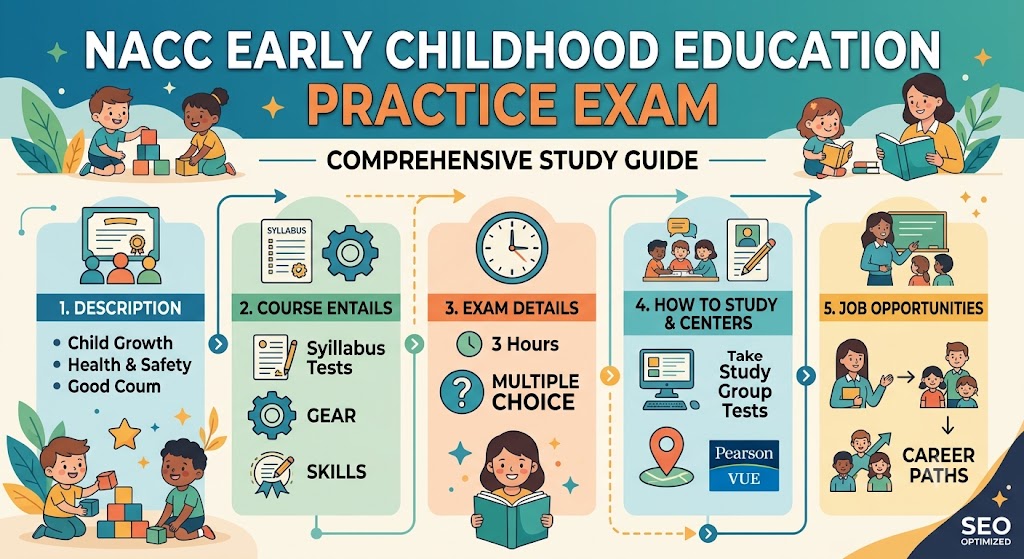
Additional Information
What the Course
Entails and Exam Details
The NACC ECE curriculum is highly comprehensive and deeply
rooted in modern pedagogical research.
Students will thoroughly explore the foundational principles
of child development, covering the cognitive, physical, emotional, and social
milestones of young children.
The syllabus heavily emphasizes health, safety, and
nutrition, ensuring that educators can maintain secure environments and manage
dietary or medical needs.
Additionally, the course covers curriculum planning and
play-based learning, teaching candidates how to design engaging activities that
stimulate curiosity and growth.
Another core element is guidance and behavior management,
which equips future educators with positive reinforcement strategies to handle
challenging behaviors constructively.
Finally, interpersonal communication forms a large part of
the syllabus, preparing students to build strong, collaborative relationships
with parents, colleagues, and the broader community.
What to Expect in the Final Exam
The NACC Early Childhood Education final exam is a rigorous,
cumulative assessment of your theoretical knowledge and practical
understanding.
It is primarily delivered in a multiple-choice format,
requiring you to select the most appropriate pedagogical action or
developmental theory from given scenarios.
Students are typically given a strict time limit, often
ranging between two to three hours, which requires excellent time management
and pacing.
To achieve certification, candidates must meet a minimum
passing score, which generally sits at 70% to 75%, depending on specific
college protocols and provincial standards.
The test is conducted under closed-book conditions, meaning
no outside notes, textbooks, or digital devices are permitted in the testing
area.
Expect questions to be heavily scenario-based, testing your
ability to apply textbook concepts to real-world classroom situations.
How to Study and Exam Centers
Success on the NACC ECE exam requires a blend of consistent
review and active recall strategies.
Begin by breaking down your syllabus into manageable weekly
sections, creating flashcards for key developmental milestones and pedagogical
vocabulary.
Taking full-length practice exams is incredibly important,
as this builds your stamina and familiarizes you with the phrasing of
multiple-choice questions.
Forming study groups with your peers can also be highly
beneficial for discussing complex behavioral scenarios and testing each other's
knowledge aloud.
When it comes time to take the test, exams are traditionally
administered through your authorized NACC-member career college.
Depending on your institution's specific arrangements, you
will either sit for the exam in a physical, proctored testing center on campus
or through a secure, live-proctored online testing portal.
Always confirm your specific testing location, technical
requirements, and scheduling deadlines with your program coordinator well in
advance.
Job Opportunities from the Course
Earning your NACC ECE certification opens the door to a wide
variety of fulfilling career paths in the childcare and education sectors.
You can step into a role as an Early Childhood Educator,
leading daily activities and curriculum implementation in a daycare or nursery
setting.
It also qualifies you to work as a Preschool Teacher,
preparing young children for their transition into the primary school system.
For those interested in leadership, this credential provides
the foundation to become a Daycare Supervisor or Childcare Center Director,
overseeing staff and facility operations.
You may also pursue positions as a Before and After School
Program Coordinator, designing enriching activities for older children outside
of standard school hours.
Additionally, graduates often find rewarding work as Special
Needs Support Assistants within integrated classroom environments, or as
Private Nannies providing dedicated, professional in-home care
Frequently Asked Questions
Reviews
5.0
Based on 0 reviews
Leave a Review
No reviews yet. Be the first to review!