
NAFC Group Fitness Certification Exam
$69.00
- Buy to unlock unlimited access to all Quiz questions and Answers in this Quiz.
- After purchase you can print a PDF of the whole quiz at any point. The PDF will contain the questions and the correct answers.
About this Exam
The National Association for Fitness Certification (NAFC) Group Fitness Certification is a premier credential designed for aspiring fitness professionals who want to lead dynamic, safe, and motivating group exercise classes.
This certification validates your understanding of exercise science, class design, leadership techniques, and your ability to coach diverse populations effectively. It is specifically created for individuals who are passionate about group dynamics and want to transition from a participant to a certified instructor, guiding others through formats like high-intensity interval training (HIIT), strength training, dance, step, and cardiokickboxing.
Earning this certification demonstrates your dedication to professional standards, legal liability awareness, and scientific methodology in group training.
Ready to test your knowledge?
Buy Now to Access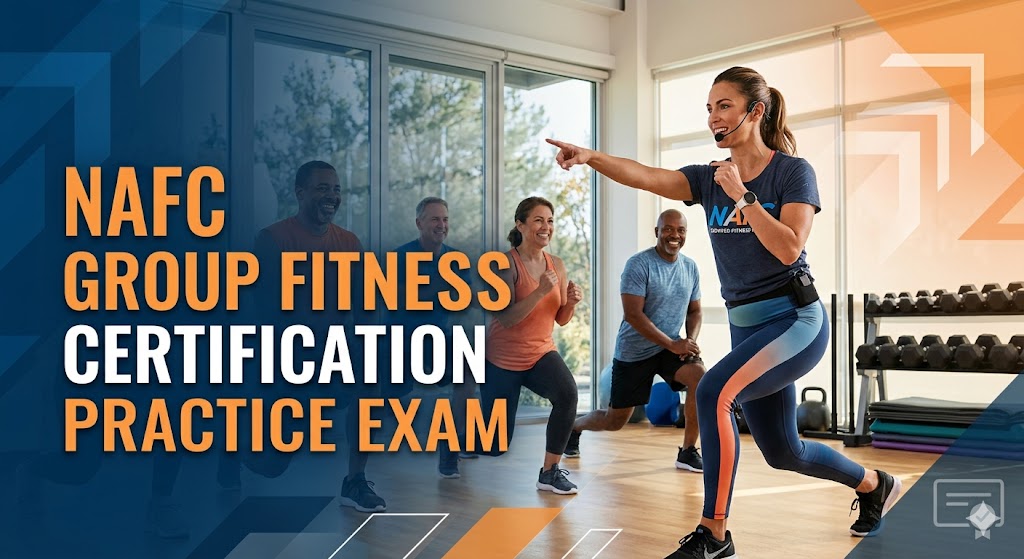
Additional Information
What the Course
Entails and Exam Details
The NAFC course material is a rigorous exploration of
everything a group instructor must know before stepping onto the stage. The
syllabus covers five primary domains of knowledge, which the exam will
evaluate.
Domain 1: Foundations of Exercise Science.
Candidates must master the basics of human anatomy,
physiology, and biomechanics. This includes understanding the skeletal and
muscular systems, energy systems, and how the body responds to acute and
chronic exercise stress.
Domain 2: Nutrition and Wellness.
This section covers essential nutrition concepts, basic
hydration strategies, and how to discuss dietary guidelines with clients within
the appropriate scope of practice for a fitness instructor.
Domain 3: Program Design and Choreography.
Instructors are tested on their ability to create balanced
class formats. You must understand music tempo (BPM), how to structure a
warmup, the training logic of the main workout (e.g., anaerobic vs. aerobic,
strength vs. cardio), and essential cooldown strategies.
Domain 4: Class Leadership and Instruction.
This domain is critical for real-world application. It
focuses on communication skills, cueing techniques (verbal, visual, and
directional), effective motivating strategies, and managing group dynamics for
large numbers of participants.
Domain 5: Safety, Legal, and Risk Management.
Safety is paramount in any fitness environment. This section
focuses on injury prevention, understanding legal liability, maintaining
certifications (such as CPR/AED), environmental safety checks, and professional
ethical guidelines.
What to Expect in the Final Exam
The NAFC Group Fitness Certification Final Exam is a
comprehensive assessment that must be approached with preparation and strategy.
Exam Format: The exam is delivered primarily as a
closed-book, theoretical test. It consists of multiple-choice questions
designed to assess your ability to recall information and, more importantly,
apply those concepts to common group fitness scenarios.
Passing Score Requirements: Candidates must achieve a
specific minimum percentage to pass. Standard academic standards usually
require a score of 70% or 75% or higher, depending on the current iteration of
the exam, though candidates should always confirm the exact requirement upon
registration.
Time Limit: You will be given a set time allocation
to complete the entire exam. Students must maintain a steady pace, as there are
no breaks allowed during the timed session.
Specific Rules and Prerequisites: It is crucial to
note that while you can sit for the exam, your final certification is usually
not issued until you provide a current, valid certification for Adult CPR/AED
and sometimes First Aid. This is a non-negotiable requirement for professional
safety.
How to Study and
Exam Centers
Effective preparation is the difference between anxiety and
success on exam day.
Utilize Official Materials: Your primary study
resource should be the official NAFC Group Fitness course text or learning
management system (LMS). Read it thoroughly, and then go back and outline key
concepts, vocabulary, and physiological principles.
Leverage Practice Exams: This is your most valuable
study tool. Practice exams (like the title of this guide) allow you to
experience the specific question phrasing, difficulty level, and timing of the
real NAFC test. Use these to identify your knowledge gaps.
Practice Practical Application: Do not just study the
theory; practice being an instructor. Plan a sample class from warmup to
cooldown. Practice cueing exercise modifications for specific scenarios (e.g.,
a movement modification for a beginner versus an advanced participant).
How and Where to Take the Exam: The NAFC has
modernized its testing, and the primary method is now online proctoring.
Candidates can register for the exam via their NAFC student portal and schedule
their test.
You can take the exam from the comfort of your own home
using a computer equipped with a webcam and microphone. A remote proctor will
verify your identity and monitor the testing environment to ensure academic
integrity throughout the session. Physical testing centers are rarely used now
in favor of secure online delivery.
Job Opportunities from the Course
Earning your NAFC credential unlocks an array of
professional pathways within the dynamic health and fitness industry. This
certification proves to employers that you have the knowledge and safety
standards required to lead.
Below is a list of specific job titles and career paths this
certification enables:
- Group
Fitness Instructor (Formats: HIIT, Cardio, Step, Boot Camp, Kickboxing)
- Strength
and Conditioning Group Lead
- Aquatic
Exercise Instructor (Additional aquatic certification often recommended)
- Corporate
Wellness Class Leader
- Active
Older Adult Group Specialist
- Fitness
Director (After gaining experience in leadership and operations)
- Wellness
Coach (As part of a comprehensive wellness practice)
- Online
Group Fitness Trainer
Community Recreation Fitness Program Coordinator
Frequently Asked Questions
Reviews
5.0
Based on 0 reviews
Leave a Review
No reviews yet. Be the first to review!