
Nail Structure, Disorders and Diseases Practice Test
$69.00
- Buy to unlock unlimited access to all Quiz questions and Answers in this Quiz.
- After purchase you can print a PDF of the whole quiz at any point. The PDF will contain the questions and the correct answers.
About this Exam
This comprehensive guide is designed to prepare aspiring nail technicians and manicurists for their essential certification examinations. This specific practice test focuses on the foundational pillars of the profession: understanding healthy nail anatomy, identifying common disorders, and recognizing serious diseases. Mastery of this content is not just a regulatory requirement but a fundamental skill for ensuring client safety, providing effective treatments, and knowing when to refer a client to a medical professional. This guide is tailored for students currently enrolled in cosmetology or manicuring programs, or those preparing for their final state board examinations.
Ready to test your knowledge?
Buy Now to Access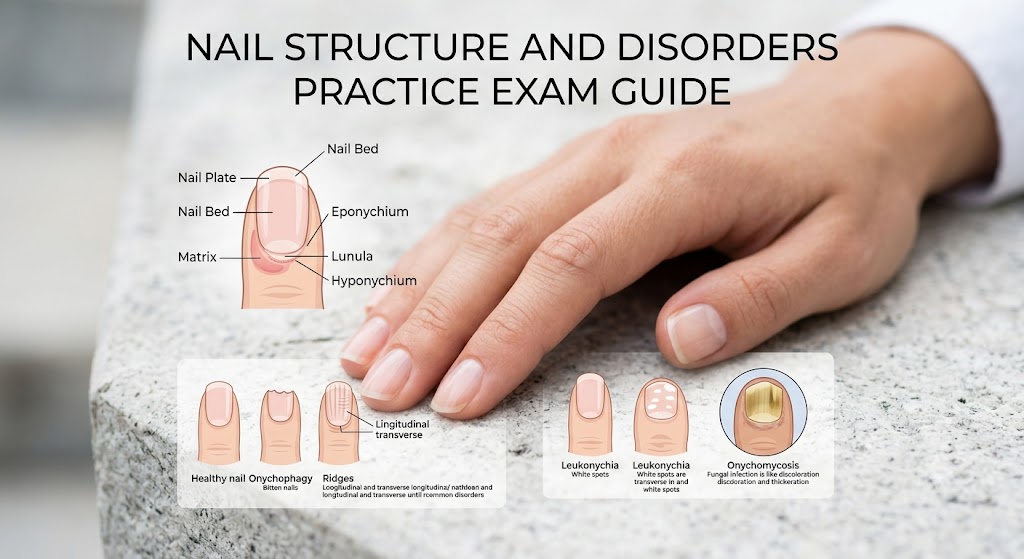
Additional Information
What the Course Entails and Exam Details
The training leading up to this exam covers a detailed
syllabus that includes:
• Anatomy of the Nail: In-depth study of the entire
nail unit, including the matrix, cuticle (eponychium and pterygium), lunula,
nail plate, nail bed, and free edge.
• Nail Growth: Factors influencing the rate of nail
growth and characteristics of healthy nail formation.
• Nail Disorders: Understanding the causes, symptoms,
and salon treatments for non-contagious conditions such as onychophagy (bitten
nails), beau's lines, leukonychia (white spots), and hangnails.
• Nail Diseases: Critical identification of
contagious and non-contagious bacterial, fungal, and viral infections, such as
onychomycosis (nail fungus), paronychia, and tinea unguium. Crucially, you will
learn which conditions require absolute refusal of service and medical
referral.
• Sanitation and Safety: Best practices for hygiene,
disinfection, and preventing the spread of infection in a salon environment.
What to Expect in the Final Exam
The actual certification exam will be a proctored,
standardized test, commonly in a multiple-choice format. Candidates can
typically expect:
• Format: 50-100 multiple-choice questions
administered via computer.
• Content Distribution: Approximately 40% on nail
structure and growth, 40% on disorders and diseases, and 20% on safety and
sanitation protocols.
• Passing Score: Requirements vary by state or
testing body, but a passing score is generally between 70% and 75%.
• Time Limit: You will typically have 60 to 90
minutes to complete the theory portion of the exam.
• Practical Component: Note that this practice test
is for the theory exam. Most states also require a hands-on practical
exam where you demonstrate actual services, including proper setup and
sanitation.
How to Study and
Exam Centers
Successful students employ active study strategies to master
this detailed terminology:
• Visual Aids and Diagrams: Create or find detailed,
labeled diagrams of the nail structure. Color-code different parts for easier
recall.
• Flashcards: Build flashcards for all terminology,
focusing heavily on matching disease names (e.g., onychomycosis) with
their common names (nail fungus), causes, and visual symptoms.
• Case Study Practice: Use high-quality visual
references to practice identifying healthy nails versus those with specific
disorders and diseases.
• Practice Quizzes: Take this [Nail Structure,
Disorders and Diseases Practice Test] multiple times. Analyze your incorrect
answers to identify weak areas.
• Study in Segments: Break down the content. Focus on
anatomy for one session, non-contagious disorders for another, and contagious
diseases for a third.
The final exam is administered by authorized testing
centers, which vary by jurisdiction. They often include:
• State Boards of Cosmetology: Many states hold exams
directly at their board offices.
• Third-Party Testing Services: Companies like
Pearson VUE, PSI, or Prometric are frequently contracted to administer the
computerized theory exams at their dedicated testing centers.
• Cosmetology Schools: Your school may be an approved
site for both the theory and practical examinations. Check with your
instructors for specific details and registration procedures.
Job Opportunities
from the Course
Obtaining certification after passing this exam unlocks a
variety of career paths:
• Licensed Nail Technician: Providing specialized
manicures and pedicures in a salon setting.
• Licensed Manicurist/Pedicurist: Specializing in the
care and aesthetics of fingernails and toenails.
• Salon Owner or Manager: Utilizing technical skills
to build and oversee a beauty business.
• Nail Art Specialist: Focusing on advanced
decorative techniques and design.
• Educator or Instructor: Teaching the next
generation of nail professionals in a cosmetology school.
• Platform Artist: Demonstrating products and
techniques at industry trade shows.
• Product Sales Representative or Consultant: Working
for beauty brands that specialize in nail care products.
Frequently Asked Questions
Reviews
5.0
Based on 0 reviews
Leave a Review
No reviews yet. Be the first to review!