
NAPLEX Mnemonics Practice Test
$69.00
- Buy to unlock unlimited access to all Quiz questions and Answers in this Quiz.
- After purchase you can print a PDF of the whole quiz at any point. The PDF will contain the questions and the correct answers.
About this Exam
The
and detailed guide are specifically crafted to empower pharmacy graduates preparing for one of the most critical steps in their professional journey: the actual North American Pharmacist Licensure Examination (NAPLEX).
The official NAPLEX is a required licensure exam for all aspiring pharmacists wishing to practice in the United States and assesses essential entry-level competency and knowledge.
This comprehensive practice test and the powerful strategy of using cleverly designed mnemonics can make a pivotal difference in your preparation, simplifying complex concepts, streamlining extensive study material, and boosting your recall during the high-pressure actual test.
Ready to test your knowledge?
Buy Now to Access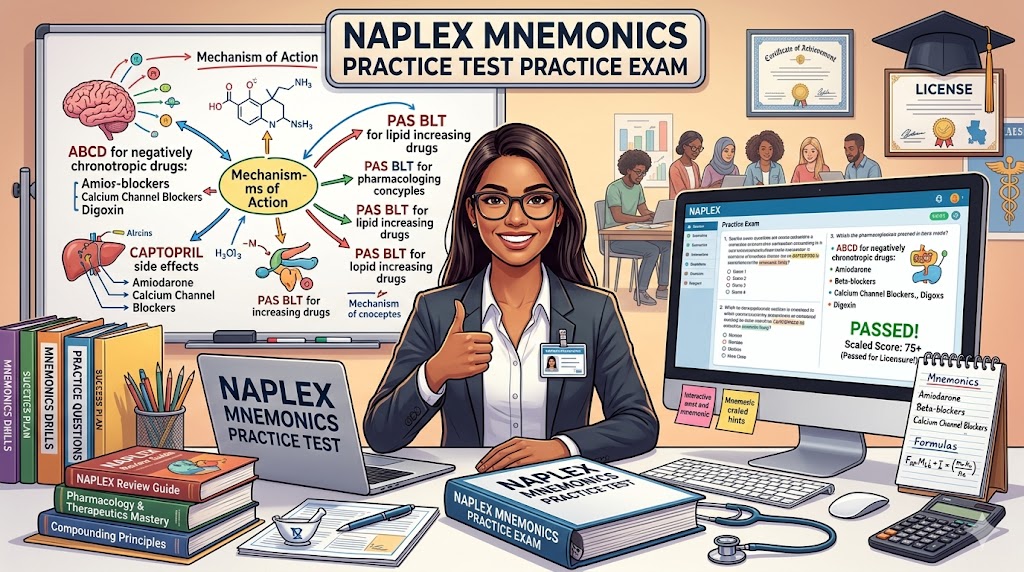
Additional Information
What the Course
Entails and Exam Details
The official pathway and the associated
$$NAPLEX Mnemonics Practice Test$$
and guide cover the key competency areas mandated by the
NABP for licensure.
This comprehensive material includes a detailed syllabus
focusing intensely on five main domains of knowledge.
You will delve deeply into managing drug therapy, ensuring
safe preparation and dispensing of medications, and providing critical drug
information and promoting public health.
The actual content domains are foundational knowledge for
pharmacy practice, the medication use process, person-centered assessment and
treatment planning, professional practice, and pharmacy management.
Mastering these vast topics, especially extensive
pharmacology, complex calculations, and scenario-based decision making, is
where the active application of clever mnemonics truly shines.
What to Expect in the Final Exam
The actual official NAPLEX is a rigorous, computerized
examination consisting of 250 scenario-based multiple-choice, multi-response,
and constructed-response questions.
Of these questions, only 200 are counted towards your
official scaled score, with a minimum passing score of 75 required for
licensure.
Fifty of the questions on the actual exam are pretest items
and do not impact your result, but they are indistinguishable from the other
questions.
Candidates have a single, comprehensive six-hour testing
window to complete the entire actual exam, which includes time for two optional
10-minute scheduled breaks.
The
$$NAPLEX Mnemonics Practice Test$$
is a perfect tool to prepare for navigating this format
efficiently and managing your time, often aided by effective and readily
accessible mnemonic recall.
How to Study and
Exam Centers
Create a personalized, structured study plan that
incorporates official materials, comprehensive review courses, and dedicated
practice with this
$$NAPLEX Mnemonics Practice Test$$
resource.
Focus intensely on actively creating and memorizing your own
effective and creative mnemonics for drug classes, mechanisms of action,
critical calculations, and essential formulas.
Practice integrating the regular use of this focused
practice test into your routine, applying your mnemonic skills to diverse
practice questions and realistic clinical scenarios to solidify your
understanding and recall.
When you feel adequately prepared, you will register for
your official licensure exam with the National Association of Boards of
Pharmacy (NABP) and then schedule your actual exam to be taken at an authorized
physical testing center, which are typically managed via Pearson VUE across the
United States.
Job Opportunities
from the Course
Achieving official pharmacist licensure by successfully
passing the actual official NAPLEX, which this practice material helps
you prepare for, unlocks an incredible array of rewarding career opportunities.
Please understand that these career paths are unlocked by
your formal licensure, which is achieved by passing the actual state-required
licensure exam, and not just this practice test alone.
Successful licensure opens doors to diverse professional
roles in a wide range of healthcare settings.
The specific job opportunities for qualified licensed
pharmacists include the following distinct job titles and paths:
*Pharmacist *Community/Retail Pharmacist
*Hospital/Health-System Pharmacist *Clinical Pharmacist (various specialties
like ambulatory care, critical care, infectious diseases, etc.) *Managed Care
Pharmacist *Pharmacy Manager *Consultant Pharmacist *Pharmacy Informatics
Specialist *Industry Pharmacist (Regulatory Affairs, Medical Affairs, R&D,
Marketing) *Public Health Pharmacist *Nuclear Pharmacist *Long-Term Care
Pharmacist *Poison Control Pharmacist *Regulatory Officer (Government Agencies)
*Poison Control Specialist *Veterinary Pharmacist *Educator / Professor
(Pharmacy School) *Researcher (Pharmaceutical, Clinical, or
Social/Administrative Sciences)
Frequently Asked Questions
Reviews
5.0
Based on 0 reviews
Leave a Review
No reviews yet. Be the first to review!