
NASFAA Student Eligibility Practice Exam
$69.00
- Buy to unlock unlimited access to all Quiz questions and Answers in this Quiz.
- After purchase you can print a PDF of the whole quiz at any point. The PDF will contain the questions and the correct answers.
About this Exam
The NASFAA Student Eligibility credential is a highly respected professional certification designed for financial aid administrators, higher education staff, and college counselors.
This certification validates your comprehensive understanding of the complex federal regulations that govern Title IV student financial aid.
It is specifically tailored for professionals who want to ensure their institutions remain compliant while effectively helping students navigate their financial aid journeys.
By passing the exam and earning this credential, you demonstrate a deep commitment to your career and a strong mastery of federal student aid eligibility criteria.
Whether you are stepping into a new role in a financial aid office or looking to advance your current career, this certification serves as a recognized benchmark of professional excellence.
Ready to test your knowledge?
Buy Now to Access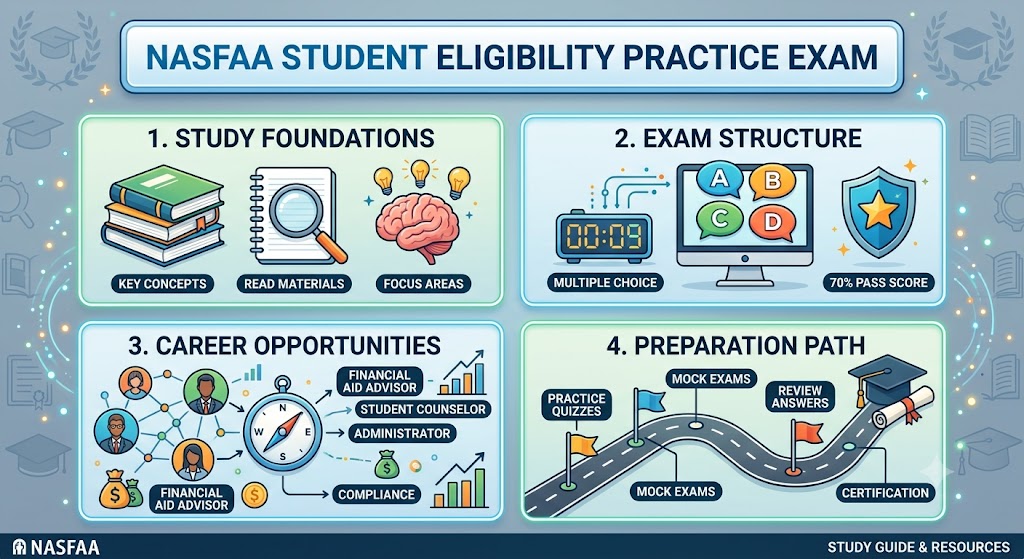
Additional Information
What the Course Entails and Exam Details
Preparing for this credential involves an in-depth study of
the core regulations required to disburse federal student aid safely and
accurately.
The syllabus is built heavily around the Federal Student Aid
(FSA) Handbook and the specific federal statutes dictating student eligibility.
Key topics covered include general eligibility criteria,
such as citizenship status, valid Social Security Numbers, and regular student
enrollment requirements.
You will also need a strong understanding of how to resolve
conflicting information and manage the Free Application for Federal Student Aid
(FAFSA) application process.
Additionally, the course material dives deeply into
Satisfactory Academic Progress (SAP) requirements, handling financial aid
history, and managing defaults or overpayments.
Mastering these subjects ensures that you can handle
real-world student cases, from basic verifications to complex eligibility
appeals.
What to Expect in
the Final Exam
The final certification exam is a rigorous but fair
assessment of your knowledge of Title IV eligibility regulations.
It typically consists of a multiple-choice format, requiring
you to apply regulations to practical, scenario-based questions rather than
just memorizing facts.
Candidates are generally given a strict time limit, usually
around 120 minutes, to complete the exam.
The passing score requirement is typically set at 80% or
higher, reflecting the high standard NASFAA holds for its credentialed
professionals.
One highly advantageous rule is that the exam is open-book,
meaning you are allowed to reference the NASFAA Self-Study Guide and the FSA
Handbook during the test.
However, because the test is timed, you must be incredibly
familiar with the material beforehand to efficiently look up specific
regulations without running out of time.
How to Study and
Exam Centers
A strategic approach is essential for passing the NASFAA
Student Eligibility exam on your first attempt.
Start by thoroughly reading the official NASFAA Self-Study
Guide and actively referencing the corresponding sections in the FSA Handbook.
Because the exam is timed and open-book, we highly recommend
creating a customized index or using tabbed dividers in your study materials so
you can locate specific topics in seconds.
Taking multiple practice exams is arguably the best study
method; it builds your test-taking endurance and helps you identify knowledge
gaps before test day.
When it comes time to take the official test, you will be
pleased to know that it is highly accessible.
The exam is administered entirely online through the NASFAA
testing portal, meaning you can take it from the comfort of your own home or
office.
There is no need to travel to a physical Pearson VUE or
third-party testing center, provided you have a reliable internet connection
and a quiet testing environment.
Job Opportunities
from the Course
Earning the NASFAA Student Eligibility credential
significantly elevates your professional profile and opens doors to various
rewarding roles in higher education.
Below is a clear list of specific career paths and job
titles that this certification unlocks:
- Financial
Aid Advisor: Work directly with students and families to determine aid
eligibility and explain funding options.
- Financial
Aid Counselor: Provide targeted guidance on loan management, scholarships,
and navigating FAFSA complexities.
- Compliance
Officer (Financial Aid): Ensure the institution's policies align perfectly
with Title IV federal regulations to avoid audit findings.
- Assistant
Director of Financial Aid: Take on a leadership role, managing daily
operations, overseeing staff, and handling complex student eligibility
appeals.
- Student
Services Coordinator: Bridge the gap between admissions, registrar, and
financial aid departments to ensure a seamless student enrollment
experience.
- Financial
Aid Director: Lead the entire department, guiding strategic initiatives,
managing institutional aid budgets, and ensuring total federal compliance.
Frequently Asked Questions
Reviews
5.0
Based on 0 reviews
Leave a Review
No reviews yet. Be the first to review!