
NATE Air Distribution Practice Test
$69.00
- Buy to unlock unlimited access to all Quiz questions and Answers in this Quiz.
- After purchase you can print a PDF of the whole quiz at any point. The PDF will contain the questions and the correct answers.
About this Exam
North American Technician Excellence (NATE) is the nation's leading nonprofit certification program for heating, ventilation, air conditioning, and refrigeration (HVACR) technicians.
The NATE Air Distribution certification is specifically designed for experienced HVAC technicians who want to demonstrate their specialized knowledge and skills in the design, installation, service, and maintenance of air distribution systems.
Whether you're working on residential or light commercial systems, this certification validates your expertise in managing airflow, ductwork, and ventilation – essential components for system efficiency and indoor comfort. Passing this exam, alongside the required Core exam, is a clear mark of professional competence and dedication.
Ready to test your knowledge?
Buy Now to Access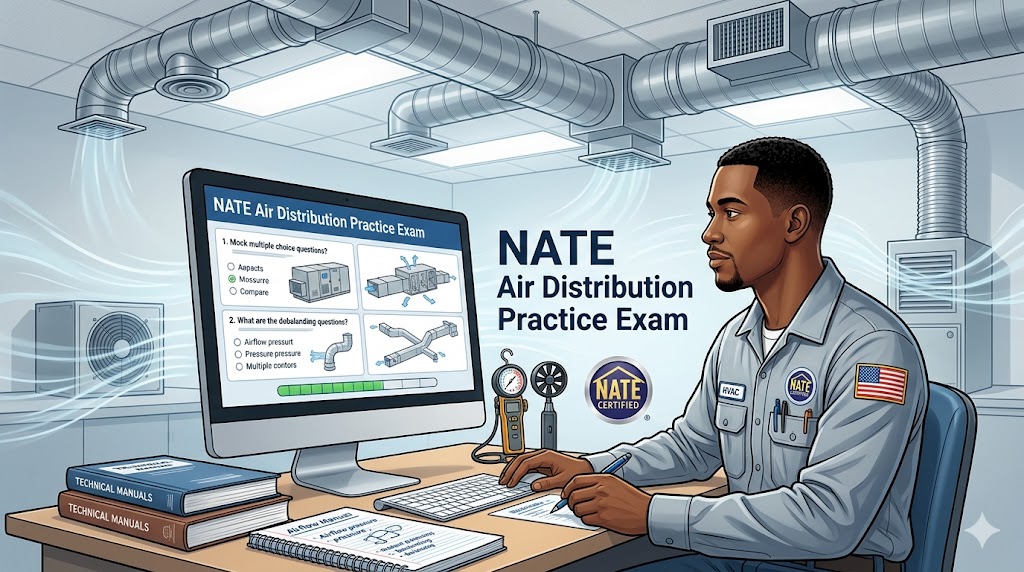
Additional Information
What the Course Entails and Exam Details
While NATE itself offers examinations, not structured
courses, your preparation will involve deeply understanding a wide range of
critical air side concepts. This involves practical knowledge as well as
theoretical understanding, frequently covered in training programs and
extensive field experience.
Key topics you must master include:
- Ductwork
Systems: Knowledge of different duct materials (metal, flexible),
proper installation techniques, sealing methods, insulation requirements
(both internal and external), and the importance of vapor barriers.
- Airflow
Fundamentals: Understanding air velocity, pressure (static, velocity,
total), and volume measurements. This involves using and calibrating
essential tools like manometers, anemometers, and pitot tubes, as well as
applying relevant formulas to determine cubic feet per minute (CFM).
- System
Balancing: Techniques for measuring and adjusting airflow across
diffusers, grilles, and registers to ensure even air distribution and
optimal system performance.
- Service
and Troubleshooting: Diagnosing common air distribution problems,
including insufficient airflow, noise issues, uneven temperatures, and
identifying component failures (fans, blowers, dampers).
- Controls
and Safety: Familiarity with residential thermostat circuitry, safety
procedures, personal protective equipment (PPE), lockout/tagout protocols,
and relevant building codes and standards.
- HVAC
System Context: A foundational grasp of general HVAC principles,
including heat transfer basics and basic electricity, is tested on the
Core exam and underpins many specialty questions.
To earn full NATE Air Distribution certification,
technicians are generally required to pass both the Core service or
installation exam and the Air Distribution specialty exam. This comprehensive
approach ensures well-rounded expertise.
What to Expect in
the Final Exam
Knowing exactly what to expect on exam day is crucial for
minimizing anxiety and focusing your efforts. The NATE Air Distribution
specialty exam (which may be specific to either Service or Installation, or a
combined path – clarify with your testing provider) typically follows a
well-defined format:
- Format:
The exam consists of approximately 50 multiple-choice questions. These are
often scenario-based, testing your ability to apply your technical
knowledge to real-world situations, rather than just simple recall.
- Time
Limit: You will typically have a total of 1.5 hours to complete the
entire specialty exam. Proper time management is essential!
- Passing
Score: To pass the NATE Air Distribution exam, you must achieve a
score of 70% or higher.
- Delivery
and Proctoring: All NATE exams are proctored to ensure integrity. They
can be taken either at an authorized physical testing center or through a
live online proctoring service, if available and chosen. The exam is
closed-book, meaning you cannot refer to study materials.
- Content
Emphasis: Be prepared for questions that require deep critical
thinking, troubleshooting logic, and the precise interpretation of data
and scenarios. Read every question carefully, particularly those
containing negatives (e.g., "Which of these is NOT...").
Remember, the NATE exams are deliberately challenging to
uphold high industry standards. Adequate preparation is non-negotiable for
success.
How to Study and
Exam Centers
Effective preparation is the single most important factor in
passing your NATE Air Distribution exam. Here are actionable study strategies
and information on where to test:
Top Study Strategies:
- Utilize
High-Quality Practice Tests: This is absolutely essential! Dedicated
practice exams, like the one referenced in our title, are your best tool.
They help you identify knowledge gaps, familiarize yourself with
"NATE logic," practice time management, and build confidence by exposing
you to the types of scenario-based questions you'll encounter. Aim to
consistently score well above 70% on practice exams before scheduling the
real test.
- Leverage
Official Resources: Thoroughly review the Knowledge Areas of
Technician Expertise (KATEs) relevant to Air Distribution, which are
detailed outlines provided by NATE. These documents precisely define the
topics covered and are foundational reference materials. Explore other
resources and study guides available on the official NATE website
(natex.org).
- Combine
Study with Experience: Theoretical knowledge is powerful, but
practical experience is invaluable. Apply what you're learning in the
field. Volunteer for air balancing tasks, participate in ductwork
installations, and observe experienced senior technicians. Actively
connect your textbook knowledge with real-world scenarios.
- Enroll
in Training Courses: Consider formal training programs offered by
technical schools, manufacturers, or industry organizations (like IHACI).
Many courses are specifically structured to prepare technicians for NATE
certifications and offer comprehensive reviews of complex topics,
electrical principles, and troubleshooting techniques. Active recall
methods, such as flashcards and regular self-quizzing, are often
incorporated for effective learning.
- Read
Technical Materials: Study relevant sections in HVAC textbooks,
manufacturer literature, code books, and industry publications. Focus not
just on what something is, but why it works that way and how
to troubleshoot it.
Finding Exam Centers and Taking the Test:
NATE exams are conveniently offered through a vast national
network of authorized testing organizations.
- Search
the NATE Website: Visit natex.org and use their official "Find a
Testing Organization" or "Locate a Proctor" tool. You can
search by zip code to find physical locations near you, which may include
HVAC training centers, technical colleges, distributor locations, or
dedicated testing facilities.
- Register
through Your Selected Provider: Once you find a suitable testing
center, register for your chosen exam(s) directly with them. They will
handle the scheduling, location details, and payment.
- Online
Proctoring Option: NATE also offers live online proctoring sessions
for many of its exams, providing flexibility for technicians who prefer to
test from a secure, remote location. Check the NATE website or inquire
with your chosen proctoring service for availability and specific
technical requirements.
Job Opportunities
from the Course
Earning your NATE Air Distribution certification
dramatically enhances your professional credibility and marketability.
Employers across the HVACR industry recognize the value of NATE certification,
making you a more attractive candidate for diverse roles and career advancement
opportunities.
Here are some of the exciting job titles and career paths
this certification can unlock (presented as a clear list, as requested):
- HVAC
Service Technician (Air Distribution Specialist): Directly use your
specialized knowledge to diagnose, repair, and maintain air handling
units, fans, and complex ductwork systems in residential or light
commercial buildings. You'll be the expert called in for challenging
airflow or ventilation issues.
- HVAC
Installation Technician: Ensure the efficient and correct installation
of entire air distribution systems, including sizing, routing, sealing,
and balancing. Quality installation leads to improved system longevity and
customer satisfaction, reducing callbacks.
- Ductwork
Installer: Focus on the fabrication (if applicable), assembly, and
installation of various types of duct systems, ensuring proper
connections, supports, sealing, and insulation for leak-free,
code-compliant performance.
- Air
Balancer / Balancing Technician: Specialize in measuring, testing, and
adjusting airflow in HVAC systems to achieve design specifications and
ensure comfort and efficiency. This precise skill is often a dedicated
role within larger HVAC companies or specialized balancing firms.
- Facility
Maintenance Technician: Maintain, troubleshoot, and optimize the
extensive HVAC and air distribution systems within large commercial
buildings, hospitals, or industrial facilities, ensuring consistent
comfort and compliance.
- HVAC
System Designer (Entry-Level or with experience): While primarily a
test for technicians, strong understanding of air side mechanics is
foundational for moving into entry-level system design roles or
collaborating effectively with engineers.
- Energy
Auditor (Related Skillset): Knowledge of efficient air distribution
and duct sealing is vital for energy auditing and helping homeowners and
businesses reduce their energy consumption and improve indoor air quality.
Frequently Asked Questions
Reviews
5.0
Based on 0 reviews
Leave a Review
No reviews yet. Be the first to review!