
National Clinical Assessment Cellular Practice Exam
$69.00
- Buy to unlock unlimited access to all Quiz questions and Answers in this Quiz.
- After purchase you can print a PDF of the whole quiz at any point. The PDF will contain the questions and the correct answers.
About this Exam
The National Clinical Assessment (NCA) Cellular Practice Exam is a pivotal evaluation designed for laboratory professionals and clinical scientists specializing in cellular pathology, molecular diagnostics, and related fields. This exam serves as a comprehensive practice tool, or a component of a formal certification process, validating an individual’s proficiency in the analysis of human cells and tissues. It is tailored for those aspiring to work in, or currently employed in, diagnostic laboratories, ensuring they possess the essential knowledge and practical skills required to provide accurate and timely cellular data for patient care. The assessment focuses on real-world scenarios, testing theoretical understanding alongside practical application within a simulated clinical environment.
Ready to test your knowledge?
Buy Now to Access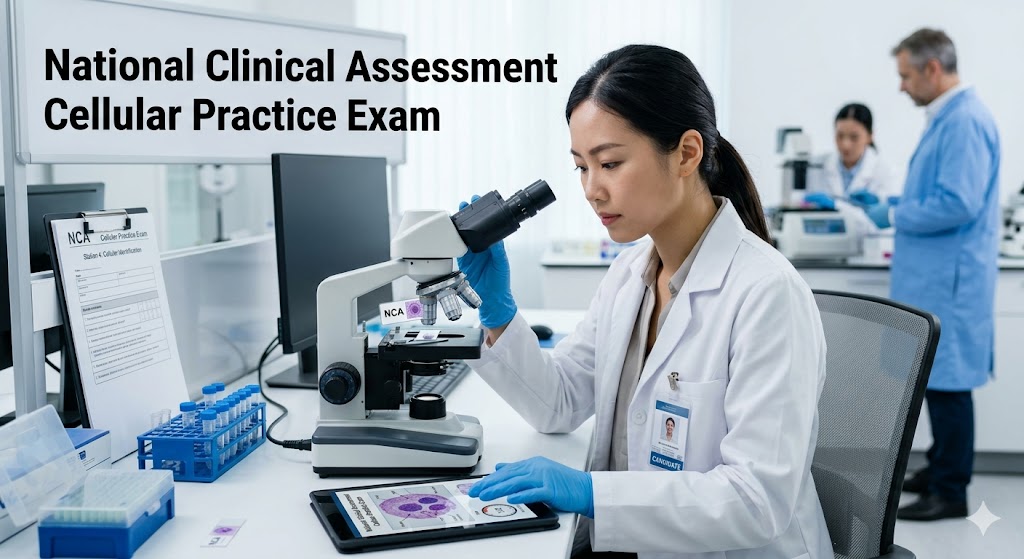
Additional Information
What the Course Entails and Exam Details
This examination covers a broad and detailed syllabus, demanding expertise in multiple facets of cellular science. Core topics and skills tested include:
Cell Biology and Pathology: In-depth knowledge of cellular structure, function, and the mechanisms of disease at a cellular level, including inflammation, neoplasia, and genetic disorders.
Laboratory Techniques: Proficiency in essential techniques, such as tissue processing, embedding, sectioning, routine, and special staining (H&E, IHC), molecular techniques (FISH, PCR), and cytological preparation.
Microscopy and Image Analysis: Advanced skills in using light, fluorescence, and potentially electron microscopes to identify and interpret cellular morphology, architectural patterns, and sub-cellular details.
Quality Assurance and Safety: Understanding of laboratory quality control, quality assurance programs, and rigorous adherence to safety protocols for handling biological samples, chemical reagents, and equipment.
Data Interpretation and Reporting: The ability to analyze complex laboratory results, correlate findings with clinical history, and generate clear, accurate diagnostic reports for clinicians.
What to Expect in the Final Exam
The final NCA Cellular Practice Exam is structured to rigorously assess both theoretical knowledge and practical competence. Candidates can typically expect a multi-modal format, which may include:
Multiple-Choice Questions (MCQ): This section evaluates foundational knowledge, covering the principles of cellular biology, pathology, and laboratory science. Questions are designed to test not only recall but also critical thinking and problem-solving within clinical contexts.
Objective Structured Clinical Examination (OSCE) or Practical Stations: This is the core component of the exam. Candidates rotate through various stations, each simulating a common or critical laboratory task. These can involve identifying pathologies in digital slides or under a microscope, performing specific techniques on tissues or cell lines, or interpreting complex molecular data under timed conditions.
Time Limit and Passing Score: The exam is typically well-structured with defined time limits for both the written (e.g., 2-3 hours) and practical portions. The passing score is a composite determined by the certifying body or national standards, requiring a minimum proficiency across all evaluated sections.
Rules: Standard exam rules apply, including prohibition of unauthorized aids and requirements for presenting valid identification.
How to Study and Exam Centers
Preparation for the NCA Cellular Practice Exam requires a dedicated and structured approach:
Actionable Study Strategies: Start with a comprehensive review of the official syllabus. Use textbook resources, peer-reviewed journals, and official practice guidelines. Create detailed study notes, use flashcards for cellular morphology and staining patterns, and form study groups for collaborative learning and discussion of challenging cases.
Practice Methods: Practical experience is invaluable. Maximize time in a working diagnostic or research laboratory. Practice identifying and describing cellular features in a wide variety of tissues. For the MCQ section, utilize available practice exams and question banks. If available, participate in mock OSCEs to build confidence with the timing and format of the practical assessment.
Exam Centers: The exam is administered at authorized locations. Depending on the specific certifying body and your location, these may include designated computer-based testing centers (e.g., Pearson VUE), specific university or hospital-based cellular pathology departments, or authorized professional regulatory body facilities. Some components of the exam may also be offered through secure online portals. It is crucial to register through the official website of the national examining body to select your preferred center and date.
Job Opportunities from the Course
Upon successful completion of the NCA Cellular Practice Exam, individuals unlock numerous career paths within the healthcare and research sectors.
Specific Job Titles Include:
Medical Laboratory Technologist (Cellular Pathology/Cytogenetics)
Cytotechnologist
Pathologist’s Assistant
Clinical Research Associate (in cell-based trials)
Laboratory Manager/Supervisor in Diagnostic Cytology/Histology
Laboratory Quality Assurance Specialist
Molecular Diagnostics Technologist
Biomedical Scientist (Cellular Sciences)
Application Specialist for Laboratory Equipment/Reagents (focused on cellular analysis)
Academic Researcher/Technician in Cell Biology or Pathology
Frequently Asked Questions
Reviews
5.0
Based on 0 reviews
Leave a Review
No reviews yet. Be the first to review!