
National Economics Challenge Practice Exam
$69.00
- Buy to unlock unlimited access to all Quiz questions and Answers in this Quiz.
- After purchase you can print a PDF of the whole quiz at any point. The PDF will contain the questions and the correct answers.
About this Exam
The National Economics Challenge (NEC) stands as the premier academic competition in the United States designed specifically to recognize and encourage excellence in economics among high school students. Orchestrated annually by the Council for Economic Education, it draws over 10,000 students from across the nation to test their critical thinking and problem-solving skills in competitive environments. The NEC is designed for ambitious high school students who possess a strong interest in economics, finance, current events, and public policy. It offers a unique platform for young scholars to apply classroom knowledge to real-world scenarios, fostering a deeper understanding of the forces that shape our global economy. Participating in the Challenge, and utilizing the National Economics Challenge Practice Exam, is a significant mark of distinction for college applications and future career pursuits in business and social sciences.
Ready to test your knowledge?
Buy Now to Access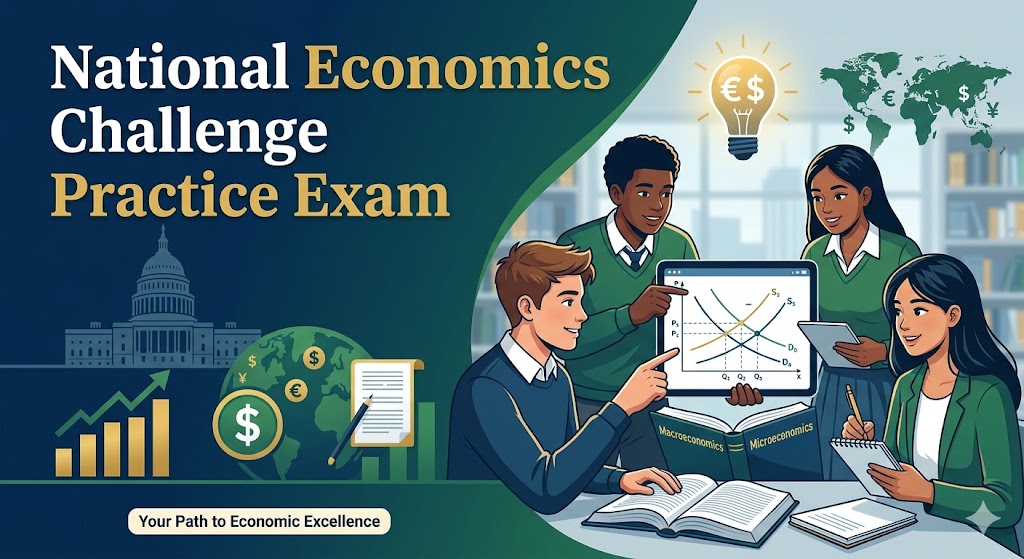
Additional Information
What the Course Entails and Exam Details
Preparing for this challenge requires a rigorous understanding of complex economic theories and their practical applications. The competition is divided into two divisions based on student experience: the David Ricardo division for first-time competitors and introductory students, and the Adam Smith division for advanced students, including those in AP, IB, or Honors economics courses.
The core areas tested encompass a broad syllabus tailored to recognized voluntary national standards in economics. Students must master Microeconomics, focusing on individual agent behavior, supply and demand dynamics, market structures, and consumer theory. Macroeconomics is equally critical, requiring knowledge of national income determination, economic indicators, fiscal policy, and monetary policy mechanisms administered by the Federal Reserve.
Furthermore, the syllabus includes International Economics, covering trade theory, tariffs, and exchange rates. Finally, a unique and challenging component is Current Events, which tests the students' ability to apply economic reasoning to contemporary issues and data currently shaping the world economy.
What to Expect in the Final Exam
The National Economics Challenge is structured as a multi-stage competition, progressing from state-level contests to the National Finals. While specific formats may vary slightly by state, the general structure relies heavily on multiple-choice testing in the early rounds. For example, in the online semi-finals, students typically face three separate, timed multiple-choice tests covering microeconomics, macroeconomics, and international economics/current events.
In the early rounds, there is generally no penalty for guessing, meaning scores are based on the total number of correct answers. Time limits are strict, often allowing approximately 15 to 20 minutes per test section, demanding quick thinking and decisive analysis.
Should your team advance to the National Finals, the format shifts dramatically to include a critical thinking round, where teams must analyze an economic problem and present their solution to a panel of judges, and a high-energy, oral "quiz bowl" round that determines the ultimate champions.
How to Study and Exam Centers
Effective preparation for the NEC goes beyond simple memorization. Active engagement with the material is key to success.
Your primary strategy should involve taking the National Economics Challenge Practice Exam repeatedly. Analyzing these practice tests helps you understand the specific framing of questions and identifies gaps in your knowledge. Students should form study teams, as the NEC is a team competition, allowing you to pool knowledge and debate economic concepts. Utilize standard high school AP or introductory college textbooks to build a solid foundational understanding of core principles. We also recommend staying current with major economic news by reading reputable publications like The Economist or The Wall Street Journal to prepare for the current events section.
Regarding exam centers, the initial preliminary rounds are typically coordinated through your high school economics teacher and are often administered online, allowing you to take them in your own classroom. State-level competitions may take place at a designated university, Federal Reserve bank, or state council office. If your team qualifies, the National Semi-Finals are held online, and the prestigious National Finals historically take place in person in a major US city, such as New York City.
Job Opportunities from the Course
While the National Economics Challenge is a high school competition and not a professional certification, excelling in it serves as a powerful catalyst for your academic and professional future. It signals to top-tier universities that you possess advanced analytical skills and a dedication to academic rigor, which can lead to admission to prestigious economics and business programs.
Success in the Challenge can eventually unlock numerous high-level career paths, including:
Financial Analyst
Data Scientist
Economic Consultant
Policy Analyst in government or non-profits
Investment Banker
Management Consultant
Statistician
Actuary
Market Research Analyst
Frequently Asked Questions
Reviews
5.0
Based on 0 reviews
Leave a Review
No reviews yet. Be the first to review!