
National Geographic Bee Practice Exam
$69.00
- Buy to unlock unlimited access to all Quiz questions and Answers in this Quiz.
- After purchase you can print a PDF of the whole quiz at any point. The PDF will contain the questions and the correct answers.
About this Exam
The National Geographic Bee Practice Test is a essential study aid designed for inquisitive students, typically in grades four through eight, who possess a deep curiosity about the world around them. While the official National Geographic Bee competition was discontinued in 2021, these comprehensive practice tests remain the definitive resource for fostering elite geographic literacy in young learners. This material is meticulously curated for students aiming to master regional knowledge, physical geography, and cultural awareness. It is also an excellent preparation tool for those competing in school geography bees or related academic decathlons that utilize the GeoBee format as the gold standard of geographical study.
Ready to test your knowledge?
Buy Now to Access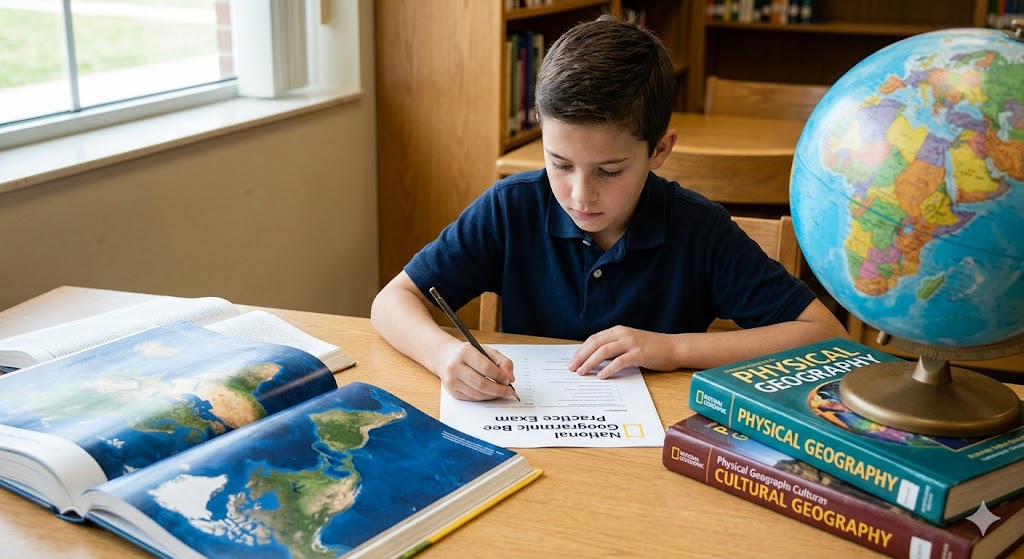
Additional Information
What the Course Entails and Exam Details
This practice material entails a rigorous syllabus spanning all aspects of geographical science and exploration. Students using this guide must delve deeply into physical geography, which requires memorizing major mountain ranges, ocean currents, climate zones, and significant river systems across every continent. The curriculum also demands a strong grasp of political geography, encompassing country capitals, international boundaries, and major geopolitical changes. Cultural geography is equally prioritized; students will be tested on their knowledge of diverse populations, global religions, dominant languages, and historic cultural sites. Furthermore, a substantial portion of the exam details focuses on visual literacy, requiring students to accurately interpret topographic maps, satellite imagery, and statistical data regarding global populations or environmental factors.
What to Expect in the Final Exam
When engaging with a comprehensive National Geographic Bee-style exam, students should expect a multi-formatted, multi-stage assessment designed to eliminate everyone but the most prepared competitors. In a simulated setting, the preliminary rounds often feature time-limited written or computer-based multiple-choice sections. However, the final stages of a true GeoBee are notorious for their demanding, rapid-fire oral response format. There is usually a very strict time limit for these answers, often just fifteen seconds or less. While passing scores are subjective in practice scenarios, in actual competition settings, near-perfect recall is necessary to advance. The primary specific rule that often catches students off guard is the high standard for specificity; for instance, giving a generalized "river" name when a specific tributary is required will not earn points.
How to Study and Exam Centers
Effective preparation requires specific, daily actionable study strategies. Students must move beyond passive reading and engage in active recall using detailed digital flashcards for capitals and physical features. Regular, intense map-reading sessions are critical—this is not just looking at maps, but actively tracing boundaries, locating landforms, and correlating them to environmental and cultural facts. We highly recommend forming geography study groups or working with dedicated coaches who can simulate the pressure of the oral rounds. Because these are practice materials, they are generally taken via online portals, utilizing platforms like Seterra or Quizlet for targeted drilling. These resources can be accessed from any location, meaning students can prepare rigorously without visiting physical testing centers like Pearson VUE, unlike many professional certifications.
Job Opportunities from the Course
While the National Geographic Bee is a middle school academic competition, the intensive skills developed by studying for it unlock critical thinking paths vital to numerous high-demand professional fields. Achieving mastery of this content serves as an essential stepping stone for advanced studies in high school and university, leading directly to future careers that rely on spatial reasoning and global awareness. This course unlocks potential career paths as a: Cartographer, responsible for designing and creating complex maps using GIS data. Geographic Information Systems (GIS) Analyst, analyzing spatial data for industries like urban planning, resource management, or logistics. Geopolitical Analyst, providing critical insights for government agencies, international non-profits, or global businesses. Foreign Service Officer, working diplomatically for the State Department to manage international relations. Environmental Consultant, using physical geography knowledge to assess and manage land use. High School or University Geography Educator, inspiring the next generation of global citizens. Travel or Nature Documentary Journalist, reporting on diverse global environments and cultures.
Frequently Asked Questions
Reviews
5.0
Based on 0 reviews
Leave a Review
No reviews yet. Be the first to review!