
National Pilates Certification Practice Exam
$69.00
- Buy to unlock unlimited access to all Quiz questions and Answers in this Quiz.
- After purchase you can print a PDF of the whole quiz at any point. The PDF will contain the questions and the correct answers.
About this Exam
The National Pilates Certification Exam (NPCE) is a rigorous assessment designed to validate the knowledge and skills of Pilates teachers. Earning this certification demonstrates a high level of commitment and expertise in the Pilates method, setting professionals apart in a competitive industry. It is specifically intended for individuals who have completed a comprehensive Pilates teacher training program and wish to gain national recognition, enhancing their credibility and career prospects. Achieving this certification signifies a deep understanding of Pilates principles, safety standards, and effective teaching techniques across various apparatus.
Ready to test your knowledge?
Buy Now to Access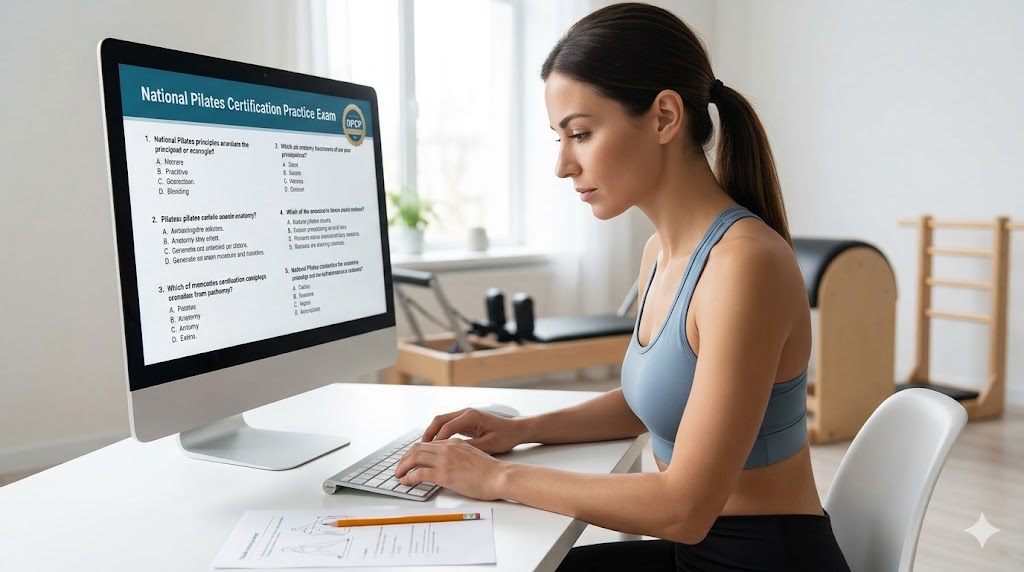
Additional Information
What the Course Entails and Exam Details
The underlying course or training programs that prepare students for this exam encompass a vast array of Pilates-specific and general fitness topics. Students delve into detailed studies of:
Pilates History and Philosophy: Understanding the origins and evolution of the method.
Anatomy and Kinesiology: Gaining comprehensive knowledge of human anatomy, muscle function, and movement patterns relevant to Pilates exercises.
Pilates Exercises: Mastering the full repertoire of exercises on all major apparatus, including the Reformer, Cadillac, Wunda Chair, Ladder Barrel, and Spine Corrector, as well as Mat work. This includes understanding the goals, cues, and proper execution of each movement.
Program Design and Progression: Learning how to develop safe and effective Pilates programs for diverse populations, including those with special conditions, and how to progress clients appropriately.
Teaching Methodology: Developing effective communication skills, cueing techniques, hands-on corrections, and client motivational strategies.
Safety and Ethics: Emphasizing client safety, contraindications, studio etiquette, and professional ethical standards.
The preparation for the National Pilates Certification Exam ensures that candidates are well-versed not just in executing Pilates movements themselves, but in accurately and safely teaching others.
What to Expect in the Final Exam
The National Pilates Certification Exam is a comprehensive test, currently delivered in a multiple-choice format. Candidates should be prepared for:
Format: The exam consists of multiple-choice questions designed to assess theoretical knowledge and practical application scenarios. There is no live practical demonstration component within the exam itself, as the practical skills are typically validated through the required comprehensive teacher training programs.
Number of Questions: Expect a substantial number of questions, typically ranging between 125 and 150.
Time Limit: Candidates are generally given a specific time allotment, often around 3 hours, to complete the exam. Efficient time management is crucial.
Passing Score: A minimum passing score is required, which is determined by the certifying body and may vary slightly, but is typically around 70-75%.
Content Distribution: Questions are distributed across key domains such as exercise technique and instruction, safety and ethics, assessment and programming, and professional practice.
Rules: The exam is proctored, whether taken online or in person, with strict rules regarding materials allowed and conduct.
Understanding the specific current exam structure and policies is essential for focused preparation.
How to Study and Exam Centers
Effectively preparing for the National Pilates Certification Exam requires a structured and dedicated approach. Consider these actionable strategies:
Utilize Official Resources: Start with the official study guides, candidate handbooks, and any practice tests or sample questions provided by the National Pilates Certification Program (NPCP). These are the most reliable sources for understanding exam content and format.
Review Your Training Materials: Thoroughly go back through your comprehensive Pilates teacher training manuals, notes, and textbooks. Re-familiarize yourself with all exercises, anatomy, and teaching principles.
Practice with Purpose: Don't just re-read; actively practice answering multiple-choice questions. Seek out practice exams from reputable Pilates education providers to simulate the testing experience and identify weak areas.
Deep Anatomy Study: Dedicate significant time to studying anatomy and kinesiology, focusing on how these principles apply directly to Pilates movements and client conditions.
Teach Others: Explaining concepts and instructing others, even friends or fellow students, is one of the best ways to solidify your understanding.
Join Study Groups: Collating with peers can provide diverse perspectives, motivation, and shared learning opportunities.
Manage Exam Anxiety: Develop relaxation techniques and positive visualization strategies to remain calm and focused during the test.
Regarding exam centers, candidates have flexibility in how they take the NPCE:
Online Proctoring: You can take the exam remotely from the comfort of your home or office, provided you meet the strict technical and environmental requirements. This option uses live online proctors to monitor the session.
Physical Testing Centers: Alternatively, you can opt to take the exam at authorized testing centers, often facilitated through established testing organizations like Pearson VUE, which have locations globally. Check the official NPCP website for a list of available testing centers or to schedule your online proctored exam.
Job Opportunities from the Course
Obtaining national certification opens doors to a variety of rewarding career opportunities. Here are specific job titles and career paths this certification unlocks:
Certified Pilates Instructor (Independent)
Pilates Teacher in a Dedicated Studio
Pilates Program Coordinator
Group Fitness Instructor (Specializing in Pilates)
Personal Trainer with Pilates Specialization
Corporate Wellness Instructor (Pilates-focused)
Rehabilitation Aide/Assistant (Using Pilates in therapeutic settings)
Pilates Studio Owner/Manager
Pilates Teacher Trainer (With significant experience)
Frequently Asked Questions
Reviews
5.0
Based on 0 reviews
Leave a Review
No reviews yet. Be the first to review!