
National Pool Lifeguard Qualification (NPLQ) Practice Test
$69.00
- Buy to unlock unlimited access to all Quiz questions and Answers in this Quiz.
- After purchase you can print a PDF of the whole quiz at any point. The PDF will contain the questions and the correct answers.
About this Exam
The National Pool Lifeguard Qualification (NPLQ) is the UK's premier industry standard for individuals seeking to work as lifeguards at swimming pools. Owned and awarded by IQL UK (the Royal Life Saving Society UK's awarding body), it validates a person's capability to ensure public safety in a pool environment.
This comprehensive certification equips candidates with essential skills in water rescue, first aid (including CPR and use of automated external defibrillators - AEDs), and pool surveillance. The course is ideal for strong swimmers who are responsible, alert, and possess a genuine interest in water safety and emergency response.
Upon successful completion, you gain a vital qualification valid for two years, unlocking opportunities in various leisure and tourism sectors.
Ready to test your knowledge?
Buy Now to Access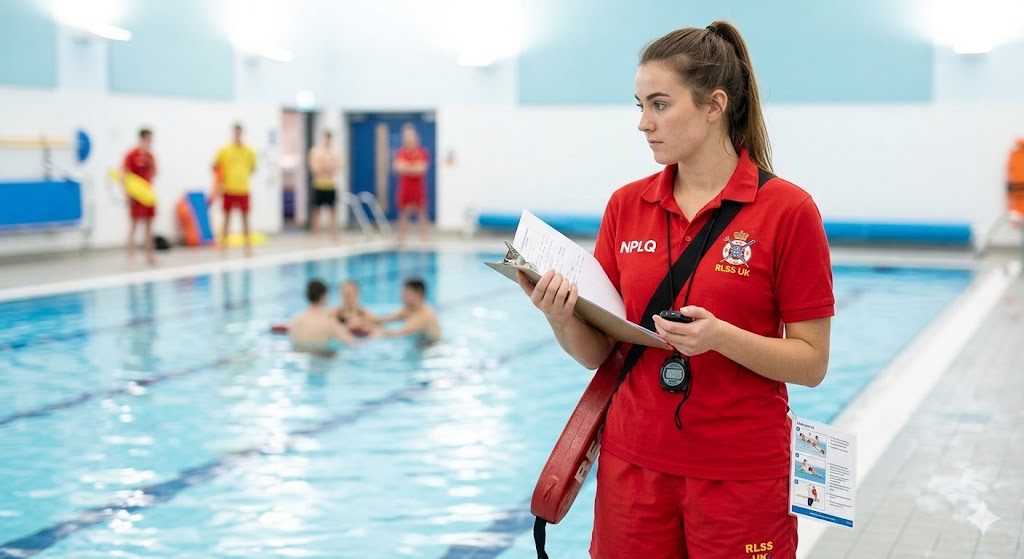
Additional Information
What the Course Entails and Exam Details
The NPLQ course is robust, covering a wide range of theory and practical modules. The syllabus typically includes:
The Lifeguard Role: Duties, professional standards, safety principles, and operational procedures in a swimming pool.
Pool Environment and Supervision: Different pool types, hazards, risk assessments, scanning techniques, and maintaining order.
Intervention and Rescue: Recognizing potential issues, intervention strategies, and practical rescue skills in and out of the water. This includes timed rescues and managing different casualties.
First Aid: Responding to common injuries and illnesses, managing incidents, and administering CPR to adults, children, and infants, including using an AED.
Pool Operations: Understanding water safety protocols, dealing with spinal injuries, and general health and safety considerations.
The "practice test" element refers to engaging with mock exams, sample questions, and simulated scenarios to consolidate learning and build confidence before the final assessment. Using these materials allows you to identify areas where you need more study, understand the depth of knowledge required, and practice responding effectively under pressure.
What to Expect in the Final Exam
The NPLQ final exam is not a single test but a thorough assessment comprising several interconnected parts. Candidates must pass all elements to achieve the qualification. You can generally expect:
Theory Assessment: A written examination, often consisting of multiple-choice questions, short answer questions, or a combination of both. It covers all key areas of the syllabus. The pass mark is typically high, and the time limit is strictly enforced.
Practical Assessment (In-Water): An independent assessor from IQL UK will evaluate your pool skills. You will be required to demonstrate various rescue scenarios (e.g., conscious and unconscious casualties, spinal injuries), including timed rescues and tows, as well as essential pool safety maneuvers. The assessor will ensure all actions are performed correctly and according to safety protocols.
Practical Assessment (First Aid): Your first aid and CPR skills will be individually assessed, often on manikins and in simulated situations, to ensure competency and accurate technique.
All practical assessments must be passed to the Assessor's satisfaction. Be prepared to show your understanding and apply your knowledge practically during these evaluations.
How to Study and Exam Centers
Effectively preparing for the NPLQ requires a dedicated and multifaceted approach. Here are actionable study strategies:
Attend All Course Sessions: The instruction, demonstrations, and practical practice within the course itself are fundamental. Take detailed notes and engage fully.
Study the Manual: Review the official IQL UK student manual thoroughly and frequently. This is your primary source of correct procedures and information.
Use Practice Resources: Actively utilize available NPLQ practice tests, online quizzes, mock scenarios, and past papers. These are invaluable for testing your recall and identifying knowledge gaps.
Practice in the Water: Dedicate extra time to practicing your physical rescue skills in a pool. Ask qualified instructors or colleagues for feedback on your technique, timing, and fitness.
Practice First Aid and CPR: Work on your first aid and CPR procedures, perhaps with a manikin or a partner (safely), focusing on speed, accuracy, and clear communication.
Courses and final assessments are conducted by approved training providers and leisure facilities across the UK. To find available NPLQ courses and testing locations:
RLSS UK Course Finder: Use the course finder tool on the Royal Life Saving Society UK (RLSS UK) website to search by location, date, and provider.
Local Leisure Centers: Many swimming pools, universities, and health clubs run NPLQ training and assessments regularly. Check their websites or speak with staff.
Private Training Organizations: Contact specialized first aid and rescue training companies in your area to inquire about upcoming NPLQ courses.
The qualification is typically achieved through physical assessment centers, although some theory aspects might involve online elements depending on the specific provider. The core practical evaluations are invariably in-person at a pool.
Job Opportunities from the Course
Gaining the National Pool Lifeguard Qualification significantly enhances your employability, particularly within the leisure and fitness industries. Some specific job opportunities and career paths this certification unlocks include:
Lifeguard (Public Pools, Health Clubs, Hotels): Working poolside in diverse aquatic environments, ensuring swimmer safety and responding to emergencies.
Leisure Attendant: Often a broader role in leisure facilities that can involve lifeguarding duties along with other operational tasks.
Senior Lifeguard: A leadership role within a lifeguard team, involving supervisory responsibilities and mentoring newer lifeguards.
Team Leader (Leisure Services): A managerial path within a leisure center, overseeing a team of staff and ensuring operational excellence.
Pool Manager: A position requiring extensive experience and often further qualifications in facility management, responsible for the overall operation of a swimming pool or leisure complex.
Swim Instructor/Swim Teacher: With additional swim teacher qualifications, your lifeguarding background provides a solid foundation for teaching swimming lessons.
Trainer Assessor (TA): With experience, you can train and assess others for their NPLQ, a valuable career step within the RLSS UK framework.
Seasonal Work/International Opportunities: The skills are universally understood, and many international resorts, summer camps, and holiday parks look for qualified lifeguards.National Pool Lifeguard Qualification (NPLQ) Practice Test
Frequently Asked Questions
Reviews
5.0
Based on 0 reviews
Leave a Review
No reviews yet. Be the first to review!