
National Protective Security Officer Practice Exam
$69.00
- Buy to unlock unlimited access to all Quiz questions and Answers in this Quiz.
- After purchase you can print a PDF of the whole quiz at any point. The PDF will contain the questions and the correct answers.
About this Exam
The National Protective Security Officer Training Program (NPSOTP) is a rigorous certification pathway designed for dedicated individuals aiming to safeguard federal facilities, government personnel, and critical infrastructure.
This comprehensive program ensures that security professionals are fully equipped with the tactical knowledge and legal understanding required for high-stakes environments.
It is specifically tailored for aspiring protective security officers, government contractors, and private security guards who want to elevate their careers and qualify for elite government contracts.
By taking a practice exam, candidates can measure their readiness, identify knowledge gaps, and build the confidence needed to pass the official certification test on their first attempt.
Ready to test your knowledge?
Buy Now to Access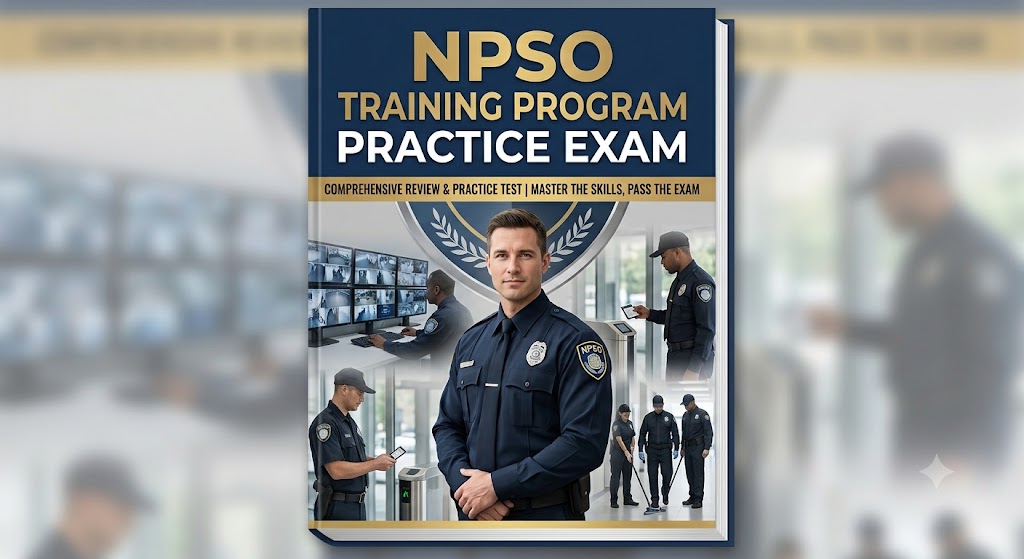
Additional Information
What the Course Entails and Exam Details
The training program is highly intensive and covers a broad spectrum of essential security protocols.
Candidates are immersed in vital topics such as advanced access control procedures, identifying suspicious behaviors, and counter-terrorism awareness.
The syllabus also emphasizes emergency response tactics, including active shooter situations, bomb threats, and medical emergencies.
Furthermore, students learn about the precise legal authorities granted to protective officers, the proper continuum of the use of force, and the specific rules of engagement.
Mastery of patrol procedures, detailed incident report writing, and effective operational communication are also core skills validated by this exam.
What to Expect in the Final Exam
The official NPSOTP final exam is a comprehensive assessment designed to evaluate both theoretical knowledge and situational judgment.
Students should prepare for a proctored, multiple-choice written examination that tests their understanding of the strict protocols taught during the course.
Alongside the written portion, candidates often face practical, scenario-based evaluations where they must demonstrate safe firearms handling, defensive tactics, and proper screening techniques.
A passing score typically requires achieving at least 80% on the written test, though specific contractor requirements may demand an even higher standard of accuracy.
The written exam usually has a strict time limit of around two hours, and it is conducted under closed-book rules to ensure absolute memorization of federal security directives.
How to Study and Exam Centers
Success on the exam requires a structured and disciplined approach to your study routine.
Begin by thoroughly reviewing all standard operating procedures (SOPs) and taking multiple timed practice exams to build your testing endurance.
Using flashcards to memorize exact legal definitions, forms of identification, and the use-of-force continuum is a highly effective strategy.
Additionally, visualizing high-stress scenarios and talking through your exact response steps can help you prepare for the practical evaluation components.
When it comes time to test, exams are typically administered at authorized training academies, Federal Law Enforcement Training Centers (FLETC), or designated third-party testing centers like Pearson VUE, depending on the contracting agency.
Always confirm your specific testing location, arrival time, and required identification through your hiring agency or training coordinator prior to exam day.
Job Opportunities from the Course
Successfully completing this training and passing the exam opens the door to a highly respected and stable career path.
Professionals who earn this credential are in high demand across various government agencies and elite private contracting firms.
You can pursue a role as a Protective Security Officer (PSO), directly guarding federal courthouses, administration buildings, and other sensitive sites.
Other lucrative roles include Federal Security Guard and Access Control Specialist, where you will manage the entry and exit of personnel in highly secure zones.
Frequently Asked Questions
Reviews
5.0
Based on 0 reviews
Leave a Review
No reviews yet. Be the first to review!