
National Real Estate Practice Exam Study Guide
$69.00
- Buy to unlock unlimited access to all Quiz questions and Answers in this Quiz.
- After purchase you can print a PDF of the whole quiz at any point. The PDF will contain the questions and the correct answers.
About this Exam
Embarking on a career in real estate is an exciting journey, and passing the licensing exam is the crucial first step. The National Real Estate Practice Exam is a powerful tool designed specifically to help aspiring real estate agents across the United States prepare for the standardized national portion of their state licensing exam. It simulates the actual testing environment, offering a comprehensive overview of essential concepts and a variety of question formats you'll encounter on exam day. For students, this practice test serves as a vital diagnostic, identifying areas of strength and weakness and boosting confidence, ensuring they are thoroughly prepared to achieve a passing score on the official test and unlock the doors to a rewarding real estate career.
Ready to test your knowledge?
Buy Now to Access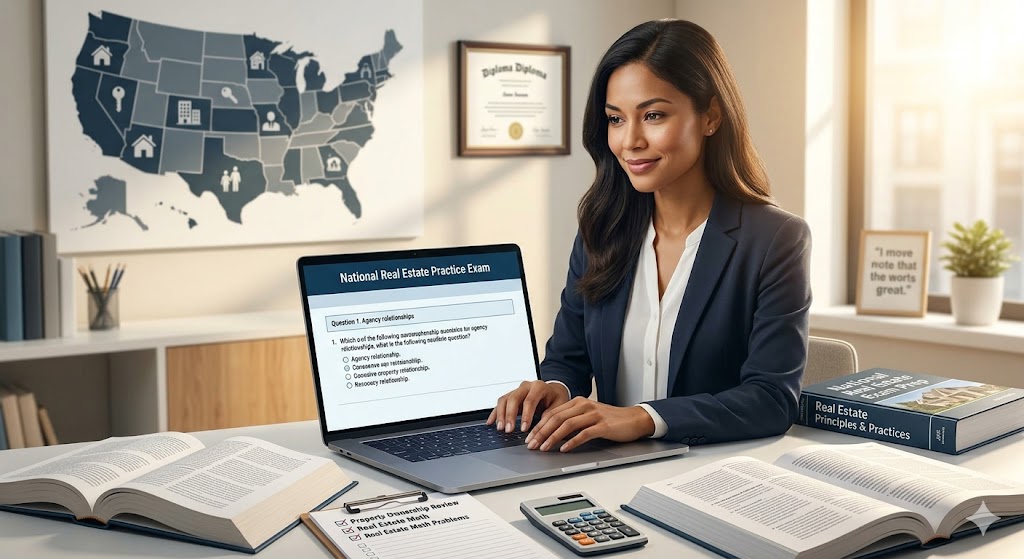
Additional Information
What to Expect in the Final Exam
It's crucial to understand that while the practice exam is an invaluable preparation tool, your ultimate goal is success on the actual national portion of your state's licensing exam. This real test is typically administered by major private testing services like PSI Exams or Pearson VUE, which partner with individual state real estate commissions. You can expect the following: \
Format: The national portion consists primarily of multiple-choice questions, which assess your understanding and application of the standardized concepts. The total number of questions can vary slightly by state but often falls within the range of 75 to 100. \
Passing Score Requirements: Each state and test administrator determines its specific passing score. While scaled scores are often used (e.g., a minimum scaled score of 75 to pass), this generally translates to correctly answering around 70-75% of the questions. In some test centers, you may receive your score immediately upon completion. \
Time Limits: Candidates are typically given a generous time allocation, often 2-3 hours for the national portion, ensuring ample time to carefully consider and answer each question. \
Specific Rules: Real estate licensing exams have strict rules. Expect to be required to present valid government-issued identification upon arrival at the secure testing center. Calculators may be permitted, but only basic, four-function models provided or specifically approved. Phones, study materials, and other unauthorized items are strictly prohibited, and security measures are in place to ensure a fair testing environment.
How to Study and Exam Centers
Effective preparation is paramount. Incorporate these actionable strategies into your study plan for both the practice and the actual national exam: \
Utilize Comprehensive Study Materials: Invest in reputable textbooks, study guides, and online courses that are fully aligned with the content of the national real estate exam. \
Take Multiple Practice Exams: Regularly taking timed, full-length practice tests is one of the most effective ways to build stamina, understand question types, and simulate the exam day experience. Use several diverse practice resources to expose yourself to a wider range of question styles. \
Analyze Weak Areas and Review Thoroughly: After taking practice tests, meticulously review your answers, especially the incorrect ones, to understand why you made a mistake and reinforce that specific concept. \
Practice Real Estate Math Consistently: Real estate math is a critical component that often causes anxiety. Dedicate focused study time to practicing common calculation formulas until you are confident. \
Join a Study Group: Collaborating with fellow students can provide motivation, different perspectives, and opportunities for shared learning. \
Use Flashcards: Create flashcards for key definitions, principles, and concepts for quick and efficient retrieval practice.
Regarding testing locations, practice exams are readily available online through numerous test preparation companies and real estate schools. The final, official national licensing exam, however, must be taken at a secure, physical testing center, typically operated by PSI Exams or Pearson VUE, or in some cases, specific authorized schools or colleges as designated by your state's real estate commission. Students are generally required to register online through the designated administrator's website, schedule their exam date and time, and locate the nearest official center. State specific content is administered separately, often on the same day and at the same center. For the final exam, ensure you check your state's specific commission website and the test administrator's site for registration details and official center locations.
Job Opportunities from the Course
Passing the National Real Estate Practice Exam and subsequently the official licensing exam unlocks a dynamic career field. Some primary job opportunities and career paths after becoming a licensed real estate professional include: \
Residential Real Estate Agent \
Commercial Real Estate Agent \
Real Estate Broker (typically requires significant experience and further licensing/education) \
Leasing Agent or Consultant \
Property Manager or Assistant Property Manager (often requires a real estate license or specialized credential) \
Real Estate Appraiser (requires separate licensure and training) \
Real Estate Investor or Developer \
Corporate Real Estate Specialist or Manager \
Relocation Specialist \
New Home Sales Agent \
Real Estate Transaction Coordinator or Analyst (though licensing is not always strictly required, knowledge is highly valuable) \
Real Estate Educator or Trainer
Frequently Asked Questions
Reviews
5.0
Based on 0 reviews
Leave a Review
No reviews yet. Be the first to review!