
National Safety Code Carrier Safety Cue Card Practice Exam
$69.00
- Buy to unlock unlimited access to all Quiz questions and Answers in this Quiz.
- After purchase you can print a PDF of the whole quiz at any point. The PDF will contain the questions and the correct answers.
About this Exam
Prepare effectively for your Canadian commercial carrier safety certification with this comprehensive study guide for the National Safety Code Carrier Safety Cue Card Practice Exam. This practice resource is meticulously designed for professional truck drivers, fleet managers, safety supervisors, and carrier operators across Canada who must adhere to the high safety standards set by the National Safety Code (NSC). The actual certification is vital for ensuring regulatory compliance, operational safety, and maintaining a positive carrier safety rating. Our guide provides an engaging and structured approach to mastering the core concepts.
Ready to test your knowledge?
Buy Now to Access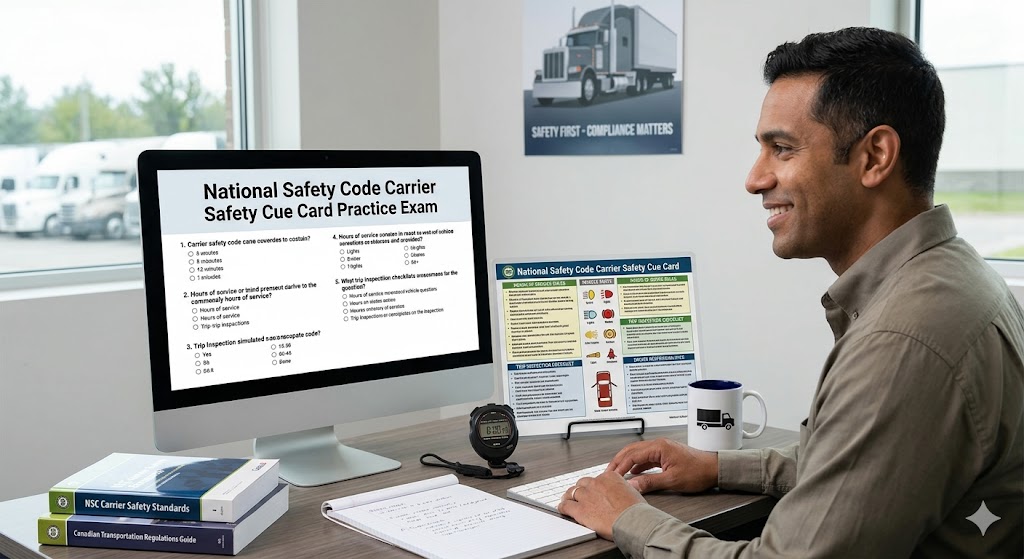
Additional Information
What the Course Entails and Exam Details
This practice exam focuses heavily on the practical application of the critical safety regulations summarized on the widely used National Safety Code Carrier Safety Cue Card. While the actual course and certification encompass the broader 16 NSC standards, this test helps refine your quick recall of essential day-to-day rules. The core topics covered include:
Driver Hours of Service: Understanding Cycle 1 and Cycle 2 limits, daily driving, on-duty, and elapsed time maximums, reset requirements (36/72 hours), and sleeper berth provisions.
Daily Logs: Requirements for recording, monitoring, and retaining logs and supporting documents (typically for 6 months).
Trip Inspection Reports: Pre-trip and post-trip inspection procedures, component checks, defect reporting, and record retention (usually 3 months).
Carrier Responsibilities: Maintaining a current Safety Fitness Certificate, driver monitoring, keeping files, understanding facility audits, and implementing safety policies.
Vehicle Maintenance: Scheduling and documenting repairs and inspections to ensure vehicle safety and compliance.
Cargo Securement & Regulatory Compliance: General awareness of standards and adherence to applicable provincial/territorial and federal laws.
The practice test consists of multiple-choice questions that simulate the format and challenge of the actual certification assessment, focusing on scenario-based application of these crucial rules.
What to Expect in the Final Exam
The final National Safety Code Carrier Safety Certification Exam is the official assessment required to obtain or renew your safety certification in many Canadian jurisdictions. To prepare effectively using this practice resource, understanding the typical format of the final exam is key:
Format: The exam predominantly consists of detailed multiple-choice questions, testing both fundamental knowledge and your ability to apply regulations to real-world carrier situations. Some exams may include practical components or review scenarios depending on the specific province or territory.
Passing Score: Requirements can vary by jurisdiction, but a strong understanding and a high passing grade (often 80% or above) are typically necessary to demonstrate competency.
Time Limit: Expect a strict time limit, requiring you to work efficiently and accurately through all questions. (The practice exam helps build this speed and accuracy).
Specific Rules: Final exams are usually closed-book, proctored assessments. You must complete the exam without referencing the cue card or any other external materials, emphasizing the importance of thorough study and memorization through practice. Ensure you bring valid identification as required by the testing center.
How to Study and Exam Centers
Maximize your study efforts with these actionable strategies:
Utilize the Practice Exam Extensively: Take the National Safety Code Carrier Safety Cue Card Practice Exam multiple times. Treat each attempt like the real test, mimicking exam conditions and timing. Analyze your results to identify weak areas.
Thoroughly Study the Cue Card: Dedicate ample time to memorizing the key summaries and bullet points on the physical or digital Carrier Safety Cue Card. Recreate its core information from memory.
Review Official Documentation: Study the full, detailed National Safety Code standards, provincial/territorial transportation regulations, and official carrier safety manuals. Do not rely solely on the cue card, but use it as a powerful summary tool.
Simulate Closed-Book Testing: As you gain confidence, transition to taking the practice exam and reviewing concepts in a closed-book manner.
Collaborate and Discuss: If possible, study with colleagues. Group discussions of safety scenarios and interpretation of regulations can deepen your understanding.
Exam Centers: The actual final certification exam is administered in several ways, and you should check the specific requirements and locations for your province or territory:
Provincial/Territorial Ministry of Transportation: Contact your local ministry or department responsible for transportation (e.g., ICBC in British Columbia, Alberta Transportation, MTO in Ontario, SAAQ in Quebec) to find physical testing locations, booking procedures, and any online options available.
Authorized Testing Agencies & Industry Associations: Some provinces authorize third-party agencies, driver training schools, or industry associations (like trucking associations) to administer the exam or associated courses.
Online Portals: An increasing number of jurisdictions offer secure, online proctored exams through specific government or authorized educational portals. Always verify that you are using an official and current version of the course and exam.
Job Opportunities from the Course
Successfully completing this certification course and the associated exam demonstrates a vital commitment to safety and compliance, significantly enhancing your career prospects in the transportation and logistics sector. Potential job opportunities include:
Professional Truck Driver: Certification ensures you possess the critical regulatory knowledge needed for safe, legal operation.
Fleet Safety Supervisor: Oversee driver compliance, conduct audits, and manage safety programs within a company.
Transportation Compliance Officer: Monitor adherence to NSC standards and provincial regulations for carriers or within government bodies.
Logistics & Dispatch Coordinator: Integrate safety considerations into daily route planning, driver assignments, and operations.
Dispatcher: Effectively manage driver communications and assignments while being mindful of hours of service limits.
Carrier Operator/Manager: Successfully managing a commercial trucking business requires a deep understanding and implementation of all safety and compliance requirements.
Safety Training Instructor: Educate current and future drivers on NSC standards and company safety policies.
Facility Auditor: (Potentially in specialized roles) Assess carrier facilities and records for compliance with safety standards.
Frequently Asked Questions
Reviews
5.0
Based on 0 reviews
Leave a Review
No reviews yet. Be the first to review!