
National Safety Compliance Practice Exam
$69.00
- Buy to unlock unlimited access to all Quiz questions and Answers in this Quiz.
- After purchase you can print a PDF of the whole quiz at any point. The PDF will contain the questions and the correct answers.
About this Exam
The National Safety Compliance certification is a prestigious credential designed to validate an individual's comprehensive knowledge of workplace health and safety regulations, risk management principles, and best practices for creating a secure working environment. This certification is ideal for safety officers, human resources professionals, facility managers, supervisors, and anyone aiming to specialize in occupational health and safety (OHS) across diverse industries. By earning this designation, professionals demonstrate their commitment to regulatory adherence, accident reduction, and the well-being of their workforce, thereby enhancing their professional standing and organizational value.
Ready to test your knowledge?
Buy Now to Access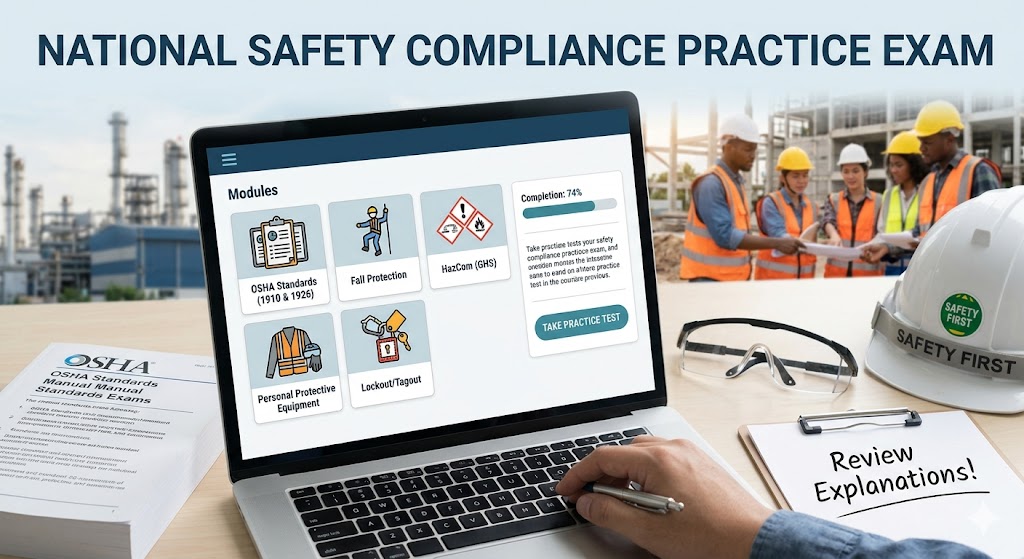
Additional Information
What the Course Entails and Exam Details
The course of study preparing students for the National Safety Compliance exam covers a rigorous syllabus divided into several core domains. Candidates must master a broad range of topics, ensuring they can apply theoretical knowledge to real-world safety scenarios.
Key knowledge areas typically include:
Regulatory Frameworks: A deep dive into relevant national and local safety standards, such as those established by OSHA (Occupational Safety and Health Administration) or equivalent national bodies, including recording and reporting requirements.
Hazard Identification and Control: Methods for recognizing, evaluating, and controlling common workplace hazards, including chemical, biological, physical, and ergonomic risks.
Safety Program Management: Strategies for developing, implementing, and auditing effective health and safety management systems, including emergency preparedness and response planning.
Risk Assessment and Mitigation: Techniques for conducting thorough risk assessments, prioritizing risks, and applying the hierarchy of controls to minimize potential harm.
Workplace Inspection and Auditing: Procedures for planning and executing effective workplace safety inspections, analyzing findings, and recommending corrective actions.
Employee Training and Communication: Best practices for designing and delivering engaging safety training and fostering a robust safety culture within an organization.
What to Expect in the Final Exam
Understanding the exam format is crucial for success. The National Safety Compliance final exam is a comprehensive evaluation designed to test both foundational knowledge and the practical application of safety principles.
The final exam generally follows this structure:
Format: Computer-based testing (CBT), consisting of multiple-choice questions. Some versions may include scenario-based questions that require candidates to analyze a workplace situation and determine the best compliance path.
Number of Questions: Approximately 100 to 125 questions, evenly distributed across the major domains of the syllabus.
Time Limit: Candidates are typically allotted 2.5 to 3 hours to complete the examination.
Passing Score: The passing score is generally scaled, but aims for an equivalent of 70% to 75% correct answers.
Rules: This is a closed-book examination. No reference materials, smartphones, or outside assistance are permitted during the test.
How to Study and Exam Centers
Preparation is the key to conquering the National Safety Compliance exam. A structured study plan combining theoretical review with practical application is highly recommended.
Actionable Study Strategies:
Master the Core Standards: Begin by thoroughly reviewing the primary safety standards tested. Create flashcards for key regulations, permissible exposure limits, and required documentation.
Utilize Practice Exams: Regularly taking full-length practice tests, like the National Safety Compliance Practice Exam, is essential. These mock exams familiarize you with the question format, pacing, and help identify areas needing further review.
Analyze Scenario Questions: Safety compliance is rarely black and white. Practice breaking down complex workplace scenarios to determine the regulatory breach and the most effective corrective action.
Join Study Groups: Engaging with peers can provide new perspectives and clarify challenging concepts.
Exam Centers and Registration:
The National Safety Compliance exam is administered primarily through secure, proctored environments to maintain the credential's integrity. Candidates have two main options for taking the test:
Authorized Physical Testing Centers: The exam is widely available at established computer-based testing networks worldwide, such as Pearson VUE or Prometric facilities. These centers offer a controlled environment with dedicated proctors.
Online Proctored Exams: Many candidates now have the option to take the exam remotely via a secure online proctoring portal. This requires a reliable internet connection, a webcam, and a private room that meets the strict testing environment requirements.
Candidates must register for the exam in advance through the official certification board's website, where they can select their preferred testing method and schedule a date and time.
Job Opportunities from the Course
Earning a National Safety Compliance certification opens doors to a variety of rewarding career paths focused on protecting workers and ensuring organizational legal adherence.
This certification prepares you for roles such as:
Safety Compliance Officer
Occupational Health and Safety (OHS) Specialist
Environmental Health and Safety (EHS) Coordinator
Loss Prevention Manager
Facility Safety Supervisor
Risk Management Analyst
HR Compliance Manager (Safety Focus)
Safety Trainer and Consultant
Corporate Safety Director
Frequently Asked Questions
Reviews
5.0
Based on 0 reviews
Leave a Review
No reviews yet. Be the first to review!