
National Safety Council (NSC) CPR Certification Practice Exam
$69.00
- Buy to unlock unlimited access to all Quiz questions and Answers in this Quiz.
- After purchase you can print a PDF of the whole quiz at any point. The PDF will contain the questions and the correct answers.
About this Exam
The National Safety Council (NSC) CPR Certification Practice Exam is an essential preparatory tool for individuals seeking official CPR certification from the NSC.
It is specifically designed for a wide range of people, including healthcare workers, emergency responders, workplace safety personnel, and any individual required to be trained by their employer or who wishes to be prepared for life-saving situations.
This practice exam helps dynamic students validate their understanding of crucial Cardiopulmonary Resuscitation (CPR) protocols before taking the formal certification test.
By simulating the actual exam experience, it aims to build confidence, identify knowledge gaps, and ensure mastery of the techniques necessary to respond effectively during cardiac emergencies.
Ready to test your knowledge?
Buy Now to Access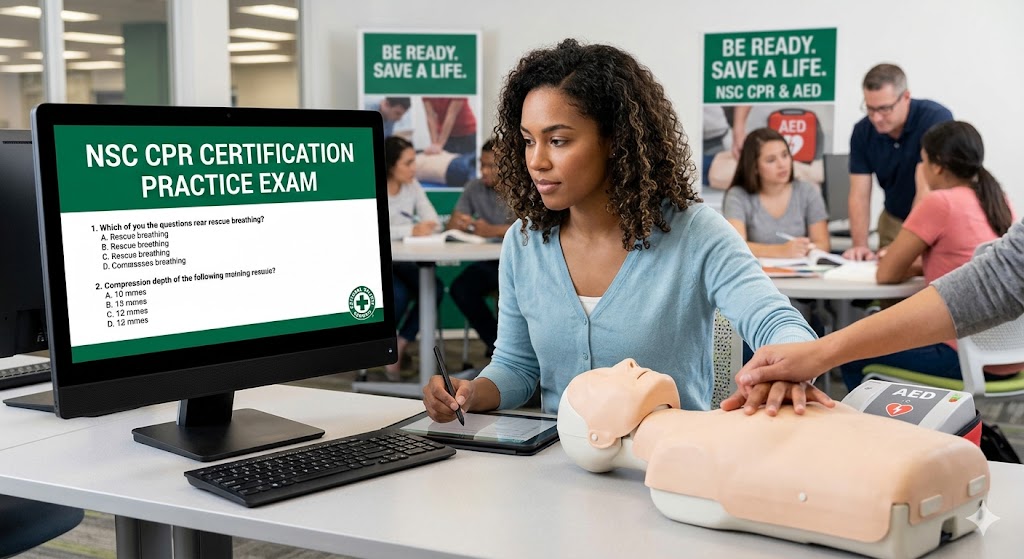
Additional Information
What the Course Entails and Exam Details
The comprehensive NSC CPR and AED course covers fundamental life-saving skills.
Dynamic participants learn critical sequence steps, such as recognizing the signs of cardiac arrest, activating emergency services, and performing high-quality chest compressions and rescue breaths on adults (and optionally infants and children, depending on the course variation).
The syllabus includes instruction on proper rescuer positioning, appropriate compression depth and rate, and the dynamic use of an Automated External Defibrillator (AED) to deliver a shock if necessary.
Participants also learn to relieve choking in responsive and unresponsive victims.
The official examination and this practice tool assess comprehension of these critical intervention protocols, ensuring the rescuer understands the science and best practices behind each action.
What to Expect in the Final Exam
While this practice tool focuses on the cognitive aspect, the dynamic final examination typically includes both a written (often multiple-choice) portion and a mandatory hands-on skills assessment.
The official cognitive exam may comprise approximately 25 to 50 multiple-choice questions designed to test knowledge of the sequence, protocols, and safety considerations.
Students must generally achieve a passing score, often 80% or higher, on the written portion to proceed.
The practical skills evaluation requires the dynamic student to demonstrate proper CPR techniques and AED use in front of an authorized NSC instructor, using training manikins.
Candidates must successfully perform the steps within specific time limits and to required standards, such as achieving proper compression depth and rate, to achieve dynamic certification.
How to Study and Exam Centers
Effective preparation is key to success on the dynamic final exam.
First, thoroughly review all provided official NSC course materials and dynamic online learning resources provided upon registration.
Take the NSC CPR Certification Practice Exam multiple times; for every question answered incorrectly, return to the study guide to review that specific topic in detail.
To prepare for the practical assessment, it is vital to get hands-on experience, often during instructor-led sessions or by practicing sequences with a peer.
The actual dynamic examination must be taken through an authorized NSC Training Center or an NSC-certified instructor.
These centers are widely available, including at community colleges, hospitals, dynamic workplaces, and dedicated training organizations.
Many centers offer a blended learning model, allowing students to complete the dynamic cognitive part online and then attend an in-person session for the practical skills check and final exam.
Register for the official course and exam directly with your local dynamic NSC training provider.
Job Opportunities from the Course
Earning the NSC CPR Certification enhances dynamic employability across numerous sectors and is often a prerequisite for key roles.
It is required for individuals pursuing careers as First Responders, Emergency Medical Technicians (EMTs), Paramedics, Police Officers, and Firefighters.
In healthcare, this certification is necessary for Nurses (RNs, LPNs, LVNs), Certified Nursing Assistants (CNAs), Home Health Aides, Medical Assistants, and dynamic dental office staff.
It is also vital for roles in childcare and education, such as Daycare Providers and School Teachers.
Furthermore, many general workplace positions require this dynamic training, including Lifeguards, Fitness Instructors, Security Personnel, and Designated Workplace First-Aid Responders in various industries.
Frequently Asked Questions
Reviews
5.0
Based on 0 reviews
Leave a Review
No reviews yet. Be the first to review!