
National Standard Master Mechanical F29 Practice Exam
$69.00
- Buy to unlock unlimited access to all Quiz questions and Answers in this Quiz.
- After purchase you can print a PDF of the whole quiz at any point. The PDF will contain the questions and the correct answers.
About this Exam
The National Standard Master Mechanical (F29) certification represents the pinnacle of achievement for mechanical professionals in the construction and trades industry. This designation is designed specifically for experienced HVAC and mechanical technicians, engineers, and contractors who wish to validate their advanced expertise. It signifies a comprehensive understanding of complex mechanical systems, encompassing design, installation, maintenance, and essential safety regulations. Achieving this Master level is a critical milestone, often required for obtaining the top-tier contractor licensing needed to lead major projects and run a mechanical business.
Ready to test your knowledge?
Buy Now to Access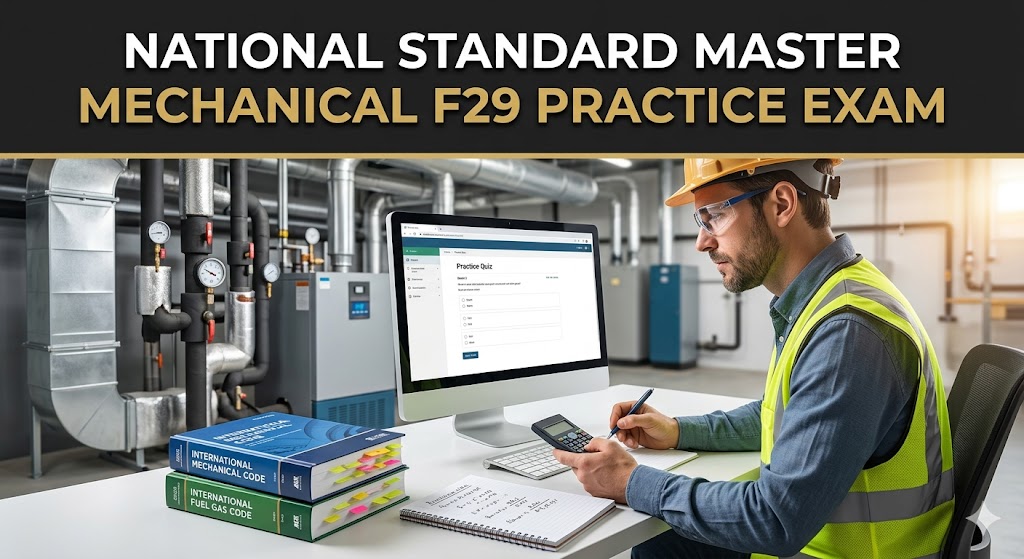
Additional Information
What the Course Entails and Exam Details
Preparing for this exam requires a deep dive into advanced mechanical engineering principles and administrative codes. The content is heavily rooted in standardized regulations, primarily focusing on the International Mechanical Code (IMC) and the International Fuel Gas Code (IFGC). Candidates must demonstrate mastery over widespread technical subjects.
The core syllabus covers the detailed design and safe installation of heating, ventilation, and air conditioning systems. It includes rigorous sections on refrigeration systems, chimneys and vents, and specific appliances. You must understand complex duct systems, exhaust hoods, and combustion air requirements. Furthermore, a substantial portion of the exam is dedicated to the safe piping of fuel gas and hydronic heating systems, ensuring comprehensive safety and structural integrity.
What to Expect in the Final Exam
The actual National Standard Master Mechanical (F29) examination is a rigorous assessment designed to test both your practical knowledge and your ability to interpret complex code standards quickly. It is typically administered as a computerized, multiple-choice test. As a master-level exam, the questions often present scenario-based problems that require critical thinking rather than simple fact recall.
The exam is generally "open-book," meaning you are permitted to use approved editions of the referenced codebooks during the test. Do not mistake "open-book" for easy; the time constraint is a significant factor, and you must know exactly where to find information. Candidates are typically allowed a generous time limit, often around 4 hours (240 minutes). While the exact passing score can vary slightly by jurisdiction, you should generally aim for a score of 70% to 75% or higher to guarantee success.
How to Study and Exam Centers
Effective preparation is the key to passing this challenging exam. Because the test is based heavily on standardized codes, your primary study tool must be the specified International Code Council (ICC) reference manuals. Invest in the current editions of the International Mechanical Code (IMC) and International Fuel Gas Code (IFGC).
A critical study technique is "tabbing" and highlighting your codebooks. Organize these lengthy references by key chapters so you can locate specific codes instantly during the timed exam. The most effective strategy, however, is taking multiple timed National Standard Master Mechanical (F29) Practice Exams. These simulations will familiarize you with the wording of the questions and help you master the speed needed to navigate your references under pressure.
The official examination is typically administered through authorized third-party testing organizations, such as Pearson VUE. These partners maintain a vast network of secure, proctored physical testing centers located in cities across the country. You must register through your state or local licensing board or directly through the ICC website to schedule your exam appointment at a convenient location.
Job Opportunities from the Course
Securing the National Standard Master Mechanical (F29) credential is a transformative step that dramatically elevates your career potential and earning trajectory. This certification is widely recognized by employers and regulatory bodies as proof of elite trade expertise and dedication.
It transitions you from a standard technician to a qualified leader, allowing you to pull permits for large-scale projects and supervise entire crews. Specific job titles and career paths unlocked by this certification include the following:
Licensed Mechanical Contractor
HVAC/R Project Manager
Facilities Manager for Large Complexes
Lead Mechanical Code Inspector
Construction Superintendent (Mechanical Focus)
Chief Mechanical Engineer (Trade Level)
Owner of a Mechanical Contracting Firm
Mechanical Systems Consultant
Frequently Asked Questions
Reviews
5.0
Based on 0 reviews
Leave a Review
No reviews yet. Be the first to review!