
NATOPS VT‑10 Primary Practice Test
$69.00
- Buy to unlock unlimited access to all Quiz questions and Answers in this Quiz.
- After purchase you can print a PDF of the whole quiz at any point. The PDF will contain the questions and the correct answers.
About this Exam
The NATOPS VT-10 Primary Practice Test is a crucial internal evaluation designed for Student Naval Flight Officers (SNFOs) at Training Squadron TEN (VT-10). Known as the "Wildcats," VT-10, based at Naval Air Station Pensacola, is responsible for the foundational, or "Primary," phase of flight training for future Navy and Marine Corps NFOs. This test, often delivered as part of a block exam, assesses a student's initial comprehension of the Naval Air Training and Operating Procedures Standardization (NATOPS) program for their training aircraft, the T-6A Texan II. It is a vital milestone that ensures students possess the requisite safety and procedural knowledge before advancing to the complex, high-stakes flight operations of the Primary phase.
Ready to test your knowledge?
Buy Now to Access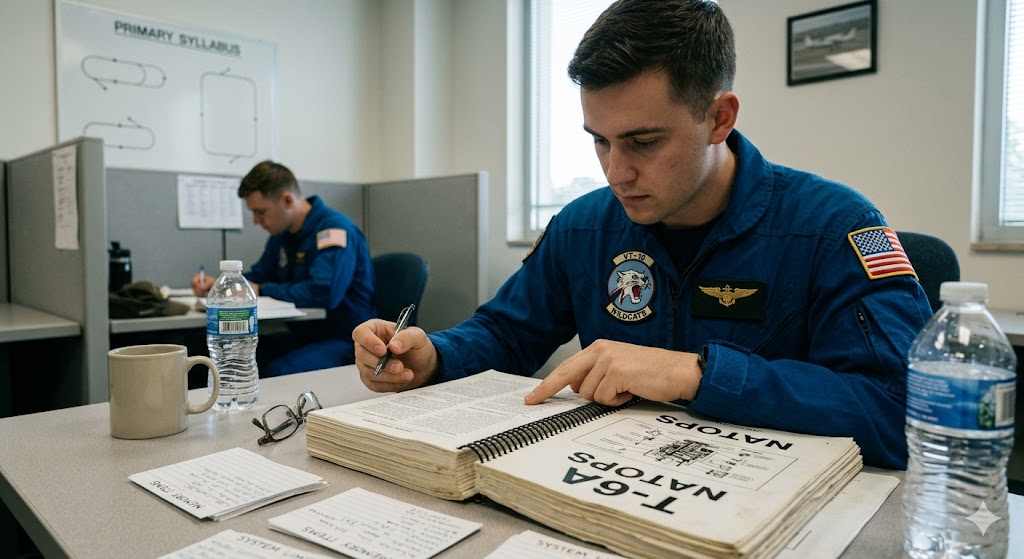
Additional Information
What the Course
Entails and Exam Details
The Primary syllabus at VT-10, for which this test serves as
a critical knowledge check, focuses on transforming students into proficient
military aviators. The test itself deep-dives into the T-6A NATOPS manual and
related standardization materials. Core topics covered include:
- T-6A
Systems: In-depth knowledge of the aircraft's powerplant, electrical,
hydraulic, fuel, environmental, and avionics systems.
- Normal
Procedures: A flawless understanding of checklists for all phases of
flight, from pre-flight to engine shutdown.
- Emergency
Procedures: Immediate, from-memory actions for critical in-flight
emergencies, as well as procedural knowledge of all complex malfunctions.
- General
Flight and Operating Instructions: An application of the "CNAF
M-3710.7," the overarching manual for all Naval aviation, focusing on
flight rules and regulations.
- Local
Course Rules: Specific procedures for operating in the busy NAS
Pensacola and surrounding airfield environments.
- VT-10
Standardization Notes: Squadron-specific policies and "best
practices" that complement the general NATOPS guidance.
The practice test is typically a comprehensive written exam
that precedes the official, graded NATOPS evaluations.
What to Expect in
the Final Exam
While the "practice" version is a
squadron-administered tool, it is explicitly modeled to simulate the rigor of
the official NATOPS examination, which all aviators must pass annually.
Students can expect a closed-book, multiple-choice format, often containing 50
to 100 questions. The questions are designed to be challenging, testing not
only factual recall but also the ability to apply procedural knowledge to
specific scenarios.
The time limit is strict, reinforcing the need for rapid
recall under pressure, crucial in dynamic flight environments. A passing score
on the official NATOPS exam is high, often 80% to 90%, with some sections,
particularly on critical emergency "boldface" or memory items,
requiring 100?curacy. The primary practice test uses similar, if not
identical, standards to provide students with a realistic assessment of their
readiness and to identify areas requiring additional focus.
How to Study and
Exam Centers
Preparation for the NATOPS VT-10 Primary Practice Test must
be proactive and disciplined, reflecting the demands of military flight
training.
Effective Study Strategies:
- Deep
Manual Dive: Your primary text is the T-6A NATOPS. Do not just read
it; dissect it. Use highlighters, take detailed notes, and draw diagrams
to master aircraft systems and procedures.
- Flashcards
for Limits and "Boldface": Utilize digital or physical
flashcards for all aircraft operational limitations (e.g., airspeeds,
engine temperatures, G-limits) and especially for all "Boldface"
or critical-action steps in emergency procedures. You must know these
verbatim.
- The
"Study-Buddy" Method: Form study groups to
"chair-fly" procedures and quiz each other. One student can act
as the Instructor Pilot, presenting scenarios, while the other executes
the correct checklist or memory item.
- Leverage
Squadron Resources: Use the squadron's "Ready Room,"
computer-based training modules, and study guides, including any
"Stan Notes" and "FTI" (Flight Training Instruction)
supplemental materials.
- Simulation:
Practice procedures and checklist flows in the squadron's flight
simulators. This reinforces academic knowledge with tactile, real-world
application.
Exam Locations:
This exam is not available at public centers like Pearson
VUE. It is a military-specific evaluation conducted internally by the Training
Squadron TEN (VT-10) academic or standardization department at NAS Pensacola,
Florida. Students are scheduled for the test as they progress through the
syllabus within Training Air Wing SIX (TW-6).
Job Opportunities
from the Course
Successfully navigating the Primary phase at VT-10,
validated by tests like the NATOPS Primary Practice Test, is the essential
first step towards earning your wings as a Naval Flight Officer.
Completion of the entire VT-10 syllabus leads to specific
career tracks based on the platform you are selected to fly. Potential job
roles and platforms include:
Naval Flight Officer Career Paths:
- Strike
Fighter: Operating in the F/A-18F Super Hornet (as a Weapons Systems
Officer) and EA-18G Growler (as an Electronic Warfare Officer).
- Maritime
Patrol and Reconnaissance: Flying as a tactical coordinator in the
P-8A Poseidon.
- Airborne
Command and Control: Serving as a mission commander in the E-2C/D
Hawkeye or as a communications officer in the E-6B Mercury.
- Strategic
Communications: Positions within the E-6B Mercury community.
Frequently Asked Questions
Reviews
5.0
Based on 0 reviews
Leave a Review
No reviews yet. Be the first to review!