
Natural Sciences CLEP Practice Exam Prep
$69.00
- Buy to unlock unlimited access to all Quiz questions and Answers in this Quiz.
- After purchase you can print a PDF of the whole quiz at any point. The PDF will contain the questions and the correct answers.
About this Exam
The Natural Sciences CLEP (College-Level Examination Program) exam is a comprehensive computer-based test designed to measure a student’s understanding of introductory physical and biological science.
It is specifically created for individuals seeking college credit without enrolling in a semester-long course.
Successful completion allows students to demonstrate knowledge equivalent to standard college freshman or sophomore requirements, saving significantly on both time and tuition costs.
Ready to test your knowledge?
Buy Now to Access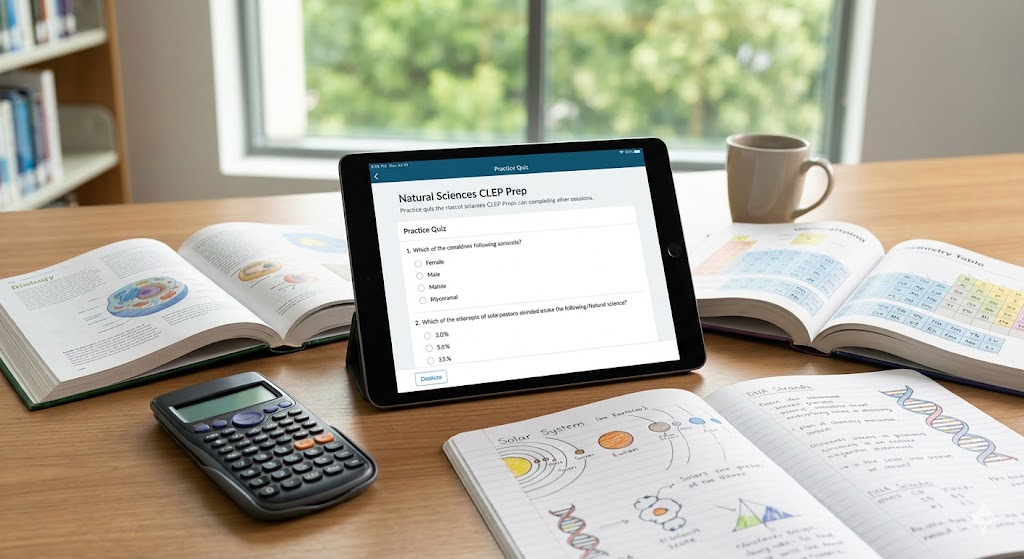
Additional Information
What the Course Entails and Exam Details
The exam content is divided almost equally between Biological Sciences (50%) and Physical Sciences (50%).
In the Biological Science category, topics include:
Origin and evolution of life
Cell organization and molecular biology
Classic genetics and modern inheritance
Population biology, ecosystems, and human ecology
In the Physical Science category, subjects covered are:
Atomic and nuclear structure and properties
Chemical elements, reactions, and stoichiometry
Thermodynamics, matter, and chemical bonding
Classical mechanics, electricity, and magnetism
Earth science and basic geology
Astronomy and the structure of the universe
The examination assesses factual knowledge as well as the ability to interpret scientific data and understand fundamental principles.
What to Expect in the Final Exam
Candidates should expect a computer-administered test consisting of approximately 115 multiple-choice questions.
You will be given exactly 90 minutes to complete the exam.
Some questions require not just knowledge, but the analytical skill to evaluate information presented in tables, charts, and graphs.
A non-programmable, four-function calculator is often provided within the testing software for specific questions.
CLEP scores are reported on a scaled range from 20 to 80; while passing scores vary by institution, a score of 50 is generally considered the minimum for credit.
How to Study and Exam Centers
Effective Study Strategies:
Because this exam covers a vast amount of material, start by reviewing standard high school or introductory college textbooks on general biology and physical science.
Focus on understanding major cycles (e.g., the water cycle, Krebs cycle) and fundamental laws (e.g., Newton’s laws, basic thermodynamics).
The most crucial study tool is a reliable "Natural Science CLEP Practice Exam" to gauge your readiness and identify weakness areas.
We recommend timed practice tests to familiarize yourself with the 90-minute constraint.
Testing Information and Locations:
CLEP exams are not taken online at home but at official designated testing centers.
These centers are located at over 2,000 college and university test centers and independent test centers across the United States and internationally.
You must register through the official College Board website, where you can locate and select a testing center near you.
Job Opportunities from the Course
Passing the Natural Sciences CLEP does not grant a specific professional certification, but it accelerates degree completion. This acceleration allows individuals to enter science-related career paths faster. Possible job titles upon graduation include:
Laboratory Technician
Research Assistant
Environmental Consultant (Entry-Level)
Science Teacher (with required licensure)
Conservation Specialist
Chemical Sales Representative
Pharmaceutical Representative
Health Care Administrator (supporting role)
Geological Technician
Frequently Asked Questions
Reviews
5.0
Based on 0 reviews
Leave a Review
No reviews yet. Be the first to review!