
Naval Academy Reef Points Practice Exam
$69.00
- Buy to unlock unlimited access to all Quiz questions and Answers in this Quiz.
- After purchase you can print a PDF of the whole quiz at any point. The PDF will contain the questions and the correct answers.
About this Exam
The Naval Academy Reef Points Practice Test serves as an essential preparatory resource for prospective and incoming midshipmen facing the rigorous professional knowledge requirements of the United States Naval Academy (USNA). This assessment is meticulously designed for individuals appointed to the Naval Academy, candidates aiming for admission, and current "plebes" (freshmen) seeking to solidify their foundational knowledge during the demanding Plebe Summer and throughout their first academic year. Mastering "Reef Points," the quintessential USNA midshipman handbook, is non-negotiable for success in Annapolis. This practice exam offers a high-stakes simulation, allowing candidates to evaluate their retention of critical naval traditions, history, leadership principles, and institutional facts necessary to succeed in a culture of excellence.
Ready to test your knowledge?
Buy Now to Access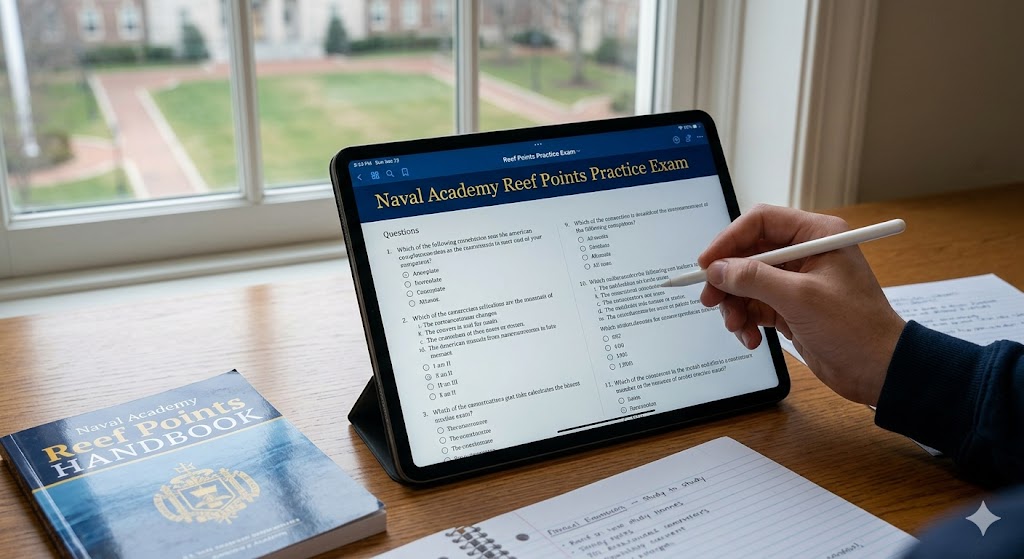
Additional Information
What the Course Entails and Exam Details
This comprehensive practice experience is not a traditional "course" in a classroom setting; rather, it is a self-paced, iterative testing method based solely on the material found within the current edition of Reef Points. The content focuses intensely on rote memorization and immediate recall of professional knowledge essential to Naval Academy life. Core topics covered within the practice test include the USNA Mission, the Chain of Command (both military and civilian), the 11 General Orders of a Sentry, the Articles of the Code of Conduct, the foundational history and traditions of the Naval Academy, significant dates in naval history, military etiquette, and the accurate names and definitions of various ranks, rates, and components of the U.S. Navy and Marine Corps. The exam ensures candidates are ready to articulate this information under pressure, a skill tested daily during "rates" (required knowledge memorization and recitation) at the Academy.
What to Expect in the Final Exam
While there is no single, third-party "final certification exam" for Reef Points outside the Naval Academy itself, this practice test simulates the format candidates will encounter in high-stakes professional knowledge (Pro-Know) quizzes during Plebe Summer and throughout their plebe year. Candidates should expect a fast-paced environment with a variety of question formats, including multiple-choice, matching (especially for ranks and dates), and fill-in-the-blank (common for reciting orders or mission statements). In the actual USNA environment, the "passing score" requirement is exceptionally high, often exceeding 90% or even requiring 100?curacy on specific key knowledge areas like the General Orders or Mission Statement. The time limits are strict, emphasizing instant recall rather than deep contemplation, as rapid access to this information is critical in operational and high-stress scenarios.
How to Study and Exam Centers
Effective study strategies for mastering Reef Points require dedication and active recall methods. Candidates should first obtain the most current physical copy or PDF version of Reef Points. Successful study techniques include the creation of physical or digital flashcards (using platforms like Anki or Quizlet) for terms, dates, and names. Recitation is vital; candidates must practice speaking the required knowledge (rates) out loud to achieve fluency and confidence, ideally mimicking the "braced up" posture required of plebes. Simulating the exam environment by taking timed practice tests regularly will help build speed and stamina. This particular practice exam is administered via secure online portals, specifically designed self-study websites, or specialized prep applications. The official high-stakes testing, however, occurs exclusively within the confines of the United States Naval Academy in Annapolis, Maryland, during Plebe Summer and the academic year.
Job Opportunities from the Course
Mastery of the content within Reef Points, validated by passing this practice exam, is a fundamental prerequisite for successful completion of Plebe Summer and the overarching four-year curriculum at the United States Naval Academy. Success at USNA ultimately leads to a Bachelor of Science degree and a commission in the United States military. While the knowledge itself isn't a job license, it unlocks the following career paths within the Navy and Marine Corps upon graduation:
Navy Ensign (Surface Warfare Officer)
Navy Ensign (Submarine Officer)
Navy Ensign (Naval Aviator / Naval Flight Officer)
Navy Ensign (SEAL Officer)
Navy Ensign (Explosive Ordnance Disposal Officer)
Navy Ensign (Cyber Warfare Engineer)
Marine Corps Second Lieutenant (Ground Combat Officer - various specialties)
Marine Corps Second Lieutenant (Marine Aviator)
Marine Corps Second Lieutenant (Cyber / Intelligence Officer)
Frequently Asked Questions
Reviews
5.0
Based on 0 reviews
Leave a Review
No reviews yet. Be the first to review!