
Naval Safety Forces Pin Practice Exam
$69.00
- Buy to unlock unlimited access to all Quiz questions and Answers in this Quiz.
- After purchase you can print a PDF of the whole quiz at any point. The PDF will contain the questions and the correct answers.
About this Exam
Achieving the Naval Safety Forces (NSF) Pin is a prestigious milestone, symbolizing a Sailor's dedication and comprehensive mastery of safety protocols within naval environments. The NSF qualification signifies that personnel have met stringent requirements in general safety, operational safety, environmental protection, and emergency management. This practice test is designed explicitly for Sailors striving to earn this elite warfare qualification, providing a realistic simulation of the knowledge required to succeed. By utilizing this study resource, personnel can identify knowledge gaps, reinforce critical safety concepts, and build the confidence necessary to pass the formal written examination on their first attempt. This program is essential for designated personnel responsible for maintaining a proactive safety posture and ensuring operational readiness across the fleet.
Ready to test your knowledge?
Buy Now to Access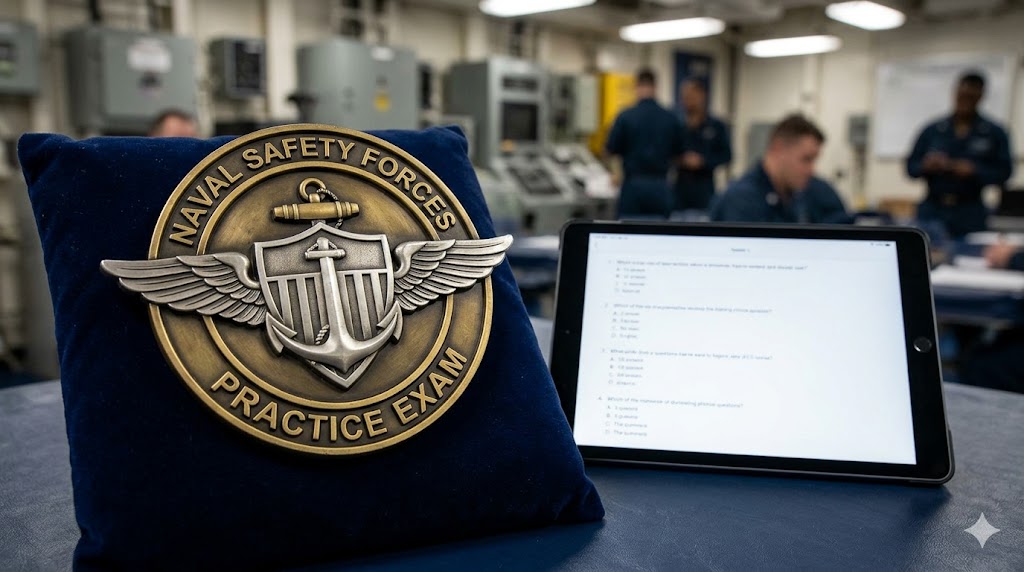
Additional Information
What the Course Entails and Exam Details
The path to earning the NSF Pin requires dedicated study of the applicable Personnel Qualification Standards (PQS), governing directives, and safety manuals. The NSF syllabus covers a broad spectrum of safety disciplines, mandating that candidates can not only define concepts but also apply them in operational scenarios. Key topics generally included within the scope of the assessment include:
General Safety Principles and NAVOSH (Navy Occupational Safety and Health) Program Fundamentals.
Operational Safety (OPSEC) integrated with Operational Risk Management (ORM) principles.
Physical Security protocols, access control, and force protection requirements.
Environmental safety regulations, hazardous material (HAZMAT) control, and spill response procedures.
Emergency management, disaster preparedness, and contingency planning.
Workplace safety, including lockout/tagout (LOTO), electrical safety, and PPE requirements.
Safety reporting procedures, mishap investigation, and hazard analysis.
Command safety program management and the roles of the Safety Officer and collateral duty safety personnel.
What to Expect in the Final Exam
While individual command requirements and test variations may exist, candidates should anticipate a rigorous assessment environment for the NSF Pin written exam. The final exam typically adopts a multiple-choice format, requiring candidates to select the single best answer from the options provided. A minimum passing score, often set around 80 percent, is required to demonstrate the necessary proficiency for qualification. Candidates should be prepared for a closed-book examination administered within a set time limit, typically ranging from one to two hours depending on command instructions. Mastery of the specific NAVEDTRA PQS references and related instructions is critical, as questions will be directly drawn from the established qualification criteria.
How to Study and Exam Centers
Effective preparation for the NSF qualification requires a disciplined and consistent study approach focused on the Personnel Qualification Standards. Sailors must actively engage with the PQS managers and subject matter experts (SMEs) to complete the required signatures and practical applications before taking the written exam. Utilize the NSF PQS as your primary study guide, ensuring you can explain, discuss, or perform every line item listed. Creating flashcards for key terms, regulatory references, and acronyms is highly recommended. Form study groups with peers who are also pursuing the qualification to practice discussing scenarios and reviewing the material. Finally, leverage this Naval Safety Forces Pin Practice Exam as a crucial final review tool to simulate exam conditions, improve time management, and boost your overall scoring potential.
The final written examination for the NSF Pin is not administered through standard civilian testing networks like Pearson VUE or Prometric. Instead, the testing process is managed internally by the command's training department or safety department. Authorized schools or command-designated proctors will administer the written test at physical testing facilities located on military installations or aboard naval vessels. Once you have completed all PQS requirements, including oral boards and signatures, coordinate with your departmental training petty officer or Command Career Counselor to schedule the formal written exam at the authorized local testing location.
Job Opportunities from the Course
Successfully earning the Naval Safety Forces Pin significantly enhances a Sailor's professional profile and demonstrates a high level of technical proficiency and commitment to safety leadership. This qualification is particularly valuable for personnel serving in security, law enforcement, safety, and training ratings within the Navy. Key career paths and specialized roles that this certification helps unlock include:
Master-at-Arms (MA) Specializations
Installation Safety Officer
Command Safety Manager
Physical Security Specialist
Force Protection Officer
Anti-Terrorism/Force Protection (AT/FP) Training Specialist
HAZMAT Program Coordinator
Industrial Safety Specialist
Security Operations Manager
Frequently Asked Questions
Reviews
5.0
Based on 0 reviews
Leave a Review
No reviews yet. Be the first to review!