
Navigating Success: The AWF Test 6 Practice Exam Study Guide
$69.00
- Buy to unlock unlimited access to all Quiz questions and Answers in this Quiz.
- After purchase you can print a PDF of the whole quiz at any point. The PDF will contain the questions and the correct answers.
About this Exam
The Naval Aircrewman – Mechanical (AWF) rating represents a dedicated group of professionals responsible for both flight duties and the critical maintenance and operation of naval aircraft, primarily within transport, patrol, and special mission squadrons. The AWF Test 6 is a fundamental assessment within this training pipeline, focusing on core mechanical systems, operational procedures, and safety protocols essential for crew performance and aircraft integrity. This exam is a hurdle designed to validate that candidates have the foundational knowledge required to operate effectively and safely as part of an integrated aircrew. It targets individuals already within the AWF training path, ensuring they meet the stringent standards set by the Navy before advancing to more complex responsibilities.
Ready to test your knowledge?
Buy Now to Access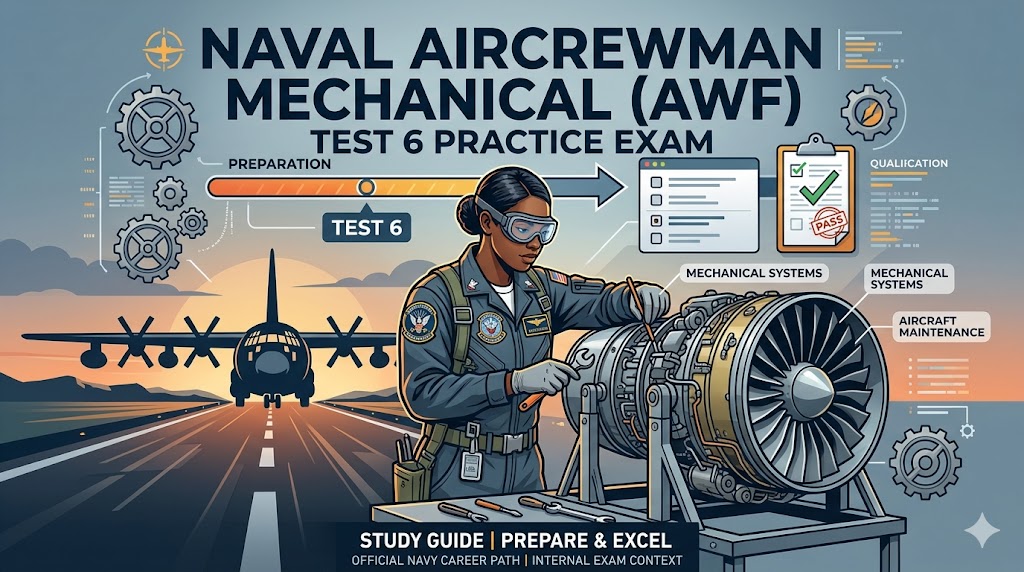
Additional Information
What the Course Entails and Exam Details
The path leading to Test 6 involves immersion in a curriculum that bridges the gap between basic naval training and advanced aircrewman skills. Test 6 specifically covers an extensive syllabus detailing various aircraft systems, operational doctrines, and the maintenance responsibilities of an AWF. Key areas of focus typically include:
Aircraft Powerplants: Deep dives into the operational principles, components, and maintenance procedures of turboprop and turbojet engines utilized by AWF platforms (e.g., C-130, P-3/P-8, etc.).
Fuel, Hydraulic, and Pneumatic Systems: Comprehensive understanding of the storage, transfer, monitoring, and troubleshooting of these essential fluid power systems, including relevant emergency procedures.
Flight and Propulsion Controls: Detailed knowledge of how pilots control the aircraft and how the engines’ power is managed and directed.
Aircraft Structure and Corrosion Control: Learning the fundamentals of airframe integrity, identifying stress points, and applying mandatory Navy protocols for inspecting and preventing the destructive effects of corrosion in maritime environments.
Emergency Procedures: Mastery of flight line and in-flight emergency protocols, including fire suppression, system failures, and aircrew responsibilities during critical incidents.
Standard Operating Procedures (SOPs): Rigorous application of the rules, regulations, and checklists that govern everyday AWF operations both on the ground and in the air.
What to Expect in the Final Exam
The AWF Test 6 is a standardized assessment designed to evaluate your operational readiness and technical proficiency. It typically follows a structured multiple-choice format, allowing for efficient objective evaluation of a broad range of topics. Here is what candidates can generally expect:
Format: Multiple-choice questions are the standard, requiring you to select the best answer from the provided options. Questions can range from purely technical definitions to scenario-based assessments.
Time Limit: A strict time limit will be enforced, often reflecting the time-sensitive nature of operational duties. Candidates must practice answering questions accurately and efficiently.
Passing Score: The Navy sets a high bar for passing, often requiring a score within the top percentile of trainees. Achieving a score well above the minimum passing standard is essential for progressing without delay in your training pipeline.
Authorized Testing Environment: This is not an open-book exam. Testing will take place in a proctored environment, typically within a military school or authorized Naval training facility, ensuring test security and integrity.
How to Study and Exam Centers
Preparing for the AWF Test 6 demands a proactive and structured approach. Passive studying will likely not suffice; active engagement with the material is paramount for success. Utilize these strategies:
Prioritize Navy Publications: Your primary study materials are the officially designated Naval Education and Training (NAVEDTRA) manuals, Naval Air Training and Operating Procedures Standardization (NATOPS) publications, and system technical manuals (NATMs). Master the content within these sources, as they are the direct basis for exam questions.
Master the Study Guides: Review all study guides provided by your instructors and schoolhouse meticulously. These often highlight high-priority learning objectives and frequent test topics.
Form Study Groups: Collaborating with your fellow aircrew candidates is highly effective. Test each other, discuss challenging concepts, and share insights. Teaching a concept to another student is one of the best ways to solidify your own understanding.
Take Practice Exams: Utilize available practice exams, like the one discussed in this guide, to simulate the actual test experience. Identify weak areas, learn to manage your time, and understand the logic behind correct answers. Analyze not just what you got wrong, but why you chose the incorrect option.
Visual Learning Tools: Mechanical systems can be complex. Use diagrams, schematics, and even physical components during your practical labs to visualize how systems interconnect and operate.
Consistency is Key: Dedicate regular, scheduled study time daily. Spaced repetition is far more effective than cramming, especially for the high volume of technical information required.
Regarding Exam Centers, the AWF Test 6 is rarely administered through civilian portals like Pearson VUE or taken online. Testing is almost exclusively conducted on-site at authorized Naval training commands, particularly at Pensacola, Florida, where many Naval Aircrewmen begin their rating-specific training. Your testing will be integrated directly into your training pipeline schedule, administered in proctored classrooms or computer labs within the Navy's educational infrastructure.
Job Opportunities from the Course
Successfully passing AWF Test 6 is a critical milestone on the road to receiving your Naval Aircrewman wings and transitioning to operational fleet service. This certification validates the prerequisite knowledge necessary for the following roles:
C-130 Loadmaster (AWF): Responsible for the critical loading, securement, and offloading of cargo and personnel, and assisting with in-flight refueling on C-130 aircraft.
C-2 Greyhound Aircrewman (AWF): Essential crew member operating the carrier onboard delivery (COD) aircraft, ensuring critical logistics reach aircraft carriers at sea.
C-9/C-12/C-20/C-37/C-40 Aircrewman (AWF): Flying on a variety of operational support aircraft, performing diverse missions from VIP transport to cargo movement.
Naval Aircrewman Mechanical Specialist (AWF): All operational AWF personnel are specialized aviation mechanical experts, combining in-flight responsibilities with ground-based maintenance roles.
Operational Flight Instructor (AWF): After significant fleet experience, highly proficient AWFs may return to training commands to instruct the next generation of aircrew.
Quality Assurance Representative (QAR): Experienced AWFs with advanced mechanical expertise perform critical quality control inspections on aircraft systems to ensure fleet readiness.
Frequently Asked Questions
Reviews
5.0
Based on 0 reviews
Leave a Review
No reviews yet. Be the first to review!