
Navigator State Certification Practice Exam
$69.00
- Buy to unlock unlimited access to all Quiz questions and Answers in this Quiz.
- After purchase you can print a PDF of the whole quiz at any point. The PDF will contain the questions and the correct answers.
About this Exam
The Navigator State Certification is an essential credential for individuals dedicated to helping consumers understand their health coverage options and guiding them through the application and enrollment processes. Designed primarily for professionals in community health organizations, non-profits, and governmental agencies, this certification validates the knowledge and skills necessary to serve as an official "Navigator" or "Assister." Navigators are crucial liaisons, providing unbiased information in culturally and linguistically appropriate ways, ensuring that all community members, especially underserved populations, have access to necessary healthcare marketplace resources and insurance affordability programs. This exam assesses a candidate’s proficiency in federal and state-specific healthcare regulations, eligibility criteria, and the ethical considerations of their role.
Ready to test your knowledge?
Buy Now to Access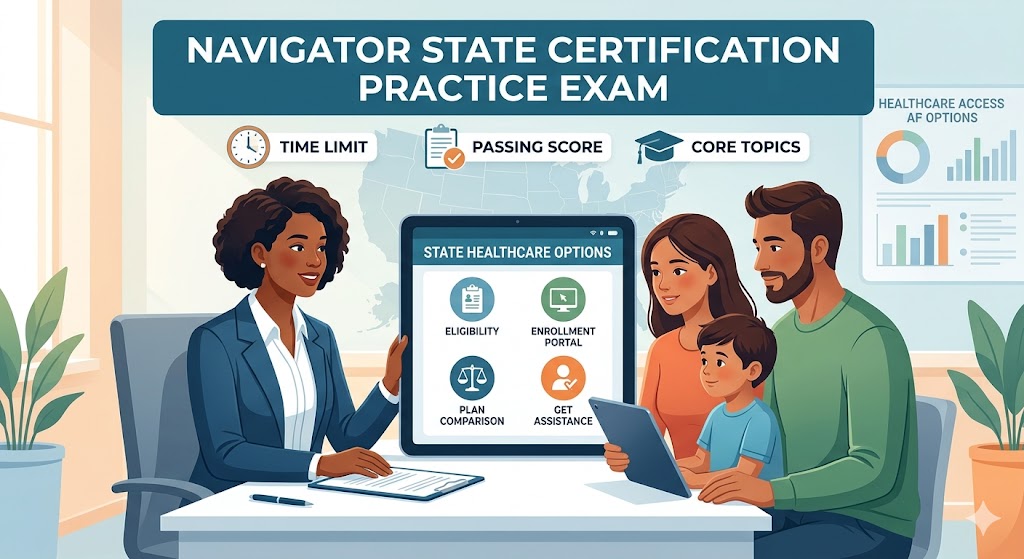
Additional Information
What the Course Entails and Exam Details
The content of a Navigator State Certification course and the subsequent exam typically focuses on the core competencies required to successfully guide individuals through the healthcare landscape. Candidates are expected to master several key domains: an overview of the Affordable Care Act (ACA) and state-specific marketplace dynamics, detailed knowledge of eligibility rules for various affordability programs (such as Medicaid and CHIP), and the complete application and enrollment processes. The exam details these core functions:
Federal and State Regulations: Understanding ACA provisions, exchange operations, and consumer protection laws.
Eligibility and Enrollment: Navigating the rules for Qualified Health Plans (QHPs), premium tax credits, and cost-sharing reductions.
Security and Privacy: Implementing strict standards for the protection of Personally Identifiable Information (PII) and Protected Health Information (PHI), and adhering to HIPAA regulations where applicable.
Referral and Assistance: Knowing how to make appropriate referrals to consumer assistance programs and grievance processes.
Culturally Competent Communication: Effectively assisting diverse clients, including those with limited English proficiency or disabilities.
What to Expect in the Final Exam
The final exam for Navigator State Certification is structured to thoroughly evaluate your readiness to serve the public. While specific formats can vary by state, you should generally expect a proctored, computer-based exam consisting of multiple-choice questions. These questions are designed to test not only your factual recall but also your ability to apply your knowledge to real-world scenarios you might encounter while assisting consumers. Candidates must pay close attention to state-specific requirements, which will dictate:
Number of Questions: Typically ranging from 50 to 100 questions, covering all training modules.
Time Limit: Usually between 90 minutes and 2 hours, requiring efficient time management.
Passing Score: States often set a passing threshold between 70% and 80%, which must be achieved to earn the certification.
State-Specific Content: Up to 30% of the exam may focus exclusively on unique state marketplace rules, Medicaid programs, and local regulations.
Rules: Standard testing protocols, including the prohibition of outside materials and a requirement to show valid identification, will be strictly enforced.
How to Study and Exam Centers
To maximize your chances of success, a multi-faceted study approach is highly recommended. Begin by thoroughly reviewing all official training materials provided by your state’s health benefit exchange or department of insurance. Actively utilize a Navigator State Certification Practice Exam to familiarize yourself with the question types and the online testing interface. Focus your study on areas where you consistently struggle during practice. Create flashcards for complex topics like eligibility income thresholds and privacy rules. Join study groups if possible.
To take the exam, you must register through your state’s designated portal. States utilize different methods for exam administration, which include:
Authorized State Portals: Many states have integrated testing directly into their learning management systems for navigators.
Third-Party Testing Centers: In some regions, the exam may be proctored at professional testing locations such as Pearson VUE centers.
Authorized Schools/Organizations: Certain training entities or lead navigator organizations may be authorized to administer the exam in person.
Always check your state's official marketplace website for the most accurate information on approved training providers, registration procedures, and official testing locations.
Job Opportunities from the Course
Earning your Navigator State Certification unlocks several rewarding career paths focused on community service and healthcare advocacy. This credential is widely recognized by organizations that receive state or federal grants to provide consumer assistance.
Upon certification, you can pursue job titles and roles such as:
Certified Health Insurance Navigator
In-Person Assister (IPA)
Certified Enrollment Counselor (CEC)
Healthcare Marketplace Guide
Community Health Worker (in specialized enrollment roles)
Patient Advocate (with a focus on coverage access)
Outreach and Enrollment Specialist at Community Health Centers or Non-Profit Organizations
State Health Department Program Assistant
Frequently Asked Questions
Reviews
5.0
Based on 0 reviews
Leave a Review
No reviews yet. Be the first to review!