
NAVLE Practice Exam
$69.00
- Buy to unlock unlimited access to all Quiz questions and Answers in this Quiz.
- After purchase you can print a PDF of the whole quiz at any point. The PDF will contain the questions and the correct answers.
About this Exam
The North American Veterinary Licensing Examination (NAVLE) is the rigorous, definitive licensure exam that every aspiring veterinarian must pass to practice medicine in the United States and Canada. This high-stakes assessment is designed for senior students graduating from AVMA-accredited veterinary colleges, as well as foreign veterinary graduates seeking certification through ECFVG or PAVE programs. Its primary purpose is to ensure that entry-level veterinarians possess the essential, foundational knowledge and clinical competencies required to provide safe, effective, and ethical veterinary care on "Day One" of their professional careers.
Preparing for this monumental challenge requires significant dedication, and a NAVLE practice test is an absolutely indispensable tool in a student's arsenal. Utilizing a practice exam allows you to familiarize yourself with the sophisticated computer-based testing format, identify critical knowledge gaps across various species, and develop the mental stamina needed for the full seven-and-a-half-hour test day.
Ready to test your knowledge?
Buy Now to Access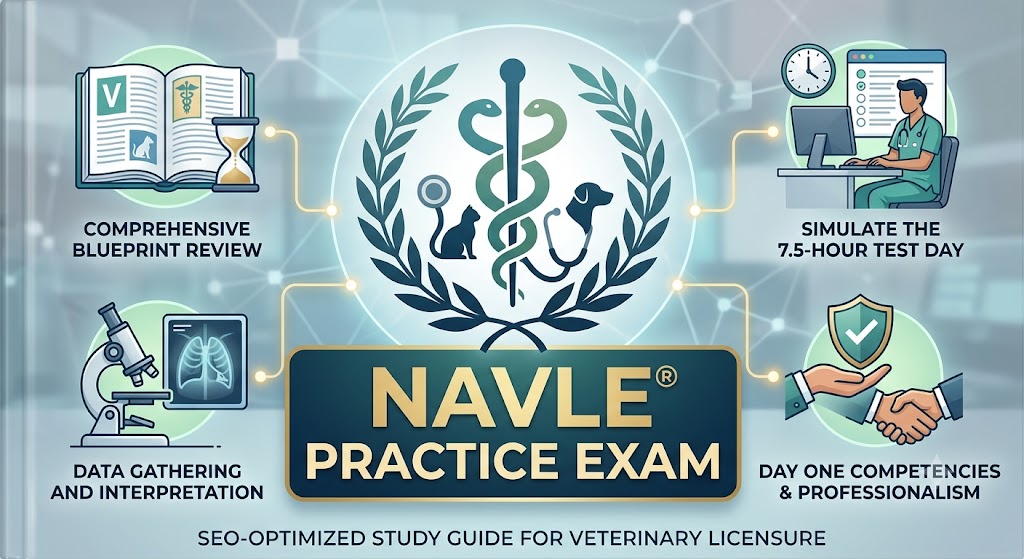
Additional Information
What the Course Entails and Exam Details
While not a "course" in the traditional sense, the NAVLE acts as a final summation of the entire four-year veterinary curriculum. The exam content is based on a detailed blueprint that reflects the actual tasks and knowledge required in general veterinary practice. A NAVLE practice test simulates this breadth by covering all animal species commonly encountered by practitioners in North America, as well as professional competencies.
The core syllabus of the NAVLE is divided into four main Competency Domains:
Clinical Practice (70%): This is the largest section. It focuses on the primary responsibilities of a veterinarian:
Data Gathering and Interpretation (35%): Covers obtaining history, performing physical exams, interpreting laboratory results (hematology, chemistry, urinalysis), and analyzing diagnostic imaging (radiographs, ultrasound).
Health Maintenance and Problem Management (35%): Focuses on developing diagnoses, creating treatment plans, performing surgical procedures, administering pharmacological agents, and determining prognoses.
Preventive Medicine and Animal Welfare (15%): This domain tests knowledge of herd health, biosecurity, zoonotic diseases, public health responsibility, epidemiology, and recognizing/managing animal welfare issues.
Professionalism, Communication, and Practice Management (10%): Assesses skills in client communication, collaborative teamwork, medical record keeping, and ethical practice.
Species-Specific Focus: The NAVLE is renowned for its cross-species coverage. Questions are weighted based on how frequently they are encountered in private practice:
Canine (~25-26%)
Feline (~23-24%)
Equine (~14-15%)
Bovine (~13-14%)
Porcine (~4-5%)
Other Species (~10%): Including food animals (ovine/caprine), small mammals, birds, reptiles, and public health/one health topics.
A robust NAVLE practice test should mirror these percentages accurately to provide a true reflection of your preparedness across the entire spectrum of veterinary medicine.
What to Expect in the Final Exam
The actual NAVLE is a marathon of knowledge and endurance. It is exclusively a computer-based examination consisting of multiple-choice questions only; there are no practical hands-on sections or written essay components on the licensing exam itself.
Exam Format and Structure:
Total Questions: 360 multiple-choice questions.
Structure: The exam is typically divided into six testing blocks, with 60 questions per block.
Time Limit: You are allotted 65 minutes per block, totaling six and a half hours of actual testing time.
Breaks: You are given a total of 45 minutes of flexible break time, which can be taken between blocks (but not during a block).
Total Day Length: The entire testing appointment is approximately seven and a half hours, including a tutorial and an optional post-exam survey.
Passing Score Requirements:
The NAVLE is not graded on a curve. It uses a criterion-referenced scaled scoring system ranging from 200 to 800.
The minimum passing score is 425.
How to Study and Exam Centers
Studying for the NAVLE requires a long-term strategy that shifts from passive reviewing to active recall and simulation. Here are actionable study strategies:
Start Early: Do not cram. Dedicate 3 to 6 months to systematic review before your testing window.
Use the Blueprint: Align your study schedule with the official ICVA NAVLE competency domains and species weightings. Spend the most time on high-weighted areas like canine/feline clinical practice.
Incorporate Active Recall: Instead of just reading textbooks, use flashcards (like Anki) and practice questions from trusted sources.
Take Full-Length NAVLE Practice Tests: This is crucial. Schedule multiple full-length simulation days. Treat these days seriously: take the test in a quiet environment, adhere strictly to the time limits for blocks, and practice managing your 45 minutes of break time. This builds mental stamina.
Review Your Mistakes: The value of a NAVLE practice test isn't just the score; it’s the detailed explanation for why you got a question wrong. Analyze your incorrect answers to understand the pathophysiology or reasoning you missed.
Utilize Official Resources: The International Council for Veterinary Assessment (ICVA) offers official NAVLE Self-Assessments which use past NAVLE questions and offer predictive scoring.
Exam Centers and Scheduling:
The NAVLE is administered during three specific testing windows annually: generally October–November, March, and a newly added July-August window.
Testing Centers: The exam is administered through computer testing centers operated by Prometric. They have hundreds of locations throughout North America (U.S. and Canada) and selected international sites.
Scheduling: Once you have applied and been approved to take the NAVLE (usually through your state board or the ICVA directly), you will receive a scheduling permit. You must then log in to the Prometric website to select your specific testing date and location within your approved window. It is recommended to schedule your appointment as early as possible to secure your preferred date and center.
Job Opportunities from the Course
Successfully navigating the NAVLE practice test, passing the final exam, and obtaining your state licensure is the final key that unlocks a vast array of veterinary career paths.
This certification directly enables you to work in the following roles:
Associate Veterinarian in Small Animal General Practice
Emergency and Critical Care Veterinarian
Mixed Animal General Practitioner
Equine Veterinarian
Food Animal/Large Animal Veterinarian (Bovine, Porcine, Poultry)
Exotics/Pocket Pet Veterinarian
Veterinary Specialist (Requires further residency, but licensure is a prerequisite, e.g., Surgery, Oncology, Dermatology, Radiology)
Government Veterinarian (USDA, FDA, public health, state veterinarian roles)
Shelter Medicine Veterinarian
Military Veterinarian (Army Veterinary Corps)
Industry Veterinarian (Pharmaceuticals, nutrition companies in research, sales, or technical support)
Academic Veterinarian (Teaching and research at veterinary colleges)
Frequently Asked Questions
Reviews
5.0
Based on 0 reviews
Leave a Review
No reviews yet. Be the first to review!