
Navy 3-M System Practice Exam
$69.00
- Buy to unlock unlimited access to all Quiz questions and Answers in this Quiz.
- After purchase you can print a PDF of the whole quiz at any point. The PDF will contain the questions and the correct answers.
About this Exam
The Navy Maintenance & Material Management (3-M) system is the essential foundation for ensuring the operational readiness of all U.S. Navy surface ships, submarines, and aircraft intermediate maintenance activities. This comprehensive system standardizes maintenance procedures, ensures the efficient use of manpower and material resources, and provides a clear history of all work performed on Navy equipment. The Navy 3-M certification, verified through a rigorous exam, is a critical requirement for Sailors across various ratings and ranks, from junior personnel performing hands-on maintenance to senior officers overseeing entire departments. It confirms an individual's proficiency in the planned maintenance, corrective actions, and logistics processes that are vital to fleet performance.
Ready to test your knowledge?
Buy Now to Access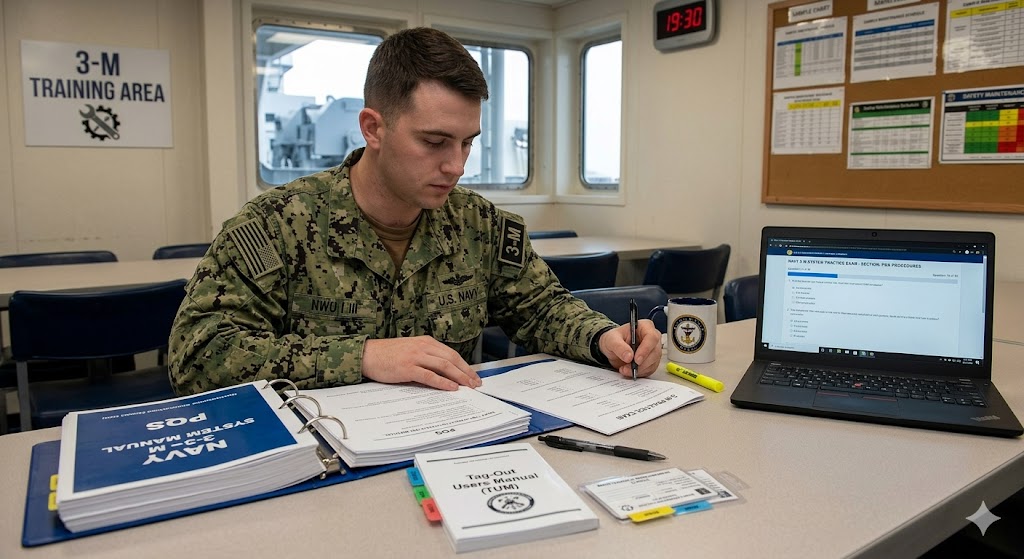
Additional Information
What the Course Entails and Exam Details
The Navy 3-M course and subsequent exam comprehensively cover the core instructions and practical applications of the 3-M manual, primarily OPNAVINST 4790.8. Candidates must demonstrate mastery in several critical areas. First, they must understand the two major subsystems: the Planned Maintenance System (PMS) and the Maintenance Data System (MDS). The PMS section tests knowledge of creating and following maintenance schedules, understanding the nuances of the List of Effective Pages (LOEP), Maintenance Index Pages (MIP), and utilizing step-by-step Maintenance Requirement Cards (MRC) with precise periodicity codes. The MDS section focuses on documentation, including opening and managing work candidates (2K) and equipment validations (2V) within the standard Navy software like OMMS-NG and SKED. The course heavily emphasizes the primary pillar of Navy operations: safety, requiring an in-depth understanding of the Tag-out Users Manual (TUM), personal protective equipment, and Operational Risk Management (ORM). Candidates must also be able to identify the distinct 3-M responsibilities for key roles, including the Work Center Supervisor, Maintenance Person, 3-M Coordinator, Department Head, and the Commanding Officer.
What to Expect in the Final Exam
While the 'Navy 3-M Practice Exam' acts as a vital tool to simulate the actual test-taking experience, the official final exam is a comprehensive assessment that must be passed with a high standard, typically a minimum score of 80 percent, to achieve certification. The exam is usually presented in a written or online format and consists of various question types, including multiple-choice, true or false, fill-in-the-blank, and scenario-based procedural questions. For instance, a candidate might be asked to correctly fill out a sample Tag-out Record Sheet or to list the proper steps to address a technical feedback report. The questions are specifically derived from the official 3-M manuals and standard Navy instructions, ensuring that certification reflects real-world procedural knowledge. It is essential to be prepared for questions that test not just memory, but the ability to apply 3-M principles to ensure shipboard and equipment safety.
How to Study and Exam Centers
Preparation for the Navy 3-M final exam requires a dedicated combination of reviewing official documentation and practical application. Candidates should begin by obtaining and thoroughly reading the current 3-M instruction, OPNAVINST 4790.8, along with related manuals like the TUM and Afloat Safety Manual. Effective study strategies include utilizing flashcards for key terms, definitions, and roles; participating in study groups to discuss complex maintenance and reporting scenarios; and, most importantly, using the 'Navy 3-M Practice Exam' to identify areas of weakness and to build test-taking stamina. On-the-job experience is invaluable; candidates should actively participate in shipboard maintenance checks and validations under the guidance of qualified personnel. The final, official exam is administered through several channels, including secure official Navy learning portals such as Navy e-Learning (NeL), during dedicated training at various Navy training commands, authorized technical schools, and sometimes by qualified 3-M Coordinators at individual commands.
Job Opportunities from the Course
A strong understanding of the 3-M system is invaluable for almost any role within the Navy's technical, engineering, and logistics rates. Achieving a formal 3-M certification through this exam process validates a Sailor's competence and significantly unlocks specialized career paths and leadership opportunities. Below is a list of job titles and career avenues that are directly enhanced or enabled by this qualification:
Work Center Supervisor (WCS)
3-M Coordinator (3MC)
Departmental 3-M Assistant
Quality Assurance Inspector (QAI)
Repair Parts Petty Officer (RPPO)
Maintenance Data System (MDS) Manager
Logistics Specialist (LS)
Engineering Training Lead
Inspections and Survey (INSURV) Team Member
Navy 3-M Instructor or Trainer
Frequently Asked Questions
Reviews
5.0
Based on 0 reviews
Leave a Review
No reviews yet. Be the first to review!