
Navy AM Practice Exam
$69.00
- Buy to unlock unlimited access to all Quiz questions and Answers in this Quiz.
- After purchase you can print a PDF of the whole quiz at any point. The PDF will contain the questions and the correct answers.
About this Exam
The Navy Aviation Structural Mechanic (AM) rating is a cornerstone of the US Navy’s airpower. AMs are responsible for the structural integrity and flight readiness of a wide variety of aircraft. They are the technicians who maintain the primary and auxiliary hydraulic power systems, flight controls, landing gear, and all metallic and non-metallic aircraft structural components. From troubleshooting a landing gear malfunction to fabricating a sheet metal repair on a jet fuselage, their work is critical for mission success and aircrew safety. The Navy AM Practice Exam is a valuable study tool designed for aspiring Aviation Structural Mechanics in "A" school and current sailors preparing for their Navy-wide advancement exams. It assesses the fundamental knowledge and technical skills required to excel in this challenging field.
Ready to test your knowledge?
Buy Now to Access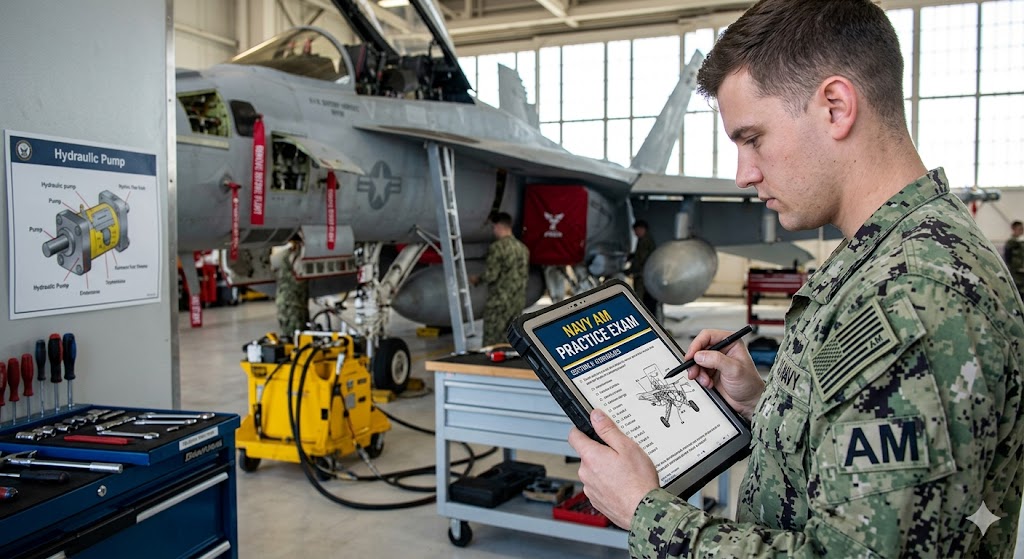
Additional Information
What the Course Entails and Exam Details
Preparing for the AM rating requires mastering a comprehensive set of technical skills. The formal training, typically delivered at "A" school, is an intensive program covering core concepts of aviation and specific technical systems. The Navy AM curriculum encompasses a broad range of topics including: basic aviation structural mechanic theory; sheet metal fabrication and repair; structural composite maintenance; aircraft corrosion control; and the installation and maintenance of hydraulic and pneumatic systems, including pumps, valves, and landing gear. Students also learn about the principles of flight, blueprint reading, and maintenance administration, including the proper documentation of work and Quality Assurance (QA) procedures. The final examination serves as a definitive validation of this accumulated knowledge and skill, confirming the individual is ready to contribute to fleet operations.
What to Expect in the Final Exam
The definitive check of an Aviation Structural Mechanic’s knowledge typically occurs at the end of their formal training or during their Navy-wide advancement exams. In "A" school, a final exam is often a two-part assessment, combining a written multiple-choice test on all theoretical knowledge with a practical evaluation of core maintenance skills. This hands-on section might require a student to troubleshoot a simulated hydraulic system, perform a structural sheet metal repair, or demonstrate correct blueprint translation. Advancement exams for paygrades E-4 through E-7 are 100 percent multiple-choice, focusing solely on technical rating knowledge derived from official Navy manuals. Candidates should consult their command's Educational Services Officer (ESO) or official instruction for specific details on passing scores, time limits, and the exact format, as these can vary by testing level and location. The purpose of these exams is to ensure every AM possesses the expertise to keep aircraft flying safely and effectively.
How to Study and Exam Centers
Effective preparation for the Navy AM exam demands a systematic study plan. The first step is to fully utilize the official study materials, particularly the relevant Navy Education and Training (NAVEDTRA) manuals, such as NAVEDTRA 14327 (Aviation Structural Mechanic) and 14328 (Aviation Structural Mechanic (H)). Aspiring AMs should also complete all required Professional Qualification Standards (PQS) for their level, ensuring they have the practical competence to match the theory. Online resources through Navy e-Learning offer official self-study courses and additional materials. Engaging with mock tests and Navy AM practice exams is a highly recommended strategy, as this helps familiarize you with the question format, identify knowledge gaps, and build your confidence. Forming study groups with fellow sailors allows for collaborative learning and a vital exchange of perspectives on complex technical systems. The final exams for Navy "A" school are conducted at the Center for Naval Aviation Technical Training (CNATT) in Pensacola, Florida. Navy-wide advancement exams are administered within a sailor's command under the direction of the local ESO, at predetermined locations, typically on military bases.
Job Opportunities from the Course
A successful career as a Navy Aviation Structural Mechanic offers diverse career paths both within the military and the civilian aerospace industry. The skills acquired are directly transferable and highly valued. Within the Navy, as an AM, you can advance through the ranks to become a technical expert and a leader. You will have opportunities to work in various assignments, from active duty on a carrier flight deck to shore-based maintenance depots, or even as part of special programs like the Blue Angels. In the civilian world, your experience and technical knowledge open doors to numerous in-demand roles, particularly for those who pursue complementary certifications such as a Federal Aviation Administration (FAA) Airframe and Powerplant (A&P) license. Your technical skills are a foundation for a rewarding future, making you a strong candidate for career titles like Aircraft Mechanic, FAA Licensed Airframe and Powerplant Technician, Sheet Metal Worker, Composites Technician, Pneudraulic Systems Mechanic, Industrial Machinery Mechanic, and Quality Assurance Specialist. These roles exist across aerospace manufacturing, commercial aviation maintenance, government services, and other industries reliant on specialized structural and hydraulic systems
Frequently Asked Questions
Reviews
5.0
Based on 0 reviews
Leave a Review
No reviews yet. Be the first to review!